

1903 - 1910
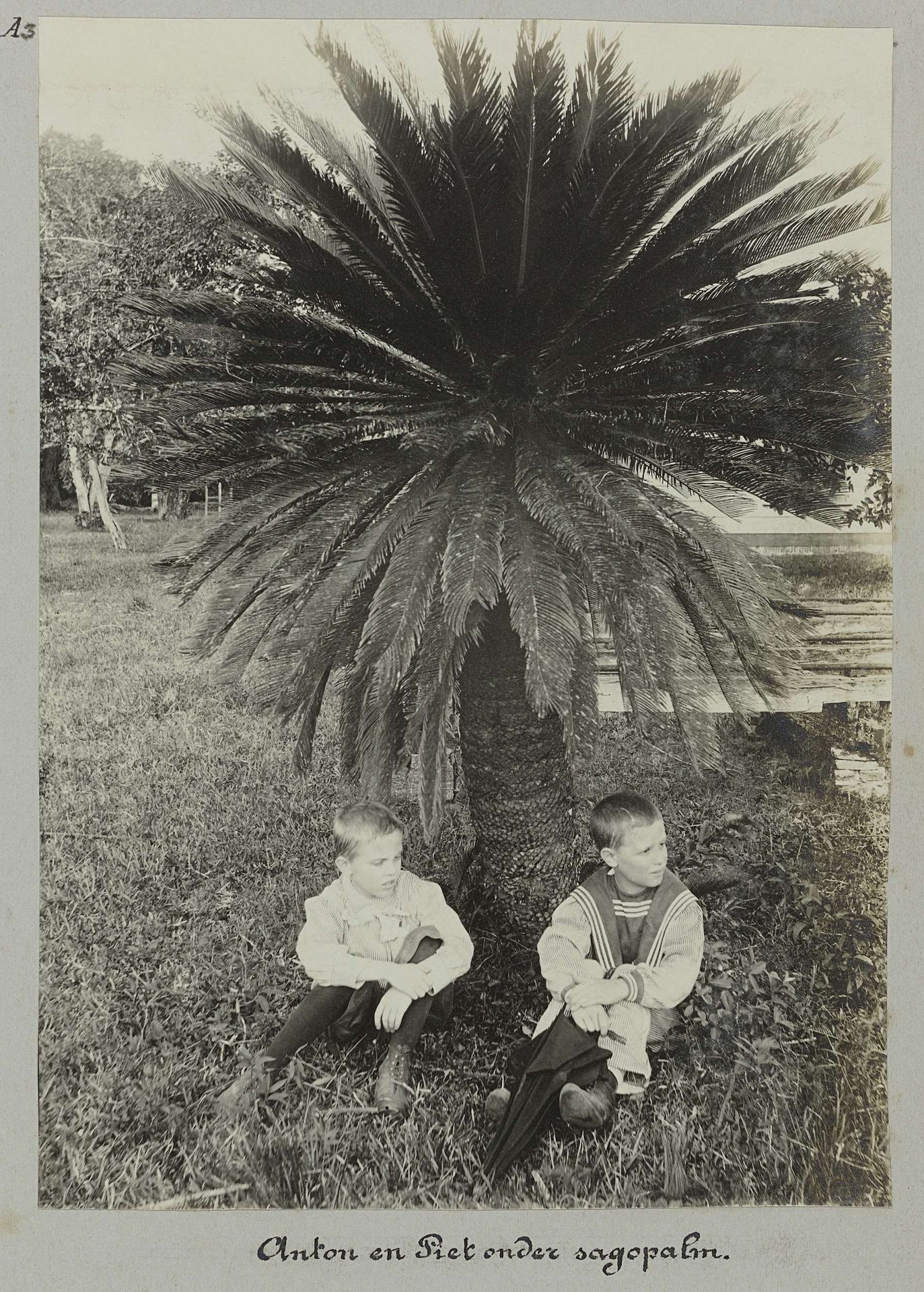
Anton en Piet onder sagopalm. (Tourtonne)

Listen to curator's interpretation
Curatorial notes
Curator: Let’s delve into this photograph by Hendrik Doijer, titled "Anton en Piet onder sagopalm," placing it between 1903 and 1910. What are your initial thoughts? Editor: There's a quiet stillness to it. The boys appear relaxed, almost pensive under the palm's heavy fronds. It's a straightforward composition, very balanced. Curator: It captures a moment in Dutch colonial life in Suriname, perhaps a rare respite for these children. It's a very intimate look into how they negotiate their space in this lush yet foreign landscape. Consider how their identities are being shaped by the interplay of their heritage and their environment. Editor: You’re right, and it's clear in Doijer's technique too, photography democratized portraiture, becoming accessible outside the upper class. Looking closely, you can see the materiality – the grainy texture, the specific tonal range afforded by the photographic process. Curator: Absolutely, and photography's democratizing effect extends further when we consider the act of image-making. Who has the power to represent whom? Doijer, as a Dutch photographer, holds a certain gaze, and understanding that colonial dynamic is crucial. These children’s likenesses become both intimate and potentially exploitative, documents caught within the broader historical power dynamics of that moment. Editor: Precisely. I am especially intrigued by the socio-economic element and what's being consumed by whom at what price. I am always drawn to materiality: the way this has aged, what chemicals have changed over time. The social context around how we view it shifts our understanding so much. Curator: Yes, indeed. What seems to me, then, the most engaging facet here is less about pure aesthetics and much more about what is not obvious from the purely aesthetic viewpoint: that the photograph exists as a site for examining complicated power relations, individual agency, the role of cultural artifacts to sustain certain types of societal inequality... I would even consider feminist and queer interpretations through performativity if it weren’t that these elements may feel a little too remote given our source of historical information. Editor: I can see how you would say that. I appreciate Doijer's framing for documenting labor history and its role in consumption. This photo certainly warrants further exploration of that era, the way materials were harvested, traded, consumed, and archived as well as photography's impact on society’s evolution regarding what objects were valuable enough to depict. Curator: Absolutely, our discussions offer just a preliminary glimpse. We are touching only on a few narrative possibilities inherent in this artwork; a true understanding necessitates delving deeper into sociopolitical considerations. Editor: Well said; exploring its materials encourages one to do more extensive and intersectional investigations.