Dimensions: height 176 mm, width 243 mm
Copyright: Rijks Museum: Open Domain
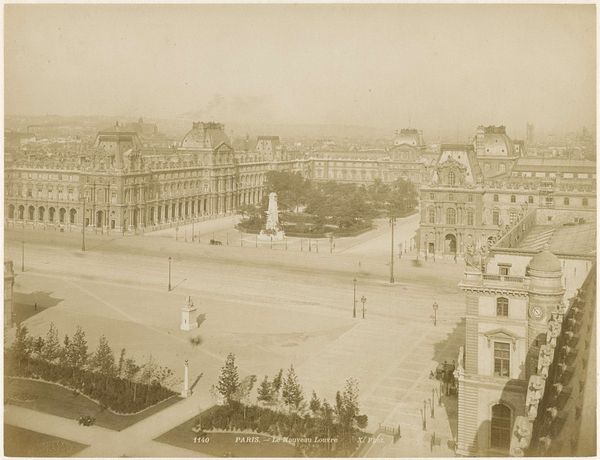
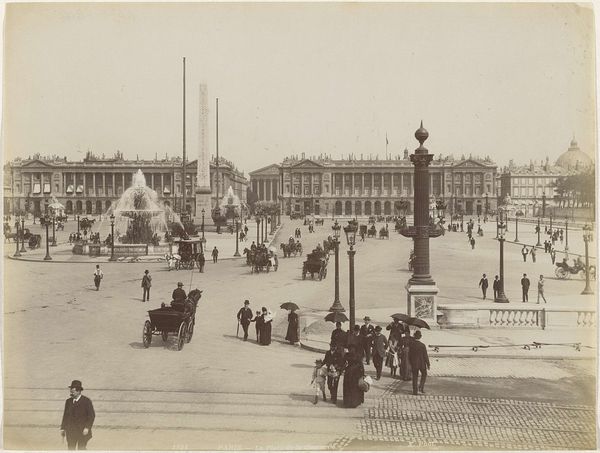
Curator: This site-specific photographic print captures the Grand Palais in Paris, circa 1900, taken by Neurdein Frères. Editor: My first thought is that it’s quite serene. The tonality and broad composition evoke a kind of poised, almost staged calm. Curator: I agree. It portrays an interesting moment in the history of technological advancement, urban planning, and artistic exchange. The Exposition Universelle of 1900 was a statement of national pride, but who did it really include? Whose perspectives were being centered at this exhibition, and whose were ignored? Editor: The building itself dominates the view—look at how its classical lines are rigorously echoed in the colonnades and the domes. The composition is essentially a study in horizontals and verticals. Even the people serve to enhance the scale and proportion of the structure, right? Curator: Right, and to understand its deeper significance, we must ask how race, gender, and class shaped the production, circulation, and reception of photography during this period. Think about who was allowed to visit and participate in the Exposition Universelle and who was not, based on societal structures. The people milling about reflect very specific demographics that tell stories about who has the economic power and social permission to leisurely gather here. Editor: So, even in its apparent neutrality, this cityscape photograph is charged with cultural information. It serves as more than just a visual document, becoming an intersection of technique, composition, and context. Curator: Precisely! By analyzing who the Exposition aimed to represent and also intentionally omitted, we reveal the photograph’s contribution to broader narratives. It encourages us to interrogate how progress, power, and representation are entangled in cultural productions. Editor: Yes, considering your viewpoints makes it much harder to return to that simple first thought about serene calm—not wrong, just woefully incomplete. Thanks to a focus on socio-historic insights, now I'm seeing a great deal more.
Comments
No comments
Be the first to comment and join the conversation on the ultimate creative platform.
 Collect
 React
React Comment
More like this