

before 1647
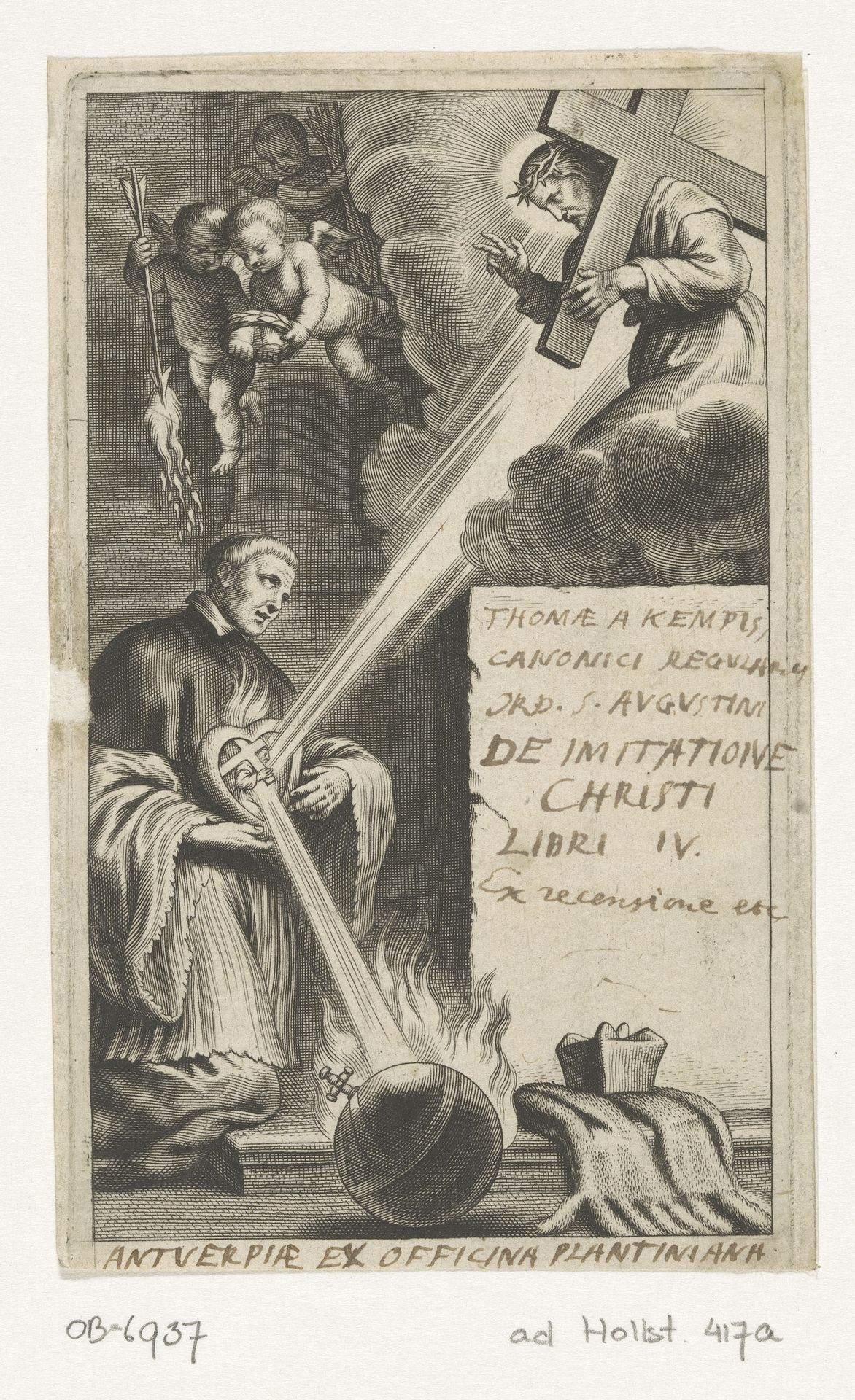
Thomas a Kempis voelt in zijn hart het lijden van Christus

Cornelis Galle I
1576 - 1650Location
RijksmuseumListen to curator's interpretation
Curatorial notes
Curator: My eye is drawn immediately to the two streams of light emanating from the heart in this engraving. It feels very theatrical. Editor: It does. This print, crafted by Cornelis Galle I, sometime before 1647, presents Thomas à Kempis experiencing the suffering of Christ. What strikes me is the clear hierarchy being established here, in both a religious and a political sense. Curator: Absolutely. The composition uses visual cues to portray spiritual ascension. The streams converge on Christ carrying the cross, an easily recognizable symbol of suffering and sacrifice. Even the putti, those chubby cherubs so common in Baroque art, seem to emphasize Christ’s burden, presenting what looks to me like the instruments of flagellation. Editor: The flames rising towards the sphere and mitre near Thomas suggest earthly desires being purged. It is definitely worth noting that the sphere itself is a traditional symbol for the world, while the mitre signifies the office of a bishop. Galle really leaves little room for interpretation. Curator: Yes, it’s a highly structured allegory typical of Baroque art. And I think that heart that Thomas à Kempis is holding tells us even more. A heart pierced by a cross. A classic symbol for divine love and empathetic connection, of course, but also, because it’s the spiritual organ from which these rays of insight and religious fervor flow, the message is unavoidable. Editor: Exactly! And think about the function of prints like these: relatively affordable and accessible imagery meant to disseminate very particular messages. Consider the political landscape of the time: The Catholic Church grappling with the Reformation, and printmakers like Galle are actively involved in visualizing Catholic doctrine. Curator: Looking at it that way certainly shifts my understanding. I came to it thinking mostly about religious ecstasy and the role of symbolic imagery in conveying those concepts, but the undercurrents of religious and institutional authority definitely make me view it in a different light. Editor: Agreed. Analyzing art through a historical lens brings a whole new set of symbolic layers to the surface, showing just how multifaceted a single artwork can be.