About this artwork
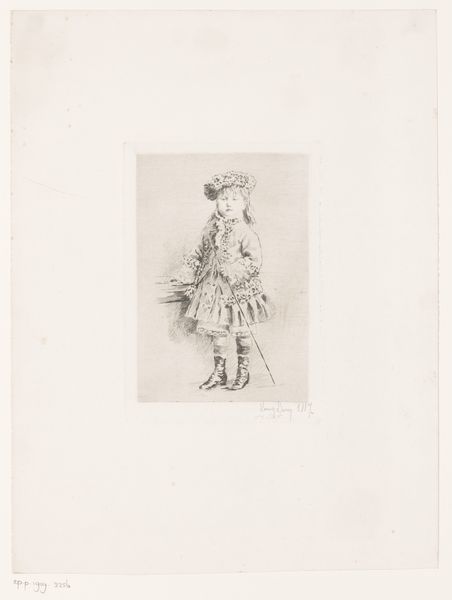
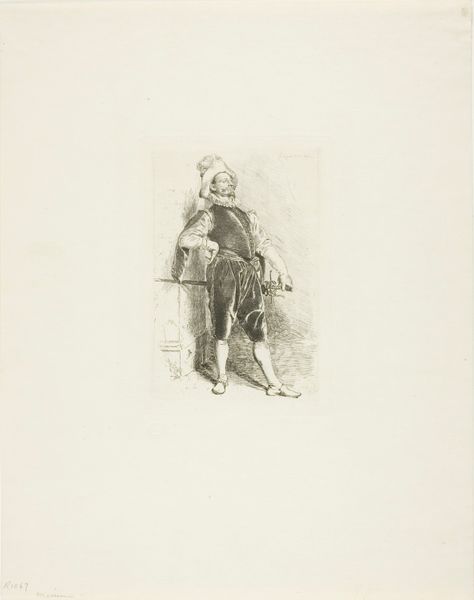
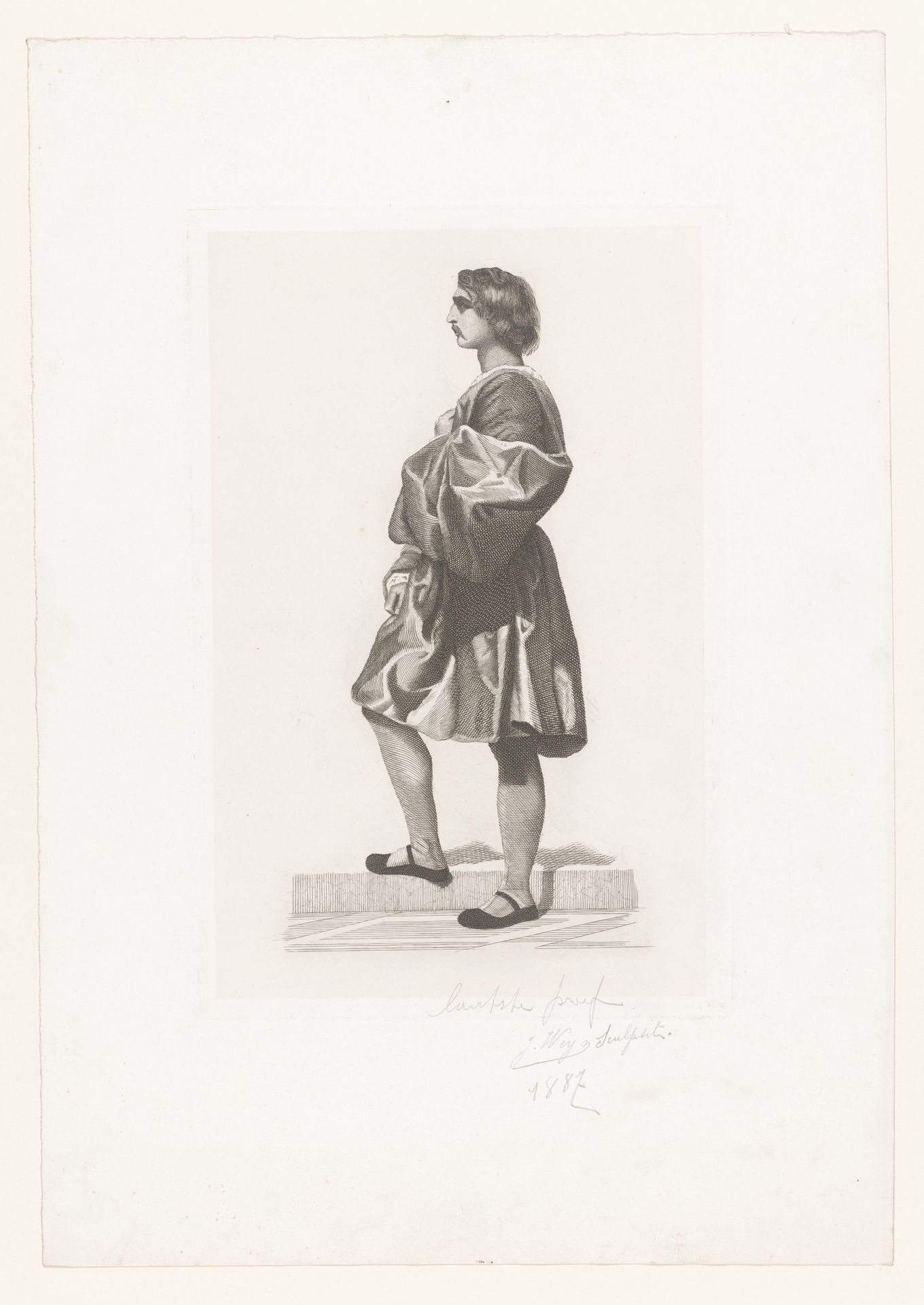
Editor: So here we have "Page," a print made in 1887 by J. Weyn. It seems to be some kind of engraving, possibly after a pencil drawing, depicting a young man ascending a set of steps. The subject is… solemn. Almost like a figure in a play. What strikes you most about this work? Curator: The figure's upward trajectory, positioned as he is within a seemingly academic framework, offers an interesting perspective on social mobility at the time. Who gets to ascend? Consider the historic role of the "page," often a young person of relatively low status, serving a member of the aristocracy. Weyn seems to present him with an active, purposeful gaze; how does this complicate traditional readings of servitude, especially within the context of late 19th-century class structures? Editor: I see what you mean. He’s not simply waiting on someone; he’s climbing. It's like a portrait of aspiration. Curator: Precisely. And aspiration must always be viewed within its context: What obstacles and barriers might a "page" in 1887 have faced? And further, how does this depiction participate in or subvert existing artistic traditions which may have traditionally depicted figures of this station? Is Weyn, through his choice of subject, pointing toward larger social narratives of equity and access? Editor: That really reframes how I see the work. I was just thinking about it formally, but now I'm thinking about the socio-political implications. Curator: Exactly. And how the academic artistic tradition itself can either reinforce or critique social structures. What tools can we glean from cultural studies to deconstruct potential bias and/or critique in images such as this? How might feminist or postcolonial theory affect how we perceive the subject matter? Editor: It gives a lot to think about! Curator: Indeed! And reminds us that art can be a lens for critical social commentary.

Artwork details
- Medium
- drawing, print, paper, engraving
- Dimensions
- height 299 mm, width 197 mm
- Copyright
- Rijks Museum: Open Domain
Tags
Comments
Share your thoughts
About this artwork
Editor: So here we have "Page," a print made in 1887 by J. Weyn. It seems to be some kind of engraving, possibly after a pencil drawing, depicting a young man ascending a set of steps. The subject is… solemn. Almost like a figure in a play. What strikes you most about this work? Curator: The figure's upward trajectory, positioned as he is within a seemingly academic framework, offers an interesting perspective on social mobility at the time. Who gets to ascend? Consider the historic role of the "page," often a young person of relatively low status, serving a member of the aristocracy. Weyn seems to present him with an active, purposeful gaze; how does this complicate traditional readings of servitude, especially within the context of late 19th-century class structures? Editor: I see what you mean. He’s not simply waiting on someone; he’s climbing. It's like a portrait of aspiration. Curator: Precisely. And aspiration must always be viewed within its context: What obstacles and barriers might a "page" in 1887 have faced? And further, how does this depiction participate in or subvert existing artistic traditions which may have traditionally depicted figures of this station? Is Weyn, through his choice of subject, pointing toward larger social narratives of equity and access? Editor: That really reframes how I see the work. I was just thinking about it formally, but now I'm thinking about the socio-political implications. Curator: Exactly. And how the academic artistic tradition itself can either reinforce or critique social structures. What tools can we glean from cultural studies to deconstruct potential bias and/or critique in images such as this? How might feminist or postcolonial theory affect how we perceive the subject matter? Editor: It gives a lot to think about! Curator: Indeed! And reminds us that art can be a lens for critical social commentary.
Comments
Share your thoughts