drawing, print, watercolor
#
portrait
#
drawing
# print
#
figuration
#
watercolor
#
romanticism
#
genre-painting
#
history-painting
#
academic-art
Dimensions: height 272 mm, width 344 mm
Copyright: Rijks Museum: Open Domain
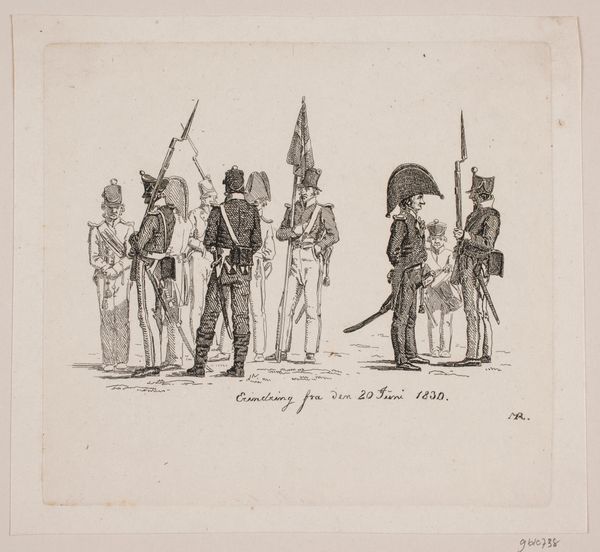
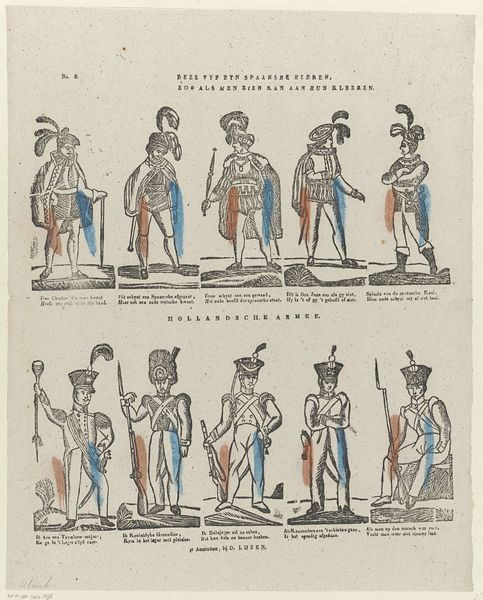
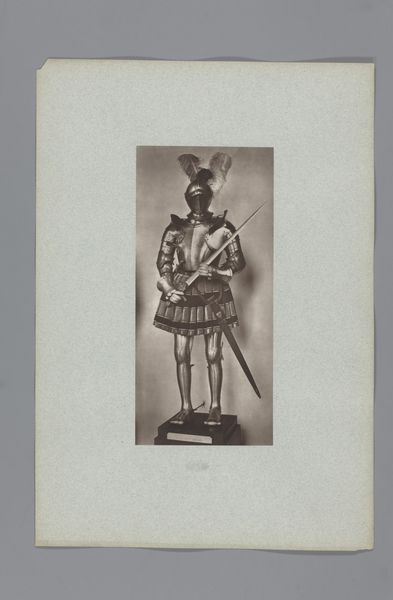
Editor: Here we have an image entitled “Manneken Pis in verschillende uitdossingen, 1817,” dating from 1810 to 1830 by an anonymous artist, a drawing that’s also a print using watercolors, located at the Rijksmuseum. It's a depiction of the Manneken Pis statue in what looks like various military uniforms. I find it peculiar that the statue is presented in this way; what does this image tell us about its historical context? Curator: This print provides insight into the early 19th-century perception and cultural role of the Manneken Pis. We see here a Romantic-era lens applied to a folk symbol. The statue is depicted in "Grande Tenue" and "Petite Tenue", hinting at the evolving public role and almost performative aspect it held in Brussels society. Why do you think an anonymous artist chose military outfits specifically? Editor: I suppose the military attire reflects the political atmosphere of the time, perhaps signifying the shifting powers and occupations Brussels experienced during and after the Napoleonic era? Is it a commentary on the statue's symbolic adaptability? Curator: Precisely. It’s reasonable to consider how the image attempts to co-opt or perhaps even neutralize a symbol of civic pride. The standardization and uniform dressing contrast sharply with the Manneken Pis's inherent irreverence. This makes me wonder about the intended audience and the politics embedded within its display in public life at that time. Editor: So it’s not just about fashion but about power, appropriation, and public persona? I hadn’t considered that the choice to depict him in uniform might actually aim to constrain his symbolism. Curator: Exactly. Consider the political implications of dressing a symbol of public spirit in the trappings of military authority. The statue is quite literally being dressed in the authority of the State. What could that mean to the people of Brussels? Editor: I now appreciate that this piece goes beyond mere depiction. It’s a historical document reflecting socio-political forces at play. Thanks for that perspective! Curator: My pleasure. Analyzing art through a socio-political lens often reveals those fascinating layers of meaning!
Comments
No comments
Be the first to comment and join the conversation on the ultimate creative platform.
 Collect
 React
React Comment
More like this