

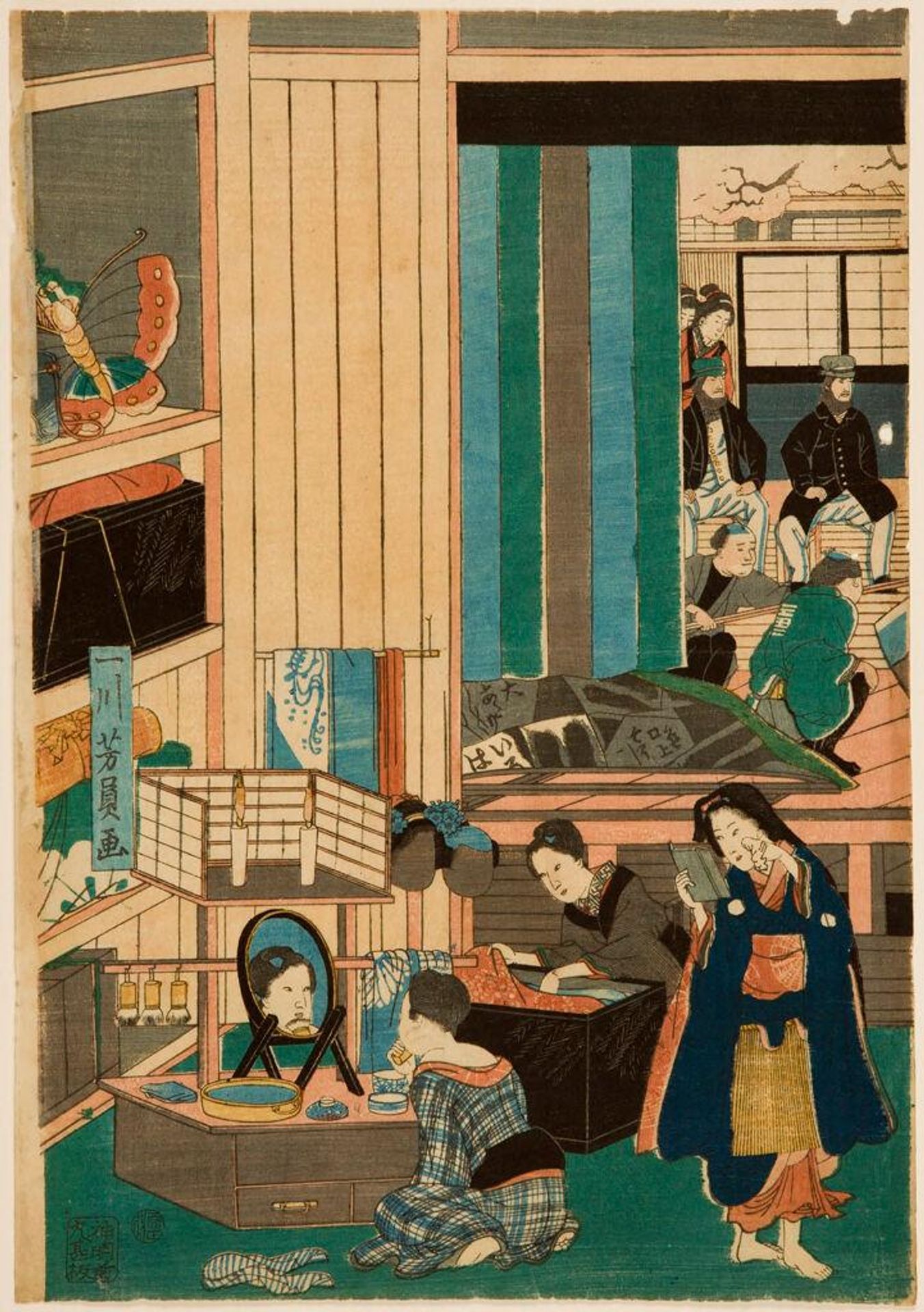
Possibly 1861
Foreigners Enjoying Children's Kabuki at the GankirÅ Tea House (Yokohama GankirÅ kodomo te odori no zu), published by Maruya Jimpachi


Listen to curator's interpretation
Curatorial notes
Curator: Here we have a woodblock print by Utagawa Yoshikazu, "Foreigners Enjoying Children's Kabuki at the GankirÅ Tea House." It's interesting to consider the layered social dynamics at play. Editor: It feels almost voyeuristic, doesn’t it? Like peeking behind the scenes. I’m immediately drawn to the contrasting spaces—the performers prepping juxtaposed against the Western audience. Curator: Precisely. We see the labor involved in creating this ephemeral entertainment. The materials—woodblocks, paper, inks—were all part of a burgeoning industry catering to the increasing foreign presence in Yokohama. Editor: And the colors! They vibrate—that turquoise curtain, the blue of the woman's robe. It speaks to the allure of the exotic that was being marketed to these foreigners, a kind of staged authenticity. It feels strangely contemporary. Curator: Yes, the production of "Japan" for consumption. The artist, Yoshikazu, was keenly aware of this dynamic, placing emphasis on the commodification of culture. Editor: It's more than just a pretty picture; it's a comment on the act of seeing, of experiencing. It’s fascinating how much is packed into this small, vibrant print.