#
pencil drawn
#
aged paper
#
toned paper
#
light pencil work
#
parchment
#
old engraving style
#
historical photography
#
old-timey
#
19th century
#
golden font
Dimensions: height 66 mm, width 99 mm
Copyright: Rijks Museum: Open Domain
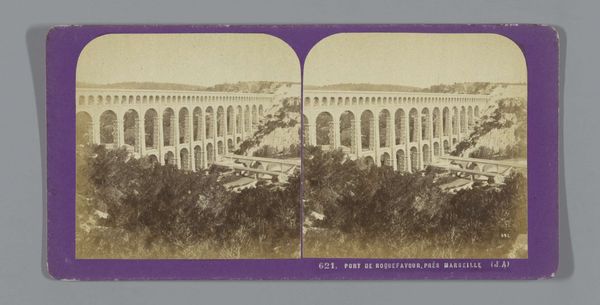
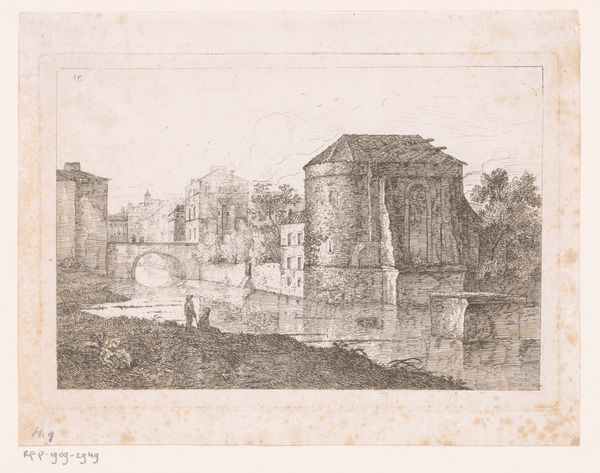
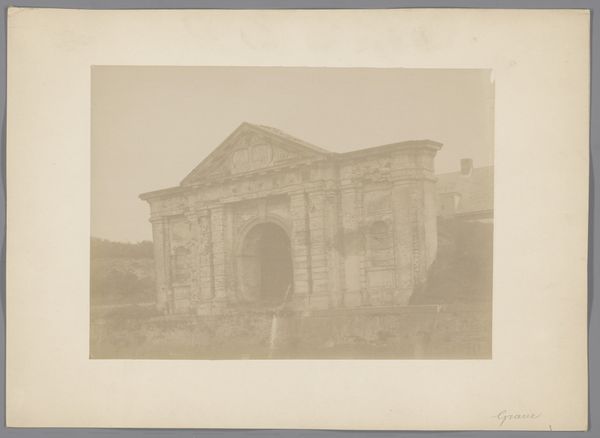
Curator: Welcome. Today, we’re examining a print titled "Gezicht op Viaduc de Morlaix," likely created between 1860 and 1900 by Alfred Beau. It presents a view of the Morlaix Viaduct. Editor: It’s quite striking. The sepia tone gives it an immediate sense of age, but there’s something haunting about the way the massive viaduct looms over the town. A palpable sign of encroaching modernity perhaps? Curator: Indeed. The construction of such infrastructure dramatically reshaped the landscape and, of course, the lives of people living in these areas. Think of the labor required, the displacement potentially caused. The photograph is a document of a transformative moment, both visually and socially. The choice to photograph it also reflects the shifting perception of progress in France and how urbanism became deeply associated with ideas of social improvement and economic growth. Editor: Right, but whose progress are we talking about? The composition is quite formal; it is carefully structured around the relationship between the urban development, its impact on land, and people's movement facilitated by structures like this bridge. One might consider what this sort of rapid building and infrastructural development meant for those who lived and worked here. Who was employed to build it, who could afford to use it? Curator: Precisely! Railroads were also instrumental in shifting power dynamics by altering relationships to distance, trade, and labor across class and cultural lines. It changed everything about their way of life. But beyond those socio-economic elements, think about the monumentality they suggest and the grand engineering vision of its time. Editor: Visually it creates quite an arresting sense of scale. Seeing the towering structure in sepia, through a modern lens, encourages us to think about the human costs associated with such sweeping construction projects and perhaps broader shifts in how labor has become a social marker. Curator: The image, therefore, invites us to consider both the progress represented and its potential repercussions on the surrounding areas and population during the mid to late 19th century in France. Editor: Yes, exactly—an invitation to consider the bridges built and the lives touched by them.
Comments
No comments
Be the first to comment and join the conversation on the ultimate creative platform.
 Collect
 React
React Comment
More like this