

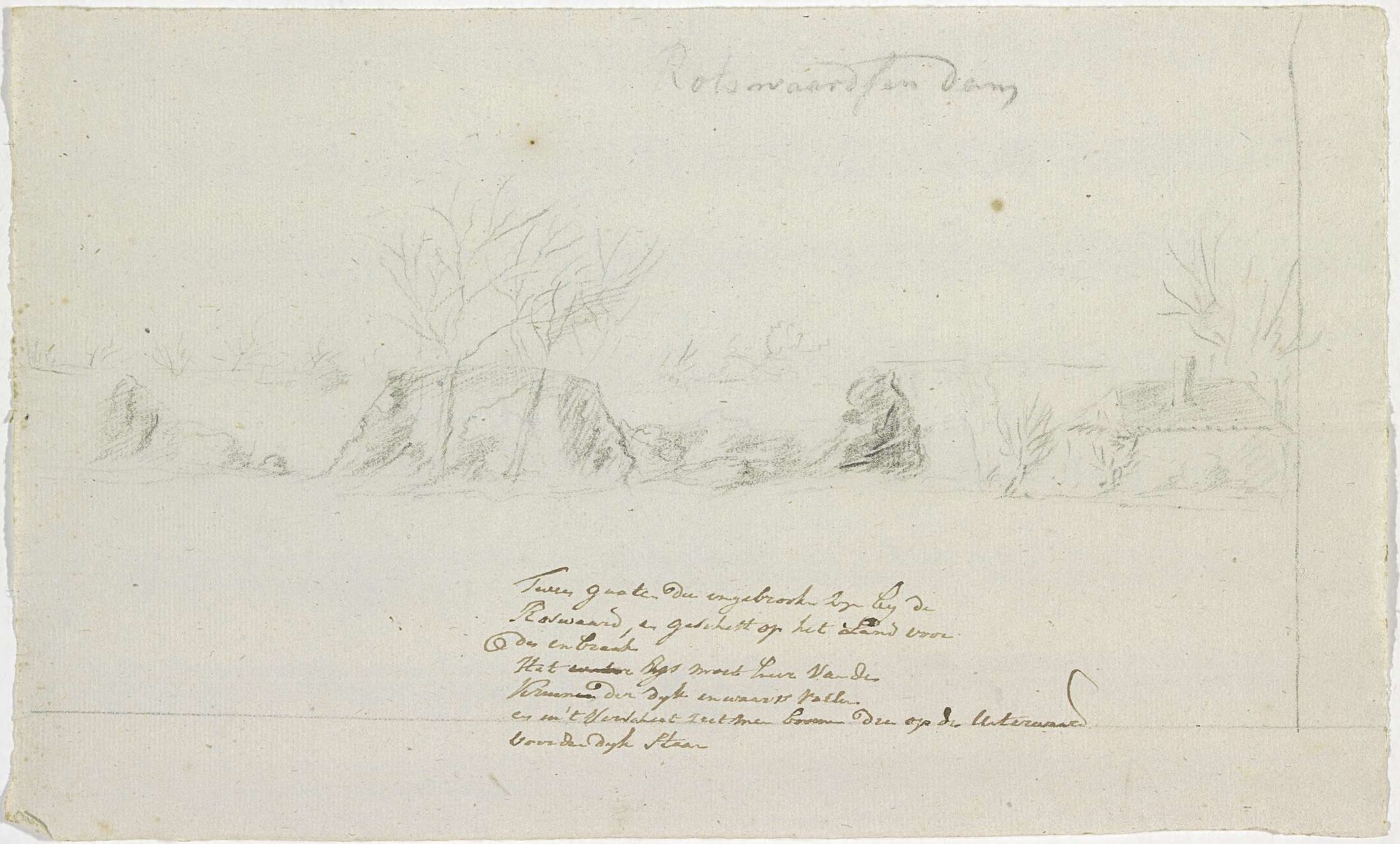
1809
Doorgebroken dam, 1809

Cornelis van Hardenbergh
1755 - 1843Location
RijksmuseumListen to curator's interpretation
Curatorial notes
Curator: Looking at "Doorgebroken dam, 1809" by Cornelis van Hardenbergh, I am struck by its seeming simplicity, rendered in pencil on paper. It almost feels like a fleeting sketch. What resonates with you when you see this? Editor: It's such a subtle, quiet drawing, isn’t it? Knowing it depicts a breached dam, I’m surprised by the lack of drama. It feels almost…meditative. I’m curious, though, how does this fit into the context of art being made at that time? Curator: Exactly, it's in that apparent tranquility where its power resides, wouldn't you say? Romanticism wasn't merely about grand landscapes; it explored humanity's relationship to nature, including experiences of trauma and disaster. Dams represent control and order over the natural world. So what happens when they fail? What does this work say about the human desire to control the earth? Editor: That's a great point! So the broken dam isn't just a visual event, but it’s making an argument. Perhaps about the futility of trying to control nature. Curator: Precisely. And beyond that, about the inherent class dimensions embedded in technological “progress,” the idea that some benefit disproportionately, whilst others face destruction of their land. Who suffered the most from this dam breaking, and who had the power to rebuild? What kind of labour was mobilized to achieve this “mastery”? Editor: That adds so much depth. I hadn't considered the social implications embedded in a seemingly simple landscape. It challenges the narrative of progress and control. It also becomes an opening to examine the connection between environmental disasters and social inequity then, as much as it does today. Curator: Yes. Seeing this work offers a moment to reflect on how power, nature, and vulnerability have been interwoven through centuries. How do these older works echo current questions?