About this artwork
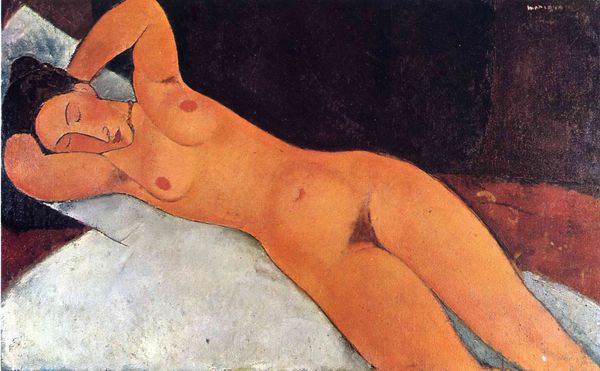
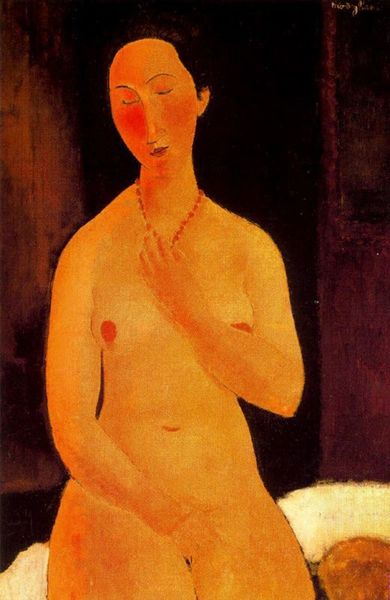
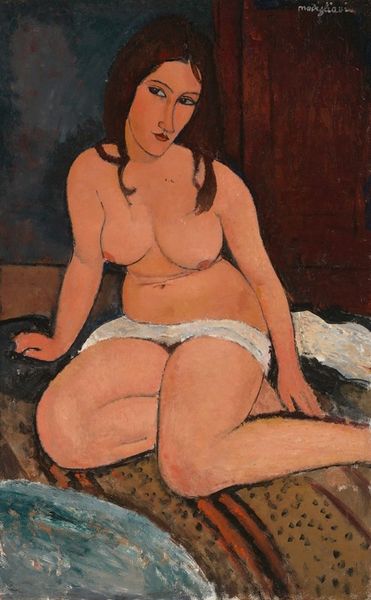
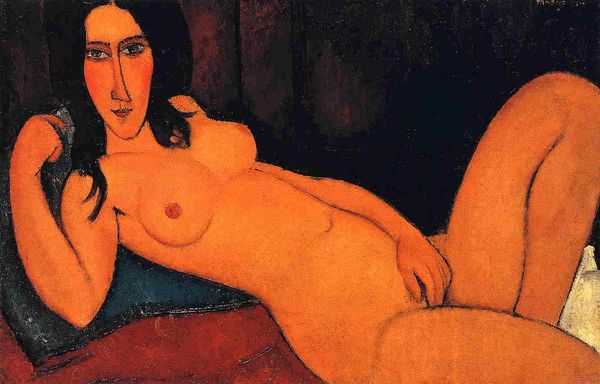
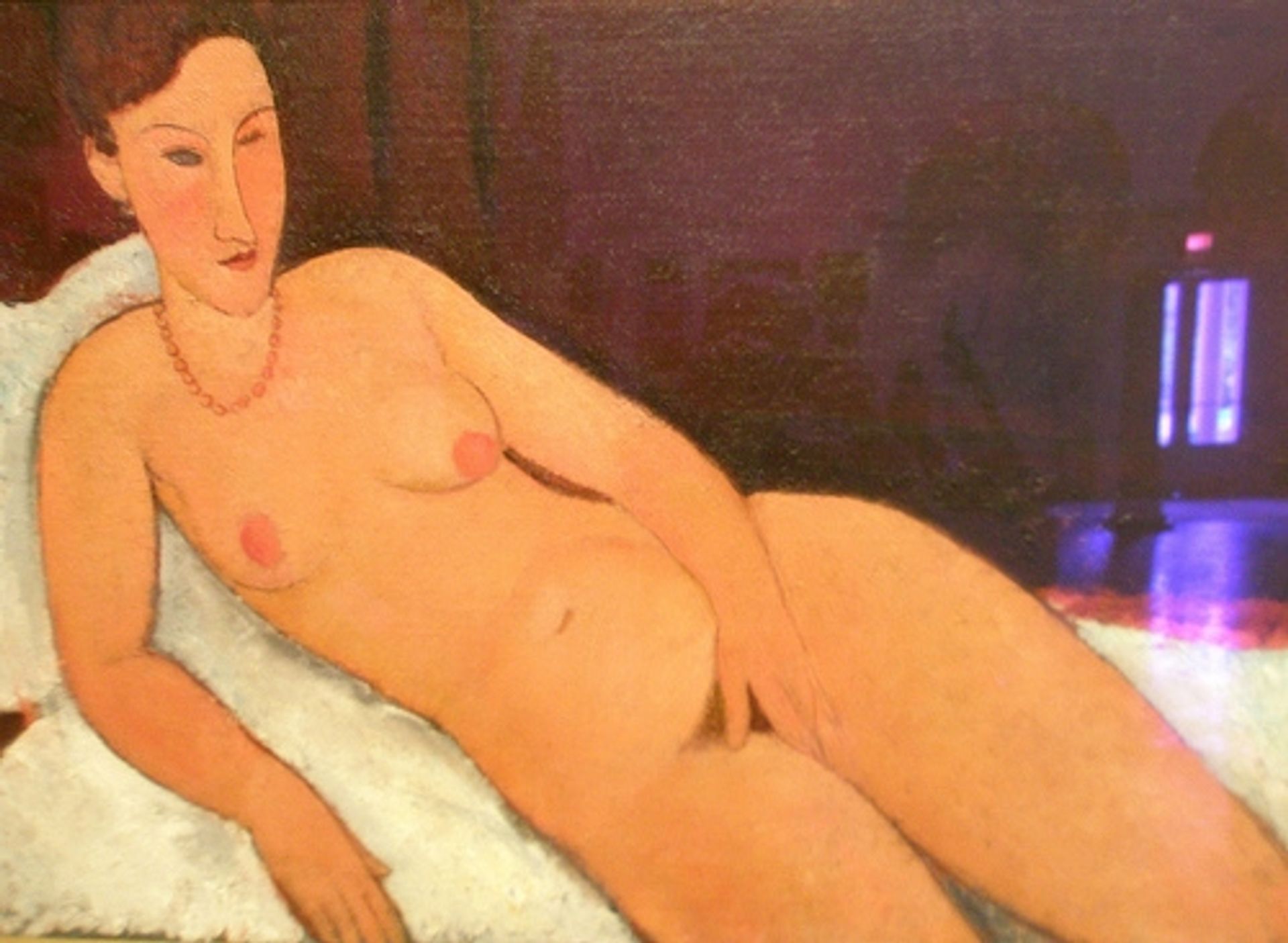
Editor: So, here we have Modigliani's "Nude with Coral Necklace" from 1917, done in oil paint. It feels intimate, almost like we're intruding on a private moment. What strikes you most about this painting? Curator: It's crucial to look at Modigliani's nudes within the socio-economic context of early 20th-century Paris. The availability of materials, the market for art, and the social status of the models he employed all contributed to the work's existence. The 'coral' necklace, likely inexpensive glass beads, hints at the model's class. Consider, too, the means of production. Oil paint itself became industrialized, allowing for wider distribution. Editor: That's fascinating! I hadn't considered the materials in such a direct social way. Do you think the fact that oil paint was mass-produced influences the subject matter he chose to depict? Curator: Absolutely. The rise of mass production and consumer culture played a huge role. Modigliani's nudes, produced relatively quickly and cheaply with readily available paints, became commodities themselves. The flattened perspective, influenced by photography and other forms of mass visual culture, removes the figure from the realm of classical idealization and places her firmly in the modern world as an object of consumption. What do you think the mass consumption means in the society that these models inhabited? Editor: I see what you mean. It moves the focus from idealized beauty to a kind of constructed representation. It's interesting to think about how the materials themselves shape not just the aesthetic, but also the economic and social value of the art. Curator: Precisely! And how those values intersect with class and labor. Looking through a materialist lens reminds us that art isn't created in a vacuum. It's deeply embedded in material conditions. Editor: That gives me a lot to think about regarding materiality! Thanks. Curator: Agreed! Considering his canvas alongside the industrial revolution reveals many underlying truths that speak louder than the painted image alone.
Nude with Coral Necklace
1917

Amedeo Modigliani
1884 - 1920Location
Allen Memorial Art Museum (AMAM), Oberlin, OH, USArtwork details
- Medium
- painting, oil-paint
- Dimensions
- 66.5 x 101.5 cm
- Location
- Allen Memorial Art Museum (AMAM), Oberlin, OH, US
- Copyright
- Public domain
Tags
Comments
Share your thoughts
About this artwork
Editor: So, here we have Modigliani's "Nude with Coral Necklace" from 1917, done in oil paint. It feels intimate, almost like we're intruding on a private moment. What strikes you most about this painting? Curator: It's crucial to look at Modigliani's nudes within the socio-economic context of early 20th-century Paris. The availability of materials, the market for art, and the social status of the models he employed all contributed to the work's existence. The 'coral' necklace, likely inexpensive glass beads, hints at the model's class. Consider, too, the means of production. Oil paint itself became industrialized, allowing for wider distribution. Editor: That's fascinating! I hadn't considered the materials in such a direct social way. Do you think the fact that oil paint was mass-produced influences the subject matter he chose to depict? Curator: Absolutely. The rise of mass production and consumer culture played a huge role. Modigliani's nudes, produced relatively quickly and cheaply with readily available paints, became commodities themselves. The flattened perspective, influenced by photography and other forms of mass visual culture, removes the figure from the realm of classical idealization and places her firmly in the modern world as an object of consumption. What do you think the mass consumption means in the society that these models inhabited? Editor: I see what you mean. It moves the focus from idealized beauty to a kind of constructed representation. It's interesting to think about how the materials themselves shape not just the aesthetic, but also the economic and social value of the art. Curator: Precisely! And how those values intersect with class and labor. Looking through a materialist lens reminds us that art isn't created in a vacuum. It's deeply embedded in material conditions. Editor: That gives me a lot to think about regarding materiality! Thanks. Curator: Agreed! Considering his canvas alongside the industrial revolution reveals many underlying truths that speak louder than the painted image alone.
Comments
Share your thoughts