Satyrs Admiring the Anamorphosis of an Elephant 1600 - 1628
0:00
0:00


drawing, print, engraving
#
drawing
#
allegory
#
baroque
# print
#
figuration
#
engraving
Dimensions: sheet: 9 9/16 x 13 9/16 in. (24.3 x 34.5 cm)
Copyright: Public Domain
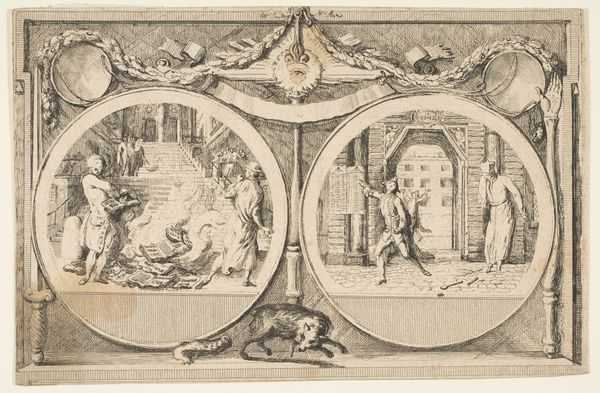
Curator: This engraving, “Satyrs Admiring the Anamorphosis of an Elephant,” attributed to Hans Troschel and dating from 1600 to 1628, offers a peculiar scene rendered with Baroque flair. My immediate impression is one of theatrical artifice, as if we’ve stumbled upon a carefully staged philosophical tableau. Editor: A theatrical artifice indeed, but one brimming with early modern anxieties and wonder regarding human perception and knowledge acquisition. Look how the satyrs actively participate, struggling to understand! It underscores an environment in which visuality becomes not merely spectacle but also intellectual performance. Curator: Let's deconstruct that performance then. The composition emphasizes the tension between the distorted image of the elephant within the cylinder and the satyrs' efforts to reconcile it with their understanding of form. Observe the crisp lines of the engraving and the balanced positioning of figures. The elephant transforms from the base of the image to something clear and legible via the trick of the eye and device placed above it. Editor: That distortion is key. As mythical figures symbolizing primal instincts and appetites, the satyrs stand as allegories for the uninitiated attempting to grapple with newfound knowledge. Consider too that banner at the top, with the Latin words 'Format et Illustrat.' Here, vision becomes inextricably linked with questions about who has the power to give "format" or knowledge, and which audiences have the opportunity to be 'illuminated' by this kind of novel learning. Curator: The cylinder isolates and transforms the elephant into an abstract idea. Furthermore, by placing it in contrast to the wildness of the satyrs, we find Troschel suggesting the humanizing effects of visual and intellectual precision. The landscape within is framed carefully to guide the viewer’s eye deeper. Editor: I see your point. Yet, it's hard to ignore how the engraver also reveals how easily perceptions can be manipulated through visual deception. In effect, we’re asked to reflect upon how readily ‘facts’ or ideas become established and accepted despite—or perhaps precisely because of—their staged or constructed nature. The satirical element cannot be ignored! Curator: A fruitful observation! In considering its allegorical implications, the work leaves me with an appreciation for the artist's deft handling of form and the intricate beauty inherent to its semiotic density. Editor: I leave feeling more alert than before to the ever-present negotiation between perception, power, and what is deemed knowledge in our world. An idea visualized and well worth revisiting.
Comments
No comments
Be the first to comment and join the conversation on the ultimate creative platform.
 Collect
 React
React Comment
More like this