Copyright: Public domain
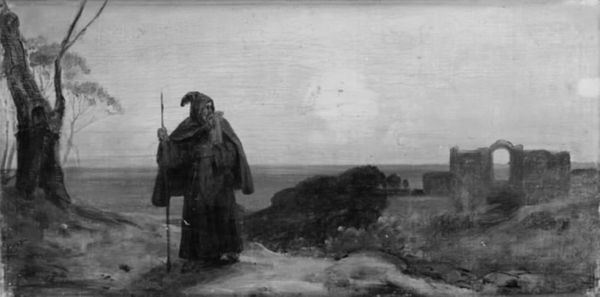
Curator: Welcome. We’re looking at Klavdy Lebedev’s "Sadko," a work from 1903, rendered in ink, engraving, and charcoal. Editor: My first impression is bleak—isolated, even. The high contrast and sparse details emphasize the solitude of the lone figure. It has an aura of pensiveness about it. Curator: Indeed. "Sadko" draws upon Russian folklore. Sadko was a gusli player, or rather, a merchant, adventurer, and musician who travelled to the underwater realm and later returned a wealthy man. Considering the pre-revolution context in Russia, the figure could be seen as representative of the merchant class at the beginning of economic power. Editor: Looking closer, I’m fascinated by the process used. The ink and charcoal seem applied in layers to create depth, while the engraving lends an almost metallic texture, particularly in the water and the figure's clothing. You see it in the texture of the rendering of the textiles. There's almost an interplay of smooth and rough across the whole thing, quite cleverly done. Curator: Absolutely. There is a palpable contrast in textures—the way he captured a sense of folk heritage. There is some amount of identity and longing to a historical past when one studies the sartorial code used. This longing is also evident of cultural crisis. Editor: And even the boats! They point towards Sadko's future voyage to the sea. Are these perhaps made with traditional techniques, each stroke reflecting the labor that went into making this trade. Curator: And what of gender roles at this point of Russian cultural history? Sadko is a man. I can not but help to consider the absence of other subject positions in this rendering. The composition is as much about the visible as the invisible: gender, other ethnicities. Editor: Ultimately, Lebedev's choice of these simple materials magnifies the emotional weight of Sadko’s journey—an emblem of human adventure and loneliness. It’s all rendered in rather economic terms in these sparse gestures of the hand. Curator: The piece does present to us both a moment frozen in time as well as broader commentary on cultural identity and societal shift during this period in Russian history. Editor: Right, so while focusing on materials reveals aspects about production and craftsmanship, historical contexts really open up deeper meanings woven into this poignant piece.
Comments
No comments
Be the first to comment and join the conversation on the ultimate creative platform.
 Collect
 React
React Comment
More like this