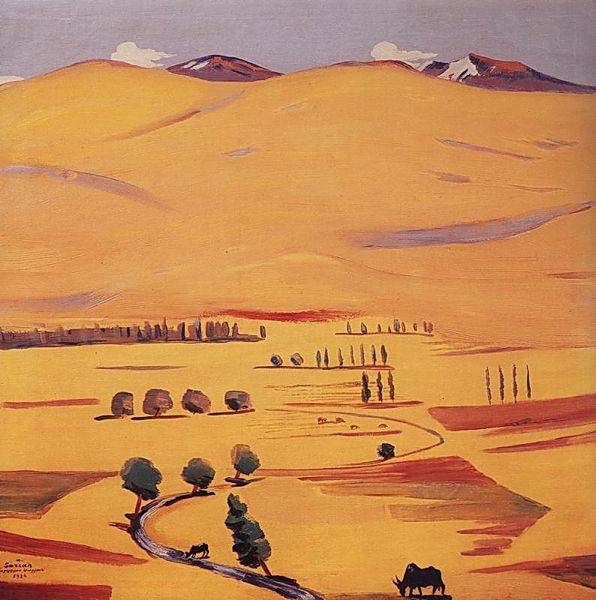
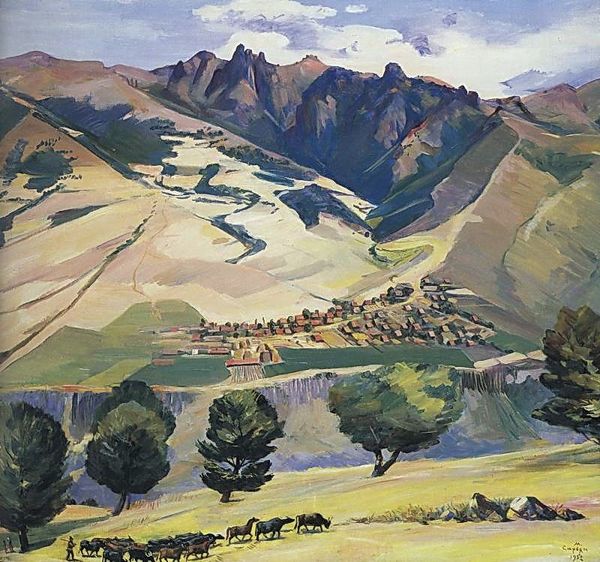
Dimensions: 54 x 73 cm
Copyright: Martiros Sarian,Fair Use
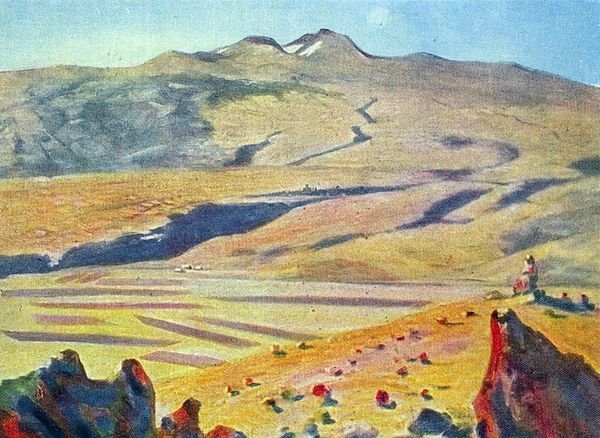
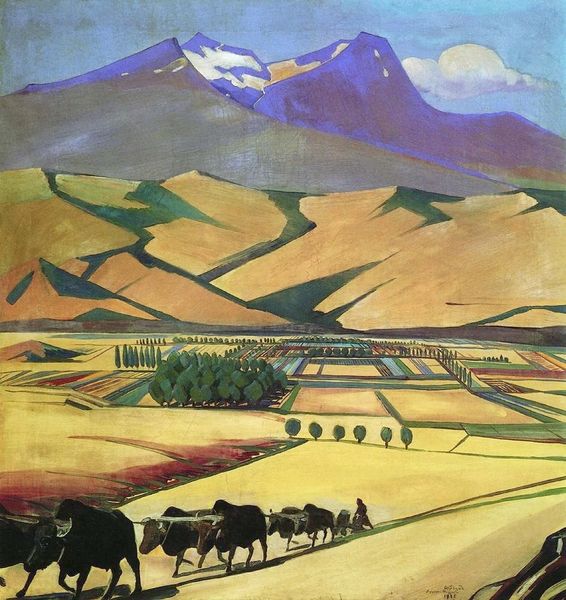
Editor: We're looking at Martiros Sarian's 1952 oil painting, "Lalvar," currently housed in the Tretyakov Gallery. It's a vibrant landscape – a panorama, really. The colors are so saturated, almost fauvist, but the overall feeling is peaceful, timeless. What do you see in this piece, especially regarding the symbols embedded within? Curator: What strikes me immediately is the strong sense of place – an idealized place, perhaps, carrying the weight of cultural memory. Notice how the composition directs our eye. The path winds through the landscape, drawing us into a space representing both labor and continuity. Do you notice the procession? Editor: Yes, figures leading animals. It almost looks biblical in a way, like a journey. Curator: Precisely. The procession is an age-old motif – a communal activity of both travel and labor. Ask yourself: What could these animals signify in the psyche? In many cultures, animals carry spiritual and ancestral connections, representing a harmony between humanity and nature. The rural-area becomes an echo, resonating with collective past experiences. What emotional impact does that realization evoke for you? Editor: I hadn't considered it that way. It's comforting but also hints at the weight of tradition, the repetition of these cycles over generations. Curator: Exactly. It reflects Sarian's dialogue with his cultural heritage and how memory and landscape intertwine, building an image of psychological and emotional meaning, carried down through these simple shapes. It brings a lot to unpack! Editor: Definitely. It makes me want to explore the artist's other work and explore the symbolism in different landscape painting traditions as well!
Comments
No comments
Be the first to comment and join the conversation on the ultimate creative platform.
 Collect
 React
React Comment
More like this