

n.d.
Peacock


Listen to curator's interpretation
Curatorial notes
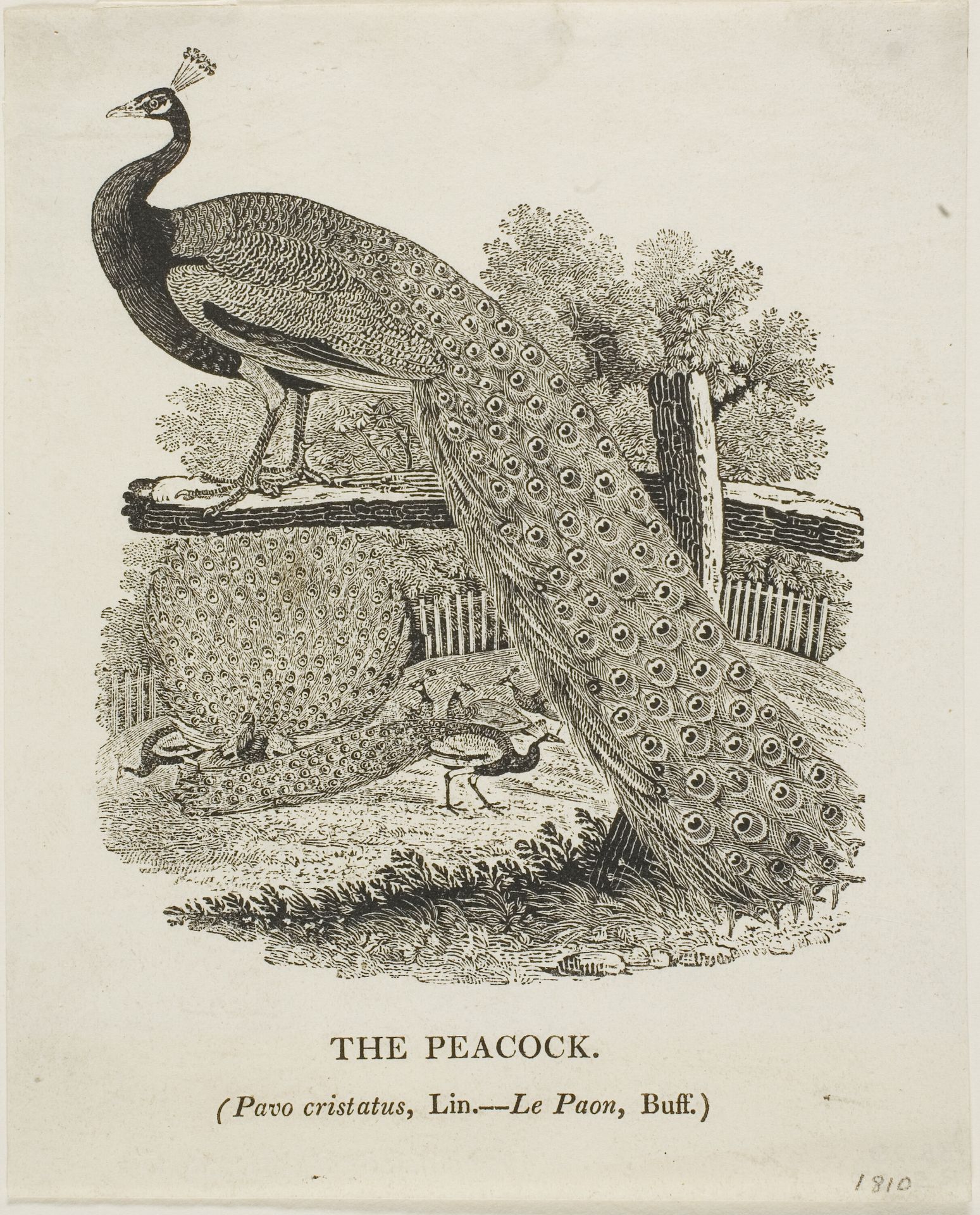
Curator: This woodcut engraving on paper presents us with a Peacock, made by Thomas Bewick. Editor: At first glance, it has a wonderful graphic quality; stark contrast in values renders depth and dimension, despite the monochromatic palette. Curator: Indeed. Bewick was known for his meticulous detail and his revolutionary technique in wood engraving. What do you make of the peacock’s depiction? Editor: It’s wonderfully observed; the texture of the feathers, rendered with incredibly fine lines, catches the light perfectly. The tail extends beyond the frame's lower edge, giving it a sense of monumentality. Curator: Beyond just depicting the animal accurately, peacocks have carried a certain cultural significance. Think about how they are symbolically connected with vanity, pride, beauty, even immortality across different cultures. Editor: I see what you mean. The pose of the peacock here is so erect and alert, emphasizing these connections to regality. But I must admit, I’m still drawn to the way Bewick utilizes his marks, cross-hatching, and stippling in the peacock itself, and in the verdant scene he has created behind it. Curator: It all adds layers of meaning. In certain cultures, its eyes were believed to be all-seeing, symbolic of enlightenment and vigilance. The placement here, at the cusp of naturalistic depiction and conceptual device creates a visually arresting scene. Editor: Thinking about the naturalism, Bewick's backgrounds provide context, giving the bird depth, allowing its beauty to emerge organically, perhaps even contradicting those loaded symbols with a grounding sense of humble nature. Curator: An interesting counterpoint. It makes us appreciate that Bewick did so much more than just reproduce images; he infused meaning and encouraged interpretation in the way all meaningful images do, beyond the formal. Editor: It's the push and pull between visual rhetoric and formal harmony that keeps our eyes dancing across its surface.