

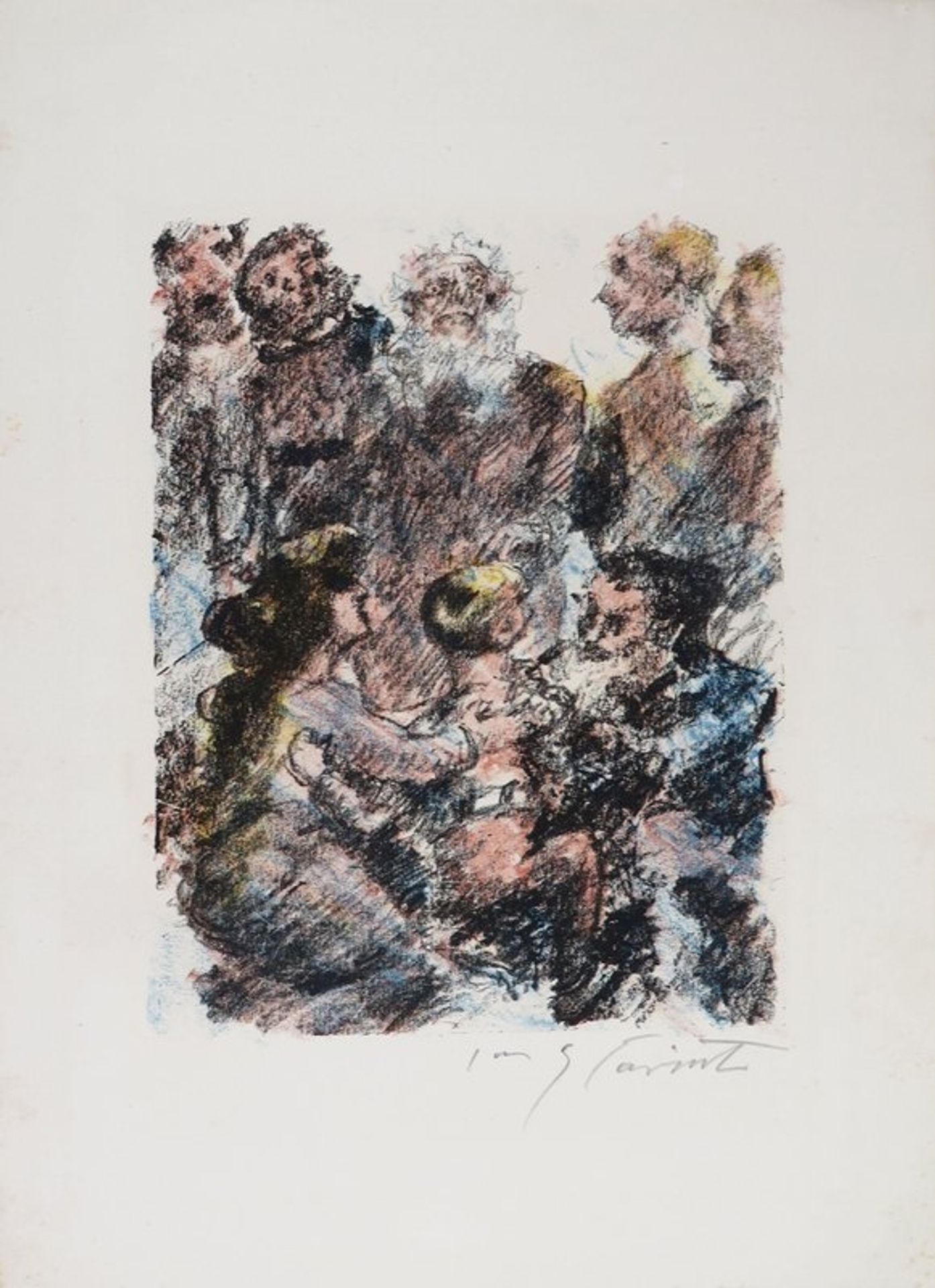
Wilhelm Tell Der Tod Attinghausens

Listen to curator's interpretation
Curatorial notes
Curator: This is Lovis Corinth’s drawing, “Wilhelm Tell Der Tod Attinghausens." It's hard to place the exact date on it, but it captures a poignant scene of death and mourning, central to the Swiss national myth of Wilhelm Tell. Editor: The overwhelming impression is one of fractured grief. The frenetic hatching and cross-hatching of colored pencil create a visual chaos. Look at how the colors bleed into one another, obscuring forms and amplifying the emotional turbulence. Curator: Corinth, known for his involvement in German Expressionism, uses this scene to comment on the power of nationalist narratives. Attinghausen, a noble, is dying, and the common folk are gathering to him. But instead of glorifying nobility, Corinth’s Expressionist lens renders everyone—noble and peasant—vulnerable to the ravages of mortality. This piece reflects the anxieties simmering beneath the surface of early 20th-century European society. Editor: Yes, that expressive handling of color adds another layer. There's no tranquility here, but also notice that Corinth only hints at form rather than fully describing it. This isn’t just a literal representation; it’s an exploration of how color and line can convey emotion directly. The background almost dissolves, but we can't look away. Curator: That unresolved quality resonates. Corinth's print echoes a broader sentiment felt around World War One—challenging traditional heroic portrayals of both historical figures and contemporary leadership, and making people feel sorrow after loss. Editor: The blurring contributes to a palpable feeling of anxiety, as if we are looking into something unstable. There’s nothing clean and pristine, so a feeling of loss is tangible. Curator: Indeed. Corinth captures that uneasy historical transition with his visual and conceptual style, leaving us to reflect on the price of liberty and nationhood. Editor: Ultimately, "Wilhelm Tell Der Tod Attinghausens" becomes a potent demonstration of the potential in colored pencil and paper; in the Expressionist style, form can become expression itself.