About this artwork
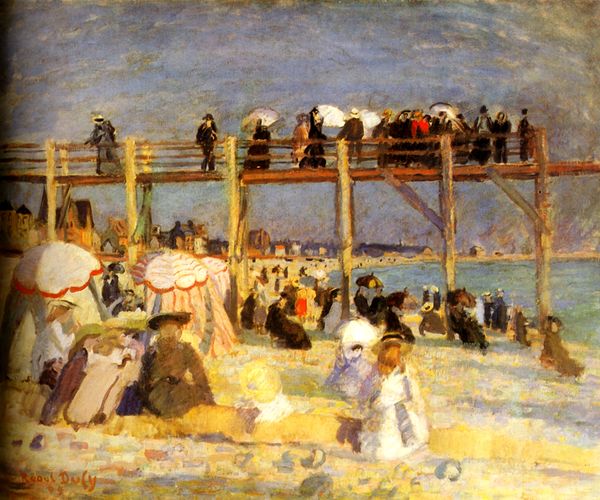
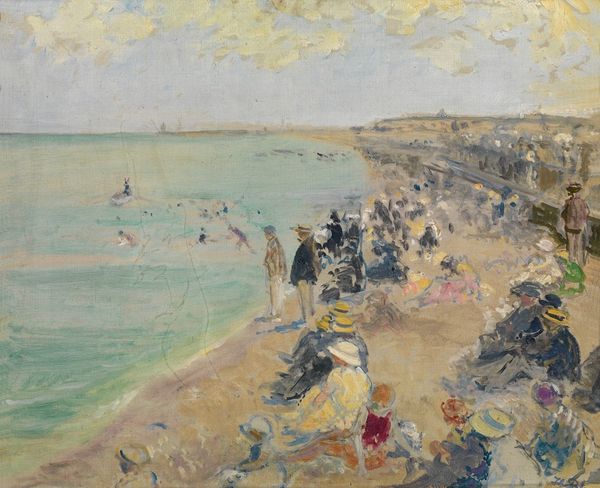
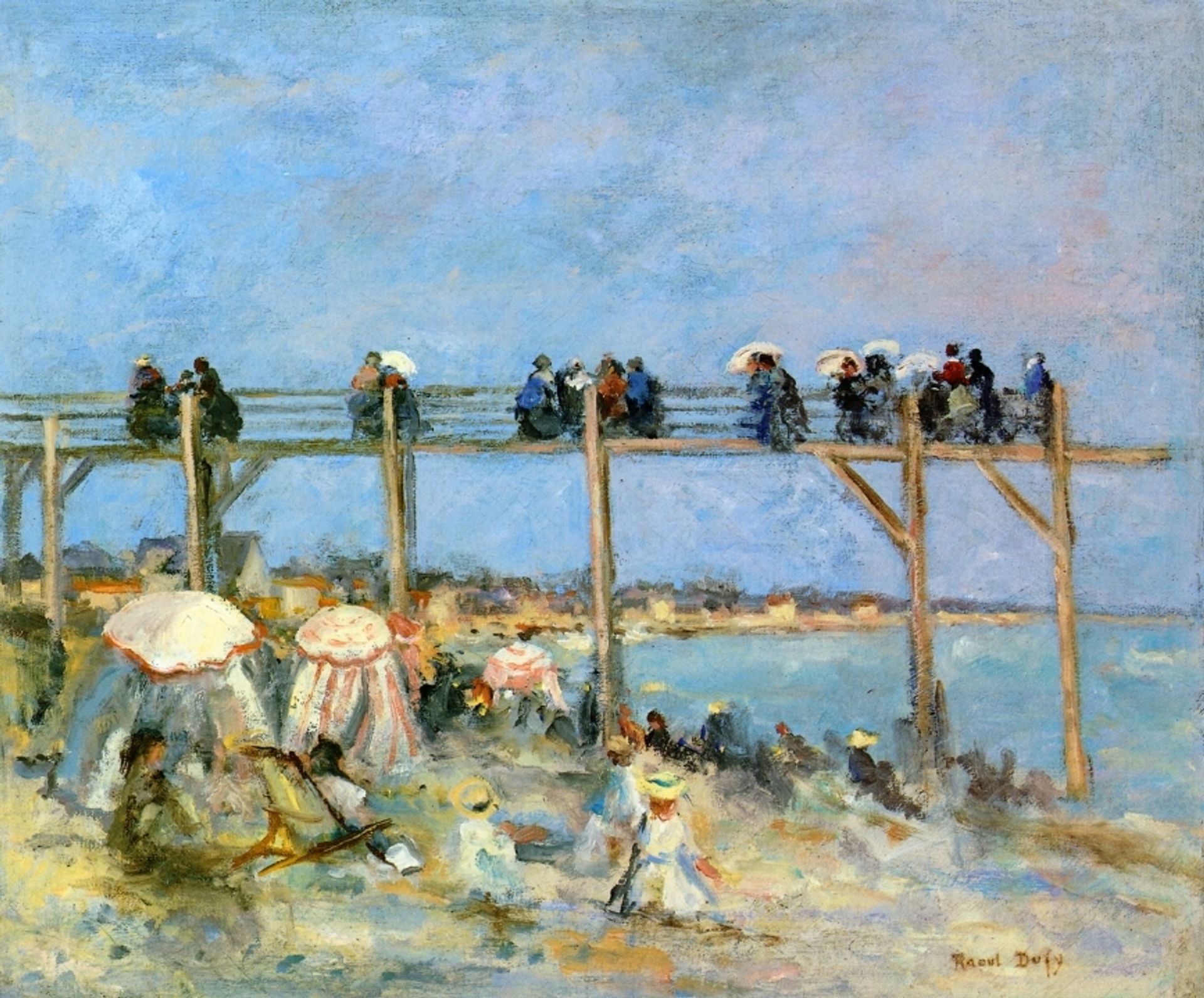
Editor: So, this is Raoul Dufy's "The Beach at Sainte-Adresse," painted in 1902 using oil. It’s… brighter than I expected! Almost cheerful. What catches your eye in it? Curator: The subject matter – leisure and tourism – can't be divorced from its moment. Consider the industrialization driving the burgeoning middle class. Their newfound free time fuels a demand for these coastal escapes and the material culture surrounding it – parasols, the pier itself, the clothing. Look at the visible brushstrokes, the very application of paint. Dufy is less concerned with rendering a realistic scene, and more engaged in the act of painting and how those materials convey this shift in leisure. Editor: So, the *how* it's painted is as important as *what* is painted? Curator: Precisely! The sketch-like quality suggests spontaneity and a democratized experience. These aren’t idealized figures; they’re ordinary people consuming a commercially available leisure experience. How does this contrast with academic painting of the era? Editor: Well, academic painting was so focused on history and myth, and…flawless technique. This is almost anti-that. What about plein-air painting more broadly? Curator: Plein-air, yes, but with a distinct focus on the material reality *around* plein-air experience and production itself – the developing culture and economy *of* the beach. What does it mean that art is documenting, and also participating in, consumer culture? Editor: It’s fascinating to consider this cheerful scene as evidence of bigger economic shifts, revealed through the very materiality of the painting! Curator: Exactly! We see leisure become industrialized through painting materials and brushwork! Dufy lets us consider class, labor, and landscape, all at once.

Artwork details
- Dimensions
- 38 x 46 cm
- Location
- Private Collection
- Copyright
- Public domain US
Comments
No comments
About this artwork
Editor: So, this is Raoul Dufy's "The Beach at Sainte-Adresse," painted in 1902 using oil. It’s… brighter than I expected! Almost cheerful. What catches your eye in it? Curator: The subject matter – leisure and tourism – can't be divorced from its moment. Consider the industrialization driving the burgeoning middle class. Their newfound free time fuels a demand for these coastal escapes and the material culture surrounding it – parasols, the pier itself, the clothing. Look at the visible brushstrokes, the very application of paint. Dufy is less concerned with rendering a realistic scene, and more engaged in the act of painting and how those materials convey this shift in leisure. Editor: So, the *how* it's painted is as important as *what* is painted? Curator: Precisely! The sketch-like quality suggests spontaneity and a democratized experience. These aren’t idealized figures; they’re ordinary people consuming a commercially available leisure experience. How does this contrast with academic painting of the era? Editor: Well, academic painting was so focused on history and myth, and…flawless technique. This is almost anti-that. What about plein-air painting more broadly? Curator: Plein-air, yes, but with a distinct focus on the material reality *around* plein-air experience and production itself – the developing culture and economy *of* the beach. What does it mean that art is documenting, and also participating in, consumer culture? Editor: It’s fascinating to consider this cheerful scene as evidence of bigger economic shifts, revealed through the very materiality of the painting! Curator: Exactly! We see leisure become industrialized through painting materials and brushwork! Dufy lets us consider class, labor, and landscape, all at once.
Comments
No comments