About this artwork
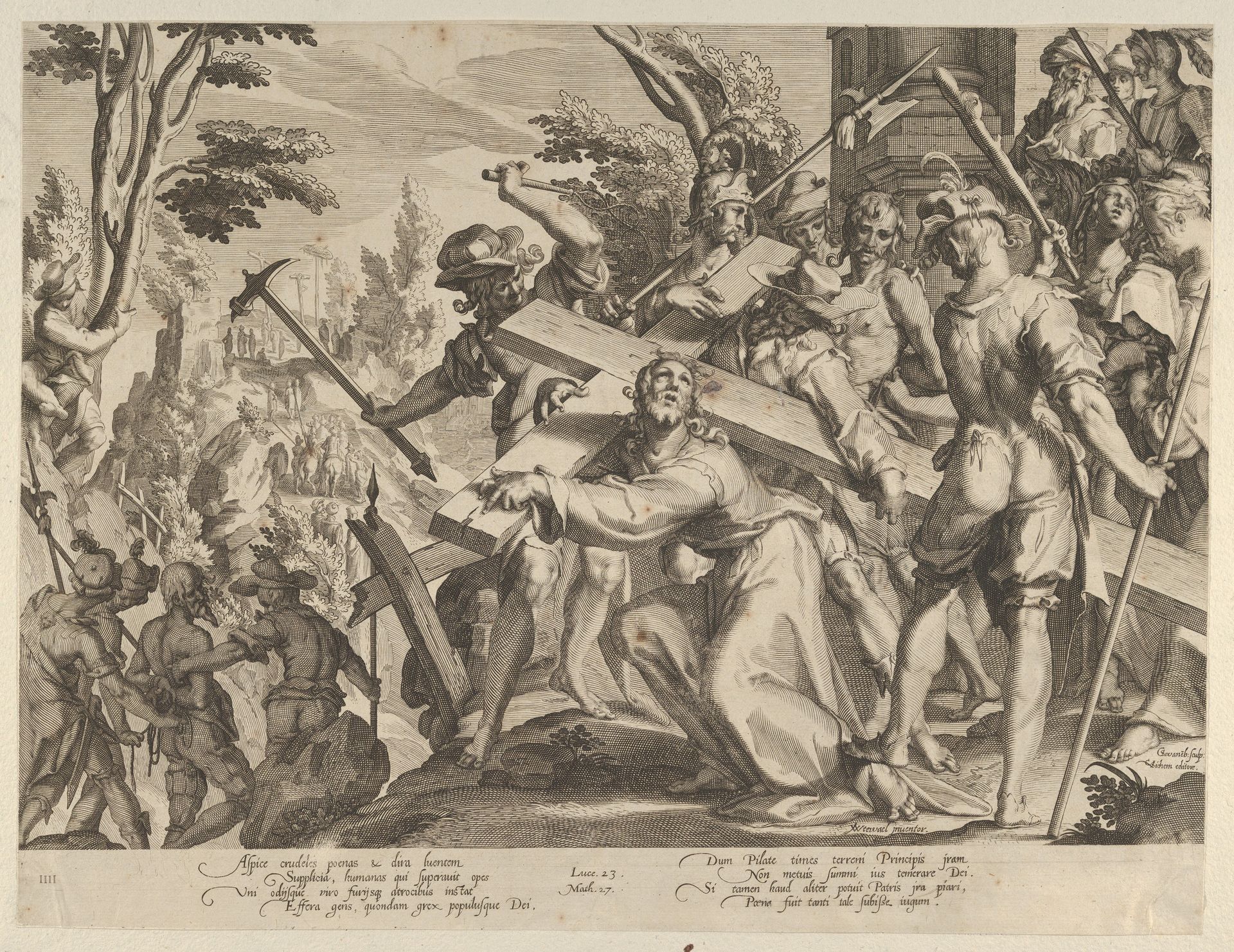
Editor: Here we have Willem van Swanenburg's "Christ Carrying the Cross," an engraving from around 1605. It's incredibly detailed, depicting a throng of figures surrounding Christ struggling under the weight of the cross. What strikes me is the contrast between the dynamic movement and Christ's quiet suffering. How do you interpret this work? Curator: This image, part of a larger series on justice, functions as a powerful indictment of power. Think about the Baroque period, a time of immense social stratification. Swanenburg is not just depicting a biblical scene. He is visually interrogating the structures of authority – both religious and secular – that perpetuate suffering and inequality. Notice how the Roman soldiers are rendered, with their exaggerated musculature and almost animalistic expressions. Editor: That's a really interesting perspective. I hadn't thought about the socio-political commentary so explicitly. So you see the soldiers’ aggression as symbolic? Curator: Exactly. It’s about visualising oppression, holding power accountable. Consider the viewer’s role here. By witnessing Christ’s humiliation, are we invited to question other injustices happening around us? Does the artist encourage dissent against tyranny? And in our contemporary context, what actions are demanded of us? Editor: I suppose I was mostly focused on the religious aspect, the depiction of Christ’s sacrifice. I didn’t immediately make connections to broader societal critiques. Curator: Right, but understanding the historical and social context allows us to see how the biblical narrative can be a vehicle for exploring universal themes of power, injustice, and resistance. Editor: It's amazing how much deeper the work becomes when you start thinking about it in terms of activism and social commentary. It's definitely given me a new perspective. Curator: Absolutely. And hopefully, it encourages us to consider art's potential as a tool for challenging oppression, both historically and today.
Christ Carrying the Cross, from Thronus Justitiae, tredecim pulcherrimus tabulis..., plate 4
1605 - 1606

Willem van Swanenburg
1581 - 1612
The Metropolitan Museum of Art
Metropolitan Museum of Art, New York, NYArtwork details
- Medium
- drawing, print, engraving
- Dimensions
- Sheet: 11 1/2 × 15 3/16 in. (29.2 × 38.5 cm)
- Location
- Metropolitan Museum of Art, New York, NY
- Copyright
- Public Domain
Tags
Comments
Share your thoughts
About this artwork
Editor: Here we have Willem van Swanenburg's "Christ Carrying the Cross," an engraving from around 1605. It's incredibly detailed, depicting a throng of figures surrounding Christ struggling under the weight of the cross. What strikes me is the contrast between the dynamic movement and Christ's quiet suffering. How do you interpret this work? Curator: This image, part of a larger series on justice, functions as a powerful indictment of power. Think about the Baroque period, a time of immense social stratification. Swanenburg is not just depicting a biblical scene. He is visually interrogating the structures of authority – both religious and secular – that perpetuate suffering and inequality. Notice how the Roman soldiers are rendered, with their exaggerated musculature and almost animalistic expressions. Editor: That's a really interesting perspective. I hadn't thought about the socio-political commentary so explicitly. So you see the soldiers’ aggression as symbolic? Curator: Exactly. It’s about visualising oppression, holding power accountable. Consider the viewer’s role here. By witnessing Christ’s humiliation, are we invited to question other injustices happening around us? Does the artist encourage dissent against tyranny? And in our contemporary context, what actions are demanded of us? Editor: I suppose I was mostly focused on the religious aspect, the depiction of Christ’s sacrifice. I didn’t immediately make connections to broader societal critiques. Curator: Right, but understanding the historical and social context allows us to see how the biblical narrative can be a vehicle for exploring universal themes of power, injustice, and resistance. Editor: It's amazing how much deeper the work becomes when you start thinking about it in terms of activism and social commentary. It's definitely given me a new perspective. Curator: Absolutely. And hopefully, it encourages us to consider art's potential as a tool for challenging oppression, both historically and today.
Comments
Share your thoughts