About this artwork
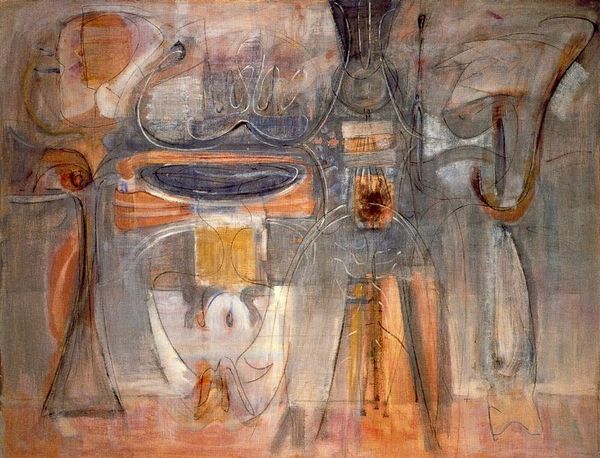
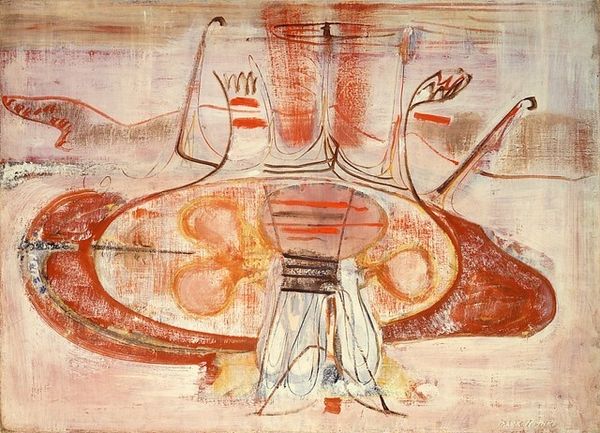
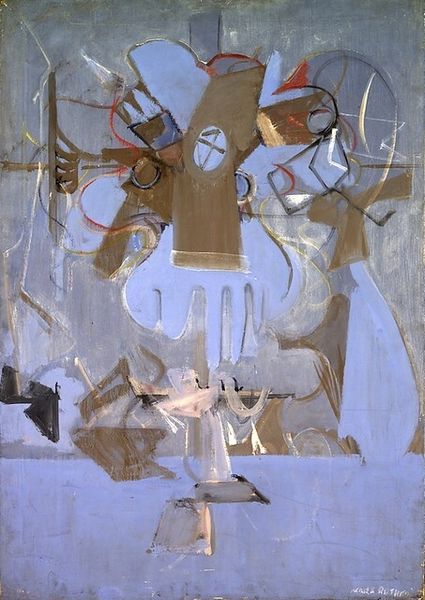
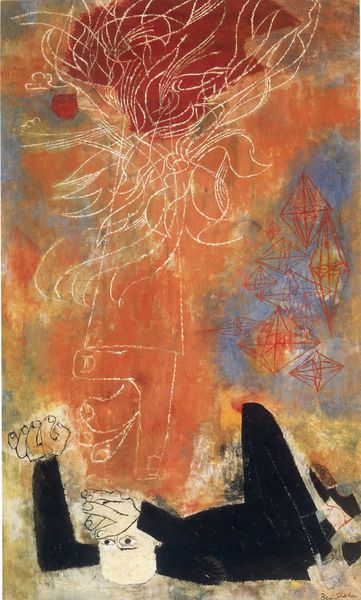
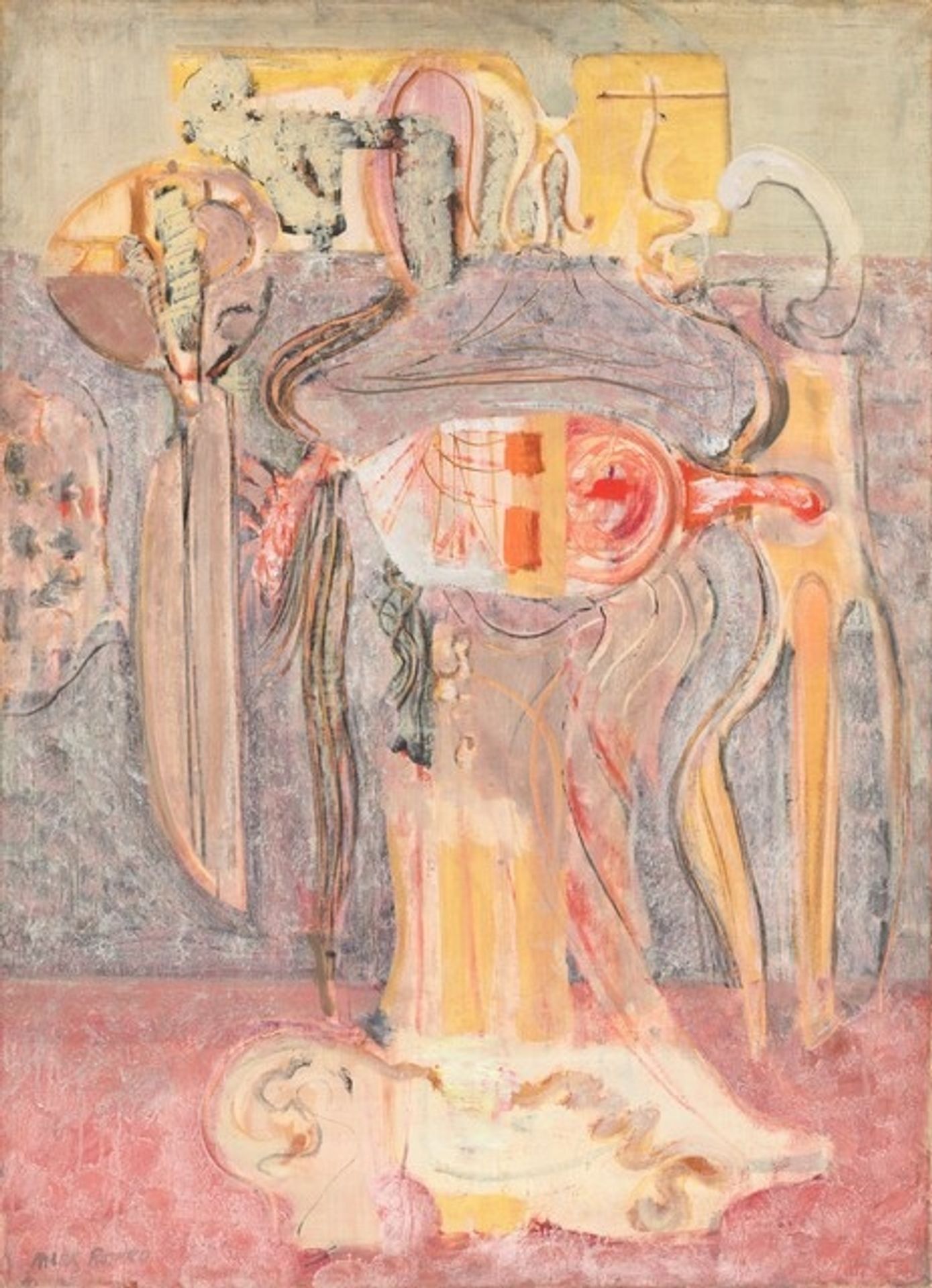
Editor: Here we have Mark Rothko’s “Sacrificial Moment,” painted in 1945 using oil paint and employing the impasto technique. The initial impact is rather unsettling, I think, with those suggestive biomorphic forms and muted colors. How do you interpret this work, especially given its title? Curator: The title certainly evokes the solemn and potentially violent act of sacrifice, but consider Rothko’s socio-political context. This work emerged just as World War II was ending and the Holocaust's horrors were coming to light. Rothko, a Jewish immigrant himself, would have been deeply affected. Could this ‘sacrificial moment’ be a commentary on the immense loss and destruction of human life, perhaps even a response to the scapegoating of entire communities? Editor: That's a really powerful point. I hadn't fully considered the weight of that historical context. Do you see the abstracted forms relating to specific figures or symbols within that narrative of sacrifice and loss? Curator: Look at the lines, the blurred forms, and how the composition almost dissolves. Do they suggest a kind of violence, the loss of individual identity within a collective trauma? Perhaps the abstracted forms are deliberately ambiguous, so they resonate universally, allowing for individual and collective grief to find expression. Editor: So it is a visual metaphor for shared human suffering at its deepest levels? A powerful and important consideration for any work of art. Curator: Precisely. It's about acknowledging that art doesn't exist in a vacuum. It's a reflection of and a response to our shared history and contemporary struggles. This painting invites us to confront uncomfortable truths and grapple with the complexities of human existence. Editor: Thank you, this definitely shifted how I view it; what I saw as simply an unsettling painting seems now to represent something profound. Curator: And that's the beauty of engaging with art critically—unveiling those deeper layers and allowing for more nuanced understanding.


Artwork details
- Medium
- painting, oil-paint, impasto
- Dimensions
- overall: 98 x 70.5 cm (38 9/16 x 27 3/4 in.)
- Copyright
- National Gallery of Art: CC0 1.0
Tags
Comments
Share your thoughts
About this artwork
Editor: Here we have Mark Rothko’s “Sacrificial Moment,” painted in 1945 using oil paint and employing the impasto technique. The initial impact is rather unsettling, I think, with those suggestive biomorphic forms and muted colors. How do you interpret this work, especially given its title? Curator: The title certainly evokes the solemn and potentially violent act of sacrifice, but consider Rothko’s socio-political context. This work emerged just as World War II was ending and the Holocaust's horrors were coming to light. Rothko, a Jewish immigrant himself, would have been deeply affected. Could this ‘sacrificial moment’ be a commentary on the immense loss and destruction of human life, perhaps even a response to the scapegoating of entire communities? Editor: That's a really powerful point. I hadn't fully considered the weight of that historical context. Do you see the abstracted forms relating to specific figures or symbols within that narrative of sacrifice and loss? Curator: Look at the lines, the blurred forms, and how the composition almost dissolves. Do they suggest a kind of violence, the loss of individual identity within a collective trauma? Perhaps the abstracted forms are deliberately ambiguous, so they resonate universally, allowing for individual and collective grief to find expression. Editor: So it is a visual metaphor for shared human suffering at its deepest levels? A powerful and important consideration for any work of art. Curator: Precisely. It's about acknowledging that art doesn't exist in a vacuum. It's a reflection of and a response to our shared history and contemporary struggles. This painting invites us to confront uncomfortable truths and grapple with the complexities of human existence. Editor: Thank you, this definitely shifted how I view it; what I saw as simply an unsettling painting seems now to represent something profound. Curator: And that's the beauty of engaging with art critically—unveiling those deeper layers and allowing for more nuanced understanding.
Comments
Share your thoughts