painting, oil-paint
portrait
narrative-art
painting
oil-paint
figuration
oil painting
jesus-christ
genre-painting
history-painting
italian-renaissance
Dimensions: 195 x 165 cm
Copyright: Public domain
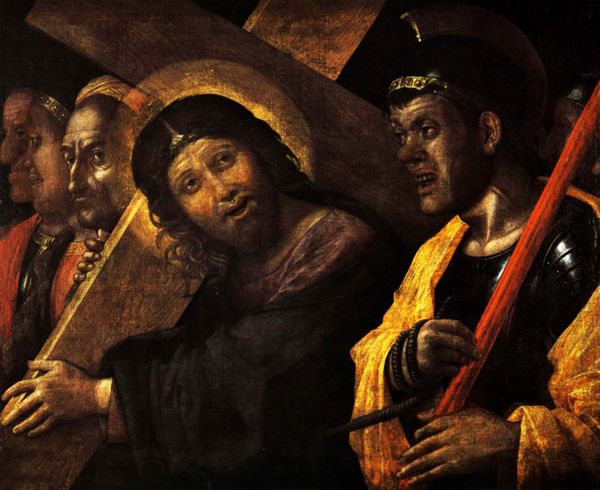
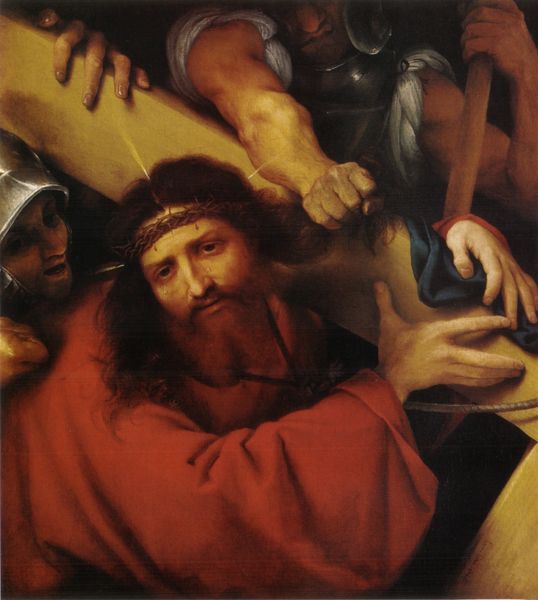
Curator: Well, that’s unsettling. Look at the almost caricatured faces—it gives me the chills. Editor: Here we have Hieronymus Bosch's "Christ Crowned with Thorns," painted around 1510, and currently residing in El Escorial, Madrid. Bosch, as always, uses oil paint to deliver his… unique vision. Curator: Unique is an understatement. The way Bosch handles oil paint here is interesting. Look at the textures! Some faces are smooth, almost porcelain-like, while others, like the figure to Christ’s right, are coarsely rendered, almost aggressively so. You can practically feel the rough fabric and aged skin. How do you think that reflects on the material reality and the labour process inherent in making the artwork? Editor: I’d say it intensifies the social commentary inherent in the Passion narrative. The expressions, exaggerated and grotesque, reveal a society rife with cruelty. Notice how the central figures are pushed so close to the foreground, almost as if to implicate the viewer, inviting them into this theater of religious and political power. The circular composition does the same; its flattening effect makes the narrative almost claustrophobic. Curator: It certainly amplifies the stark contrast. And it really drives home the stark divide between the sacred and the profane, especially how the artist uses those material techniques. Is Christ's serenity even a material contrast, rendered with finer detail in a slightly different way than the coarser executioners, underscoring that difference through its physical, tangible representation. The way in which this was executed reflects, on so many levels, the socioeconomic disparity in contemporary Bosch societies. Editor: It also subtly subverts expectations of religious art at the time. By focusing not on idealized divinity, but on brutal realism and grotesque figures, it challenged established norms around the purpose of art in reflecting or critiquing public morals and the societal treatment of religion. The choice to focus on human figures in the background, within and without the painting frame, demonstrates a conscious intention to provide an environment in which that societal breakdown and the suffering of others could be highlighted, not only reflecting the human component but also subtly highlighting how labor might become cruel at the hands of others. Curator: It does make you wonder about the economic forces at play in Bosch’s time. It would be insightful to understand how societal dynamics influenced not only his subjects, but even the artistic processes employed in portraying those same subjects. Editor: Agreed. It’s a complex work that prompts reflections on both spiritual suffering and societal rot. Curator: Indeed, a work where brushstrokes tell a story as potent as the subject.
Comments
No comments
Be the first to comment and join the conversation on the ultimate creative platform.
 React
React Comment