drawing, print, etching, intaglio
#
portrait
#
pencil drawn
#
drawing
#
light pencil work
#
narrative-art
#
ink paper printed
# print
#
etching
#
intaglio
#
pencil sketch
#
figuration
#
line
#
pencil work
#
genre-painting
#
realism
Dimensions: height 163 mm, width 126 mm
Copyright: Rijks Museum: Open Domain
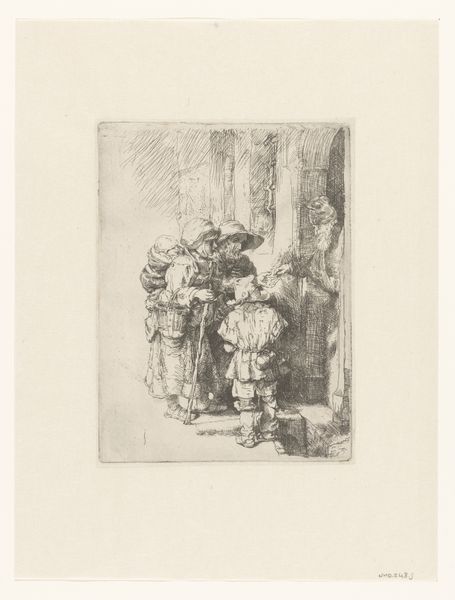
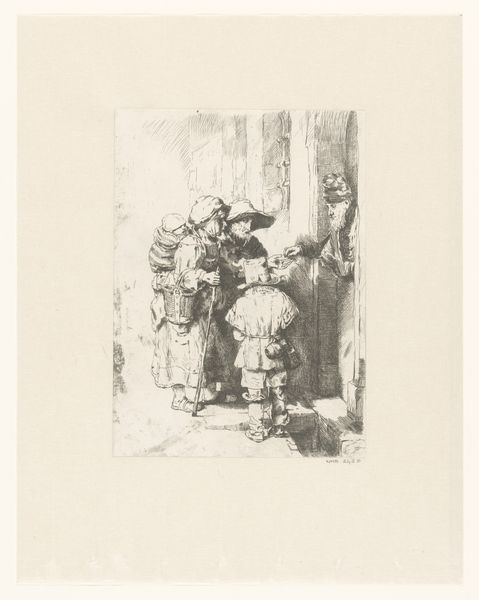
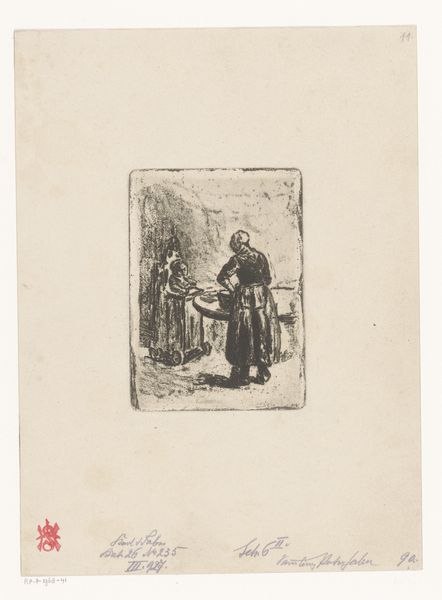
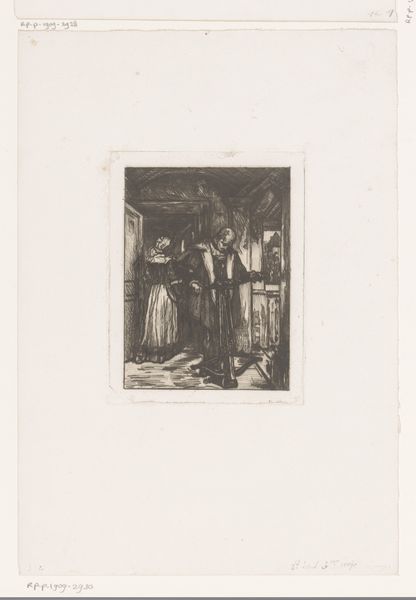
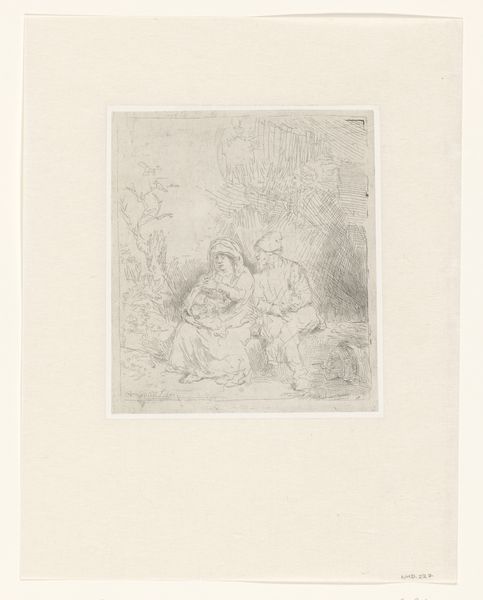
Editor: Here we have Francesco Novelli's "A Blind Hurdy-Gurdy Player and Family Receiving Alms," an etching from the late 18th or early 19th century. There is an almost desperate air to the composition; it feels cramped and dark despite the seemingly simple lines. What do you notice, looking at it from a formal perspective? Curator: Observe how Novelli uses line—thin, deliberate strokes, massed in certain areas to create shadow and volume. This establishes a hierarchy, doesn’t it? Notice how the architectural space looms, and how that contrasts with the relatively smaller human figures? Editor: Absolutely, and the concentration of dark lines really does pull my focus. So, what would you say is emphasized, or perhaps de-emphasized, by that technique? Curator: Formally, I think Novelli emphasizes the overwhelming environment. The family isn’t rendered with crisp lines, but rather appears as shapes against the backdrop, while the heavy door is much clearer. This creates a sense of being swallowed by their surroundings, doesn’t it? Editor: Yes, I can definitely see that! Almost like their poverty defines their shape. So, it’s a choice not just about representation but about... the effect on the viewer? Curator: Precisely. Novelli utilizes form to construct the subject; not just showing poverty, but enacting it, through spatial relationships, line weight, the disposition of masses on the page. It’s not just that they are poor; their very forms are determined by that state. Do you see it as purely representational? Editor: I don't think so. The composition creates a sense of imbalance. The family’s forms almost seem to fade into the lines around them. It does a lot to emphasize this visual feeling of being overwhelmed and, maybe, of disappearing. Curator: Exactly! By examining the lines, the values, we see how this piece means, not just what it means. It prompts the viewer to recognize their form and social location through pictorial components.
Comments
No comments
Be the first to comment and join the conversation on the ultimate creative platform.
 Collect
 React
React Comment
More like this