About this artwork
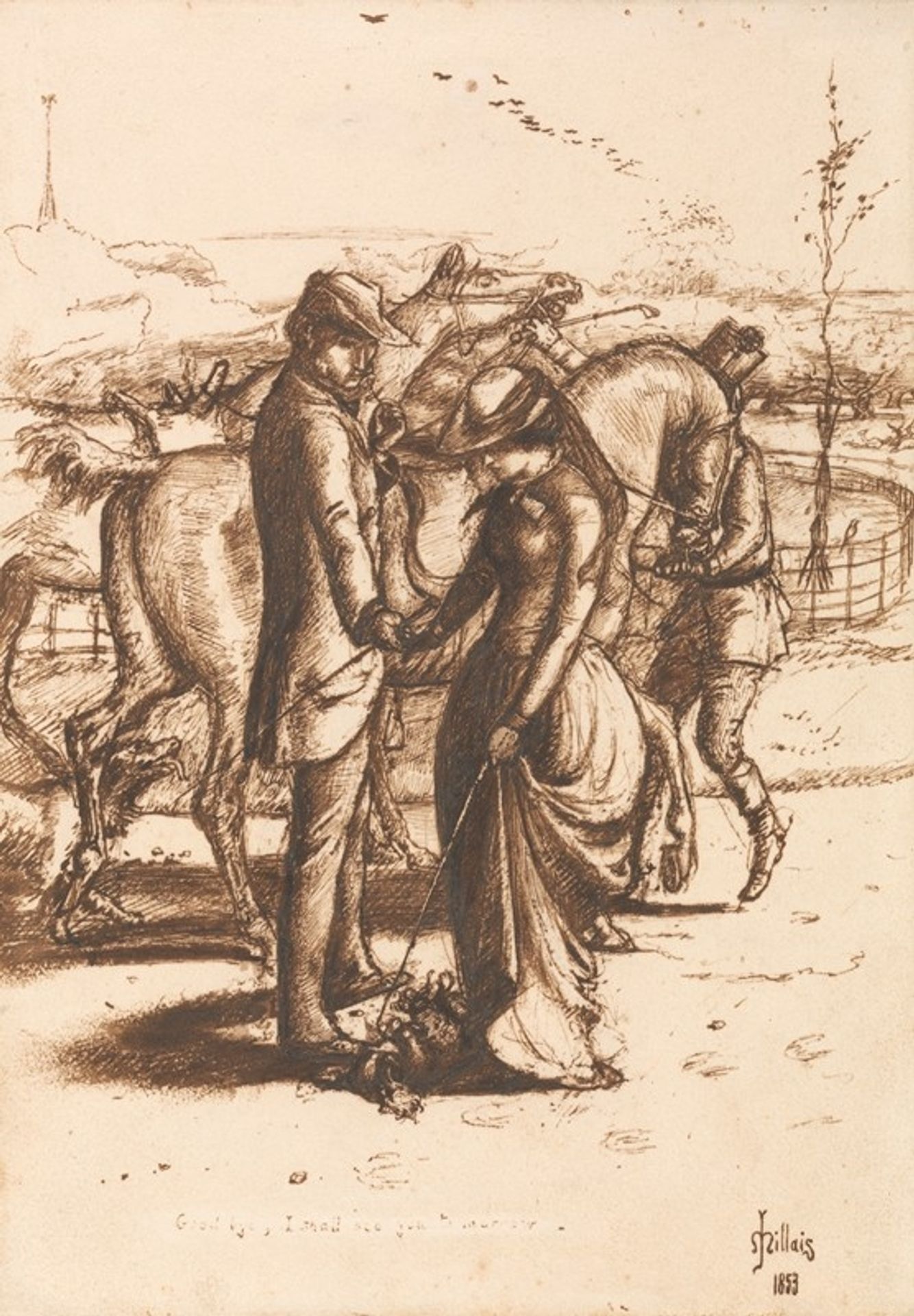
Here, we have Sir John Everett Millais's drawing titled "Rejected", which was made in 1853. The sepia ink on paper creates a tonal harmony that underscores the drawing's exploration of social and personal rejection. Millais’s composition is structured by contrasting elements. The couple in the foreground is tightly framed, their linked hands a focal point, while the background is loosely sketched, suggesting distance and detachment. The line work is intricate in the figures' clothing and faces, but dissolves into abstraction in the landscape, a technique that both defines and destabilizes traditional form. The couple's solemn posture and downward gazes, combined with the subtle shadows, evoke a profound sense of melancholy. The overall effect suggests a narrative deeply embedded in the emotional tension between connection and isolation. By focusing on these formal qualities, the drawing prompts us to consider how Millais used visual language to express a complex set of emotional and social themes, inviting viewers to interpret the narrative anew with each viewing.

Artwork details
- Copyright
- Public Domain: Artvee
Comments
Share your thoughts
About this artwork
Here, we have Sir John Everett Millais's drawing titled "Rejected", which was made in 1853. The sepia ink on paper creates a tonal harmony that underscores the drawing's exploration of social and personal rejection. Millais’s composition is structured by contrasting elements. The couple in the foreground is tightly framed, their linked hands a focal point, while the background is loosely sketched, suggesting distance and detachment. The line work is intricate in the figures' clothing and faces, but dissolves into abstraction in the landscape, a technique that both defines and destabilizes traditional form. The couple's solemn posture and downward gazes, combined with the subtle shadows, evoke a profound sense of melancholy. The overall effect suggests a narrative deeply embedded in the emotional tension between connection and isolation. By focusing on these formal qualities, the drawing prompts us to consider how Millais used visual language to express a complex set of emotional and social themes, inviting viewers to interpret the narrative anew with each viewing.
Comments
Share your thoughts