About this artwork
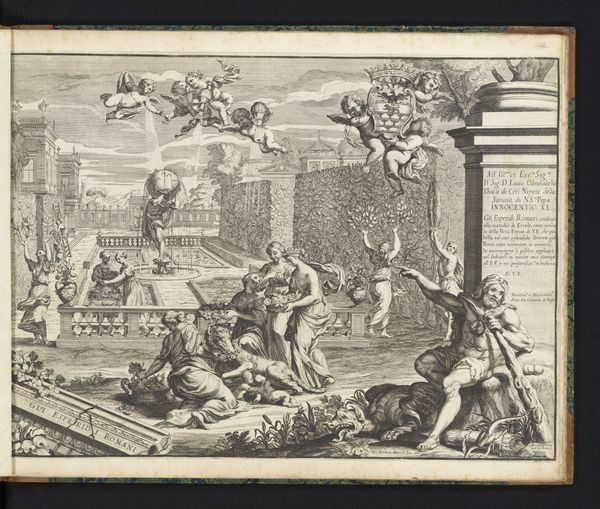
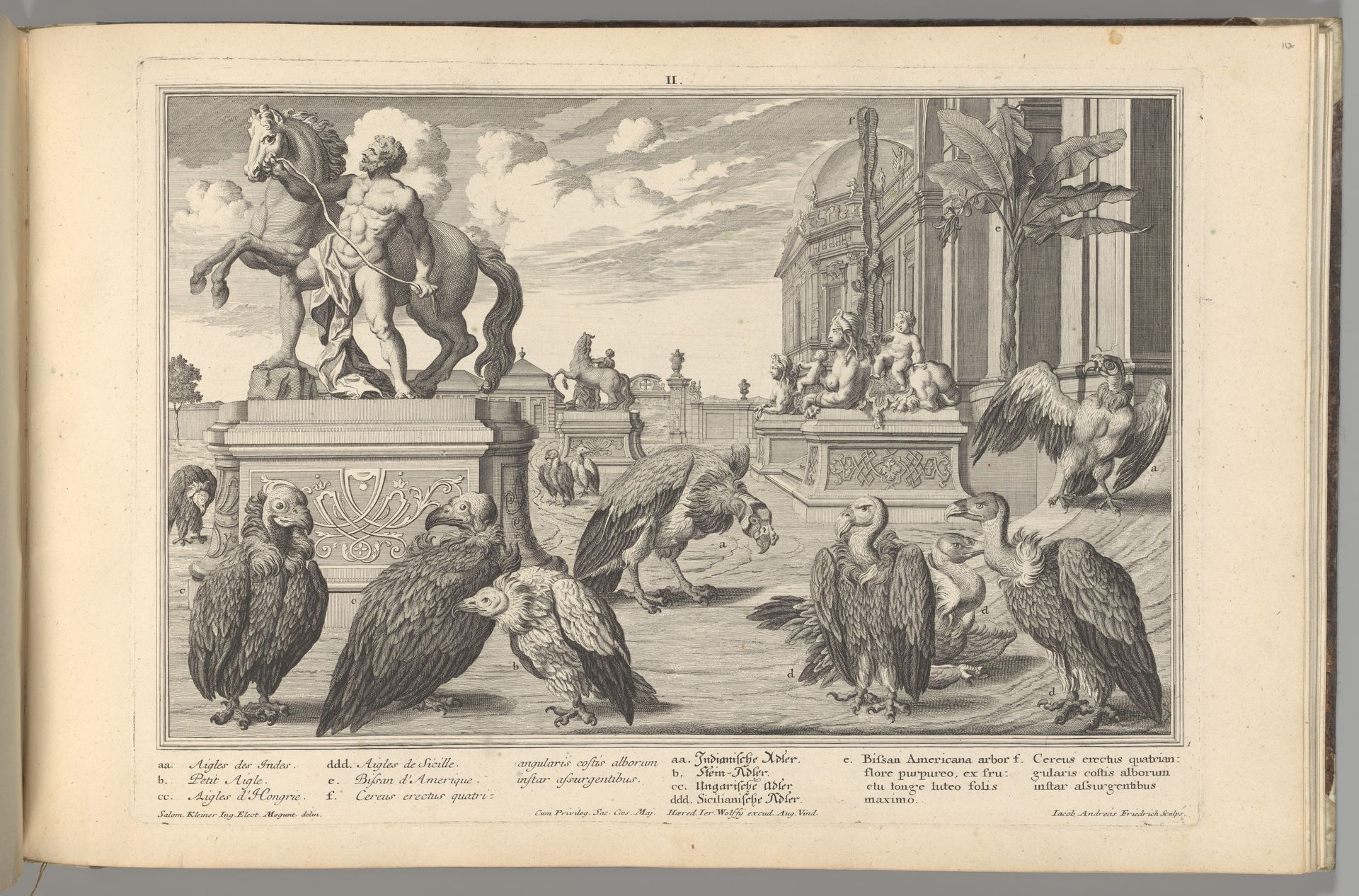
Salomon Kleiner created this print, "Residences Memorables," sometime in the first half of the 18th century. The detailed etching presents a formal garden populated with classical sculptures and a striking foreground of vultures. The contrast of textures, from the smooth stone to the birds' ruffled feathers, enlivens the scene. Kleiner uses a symmetrical layout, positioning the sculptures as markers of cultivated space. But what are we to make of the vultures? Their presence destabilizes the orderly refinement of the garden. They introduce an element of the wild, of death and decay, into a space designed to celebrate life and beauty. The vultures are not merely a naturalistic detail, but rather function as a visual challenge. The print questions established notions of beauty and taste. It invites us to consider the relationship between civilization and nature. Kleiner's composition creates a space where opposing forces—order and chaos, beauty and ugliness—collide. And through this collision, the print generates a dynamic interplay of meanings.
Residences Memorables de l'Incomporable Heros de Nôtre Siècle, ou Edifices et Jardins de Son Altesse Serenissime Monsigneur Le Prince Eugene François de Savoye et de Piedmont 1731 - 1740


Artwork details
- Medium
- drawing, print, engraving
- Dimensions
- Overall: 13 x 20 1/16 x 1 9/16 in. (33 x 51 x 4 cm)
- Location
- Metropolitan Museum of Art, New York, NY
- Copyright
- Public Domain
Tags
drawing
baroque
landscape
history-painting
engraving
Comments
No comments
About this artwork
Salomon Kleiner created this print, "Residences Memorables," sometime in the first half of the 18th century. The detailed etching presents a formal garden populated with classical sculptures and a striking foreground of vultures. The contrast of textures, from the smooth stone to the birds' ruffled feathers, enlivens the scene. Kleiner uses a symmetrical layout, positioning the sculptures as markers of cultivated space. But what are we to make of the vultures? Their presence destabilizes the orderly refinement of the garden. They introduce an element of the wild, of death and decay, into a space designed to celebrate life and beauty. The vultures are not merely a naturalistic detail, but rather function as a visual challenge. The print questions established notions of beauty and taste. It invites us to consider the relationship between civilization and nature. Kleiner's composition creates a space where opposing forces—order and chaos, beauty and ugliness—collide. And through this collision, the print generates a dynamic interplay of meanings.
Comments
No comments