About this artwork
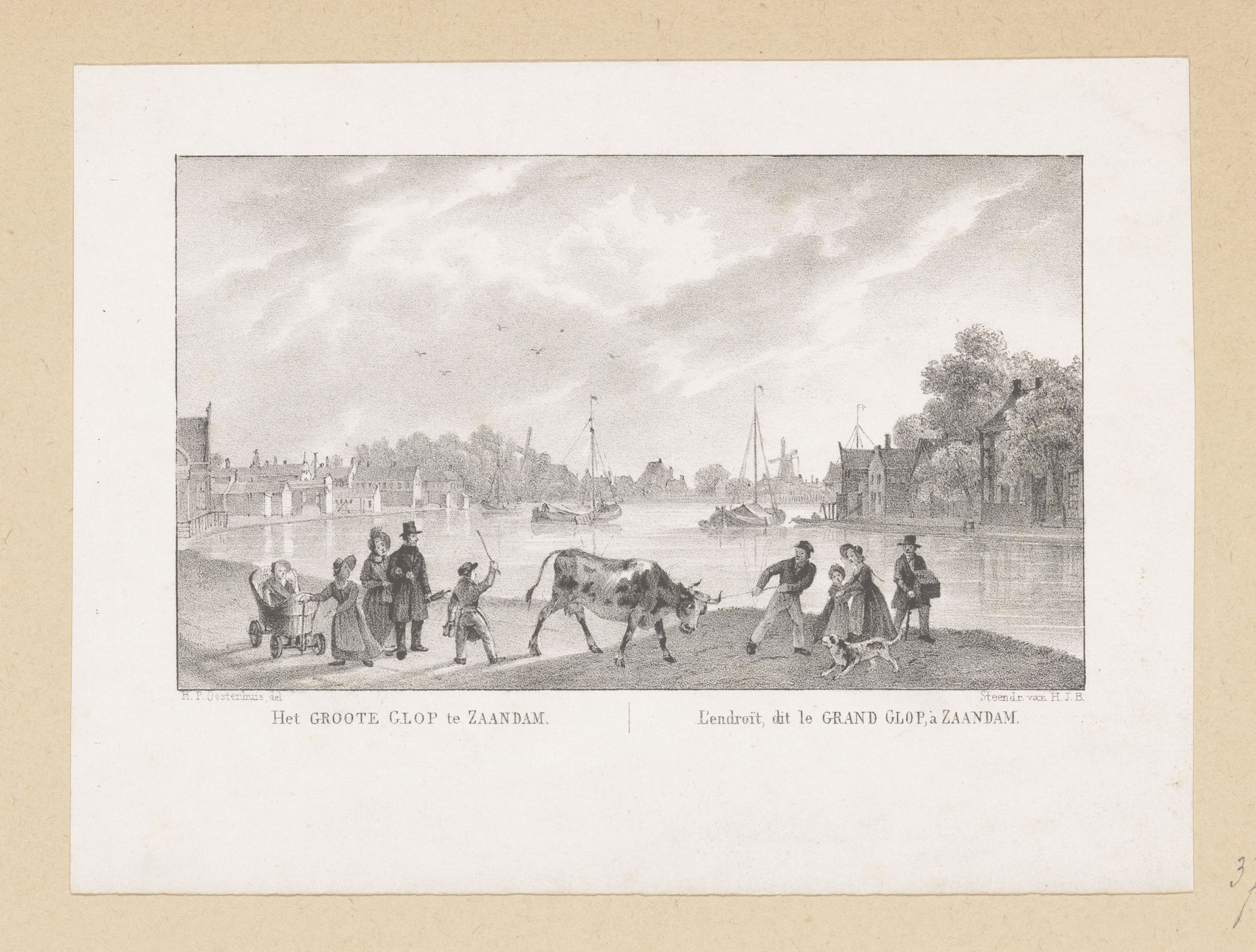
Hilmar Johannes Backer created this print of Gezicht op het Grote Glop te Zaandam, its date is unknown. The composition is horizontally divided into the foreground with figures and a cow, the middle ground with water and boats, and the background with buildings and trees. Backer’s rendering, entirely in monochrome shades, relies on tonal variation and sharpness of line to create depth and spatial recession. The artist meticulously arranges elements to guide the eye across the landscape, interweaving social observation with a structural understanding of pictorial space. This print, with its detailed etching, provides insights into 19th-century Dutch life, but it also serves as a formal study in how perspective and tonal contrast can define space and convey depth on a flat surface. The strategic placement of figures and objects invites a semiotic reading, where each element contributes to a larger narrative about rural life and community. Note how the artist uses a delicate balance between representation and formal abstraction, capturing the essence of a place while also examining the structural components of art itself.
Gezicht op het Grote Glop te Zaandam met diverse figuren
1842

Hilmar Johannes Backer
1804 - 1845Location
RijksmuseumArtwork details
- Medium
- print, engraving
- Dimensions
- height 119 mm, width 160 mm
- Location
- Rijksmuseum
- Copyright
- Rijks Museum: Open Domain
Tags
Comments
Share your thoughts
About this artwork
Hilmar Johannes Backer created this print of Gezicht op het Grote Glop te Zaandam, its date is unknown. The composition is horizontally divided into the foreground with figures and a cow, the middle ground with water and boats, and the background with buildings and trees. Backer’s rendering, entirely in monochrome shades, relies on tonal variation and sharpness of line to create depth and spatial recession. The artist meticulously arranges elements to guide the eye across the landscape, interweaving social observation with a structural understanding of pictorial space. This print, with its detailed etching, provides insights into 19th-century Dutch life, but it also serves as a formal study in how perspective and tonal contrast can define space and convey depth on a flat surface. The strategic placement of figures and objects invites a semiotic reading, where each element contributes to a larger narrative about rural life and community. Note how the artist uses a delicate balance between representation and formal abstraction, capturing the essence of a place while also examining the structural components of art itself.
Comments
Share your thoughts