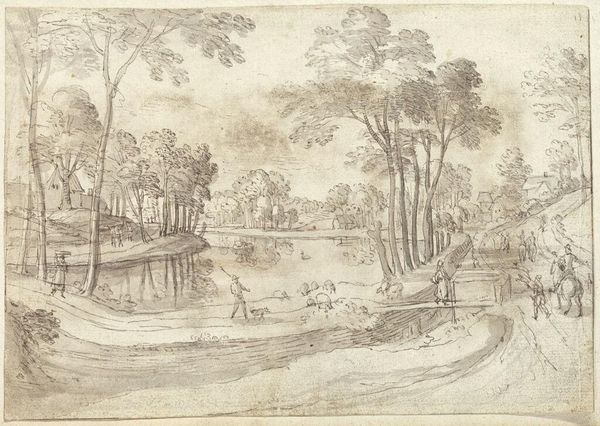
drawing, paper, ink
#
drawing
#
baroque
#
pencil sketch
#
landscape
#
paper
#
ink
#
pencil drawing
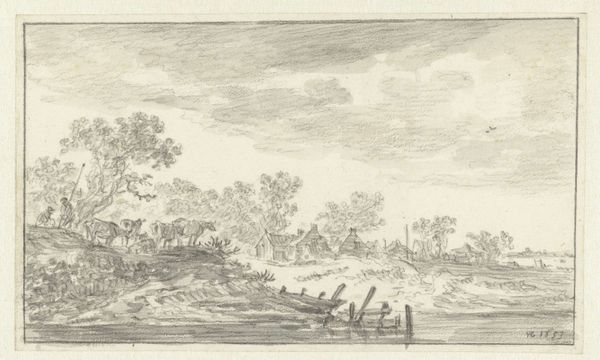
Dimensions: height 102 mm, width 201 mm
Copyright: Rijks Museum: Open Domain
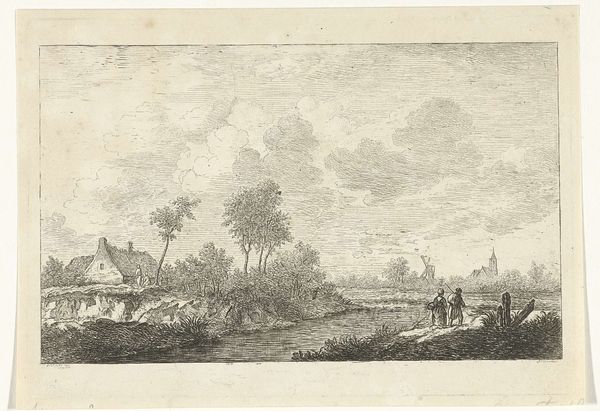
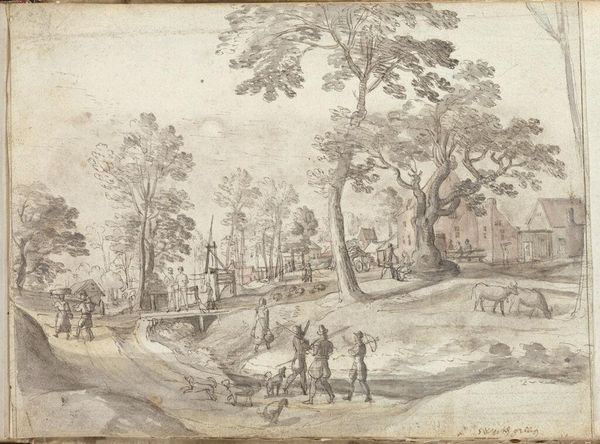
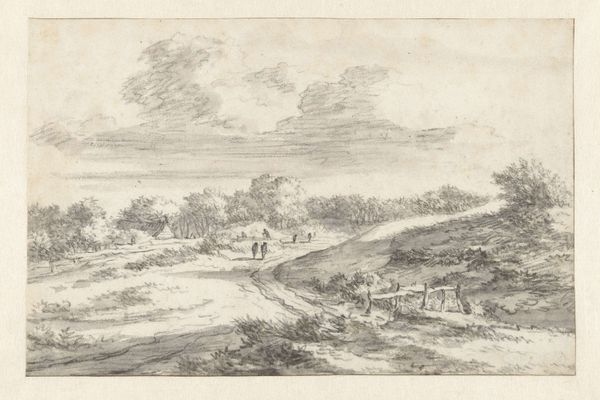
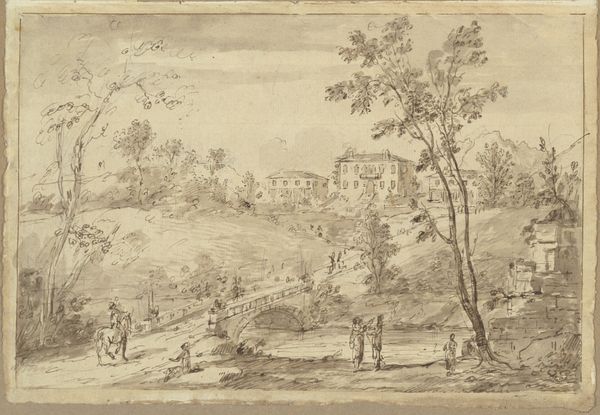
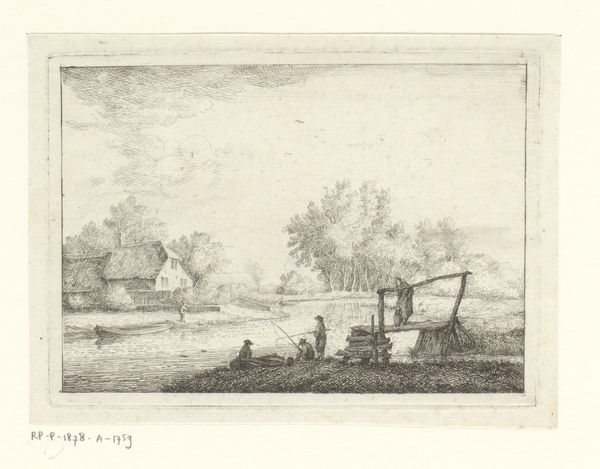
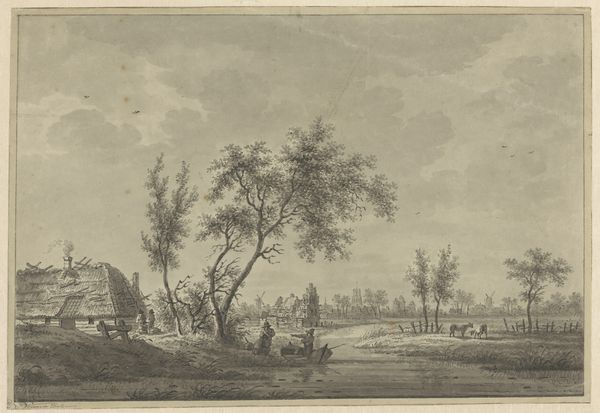
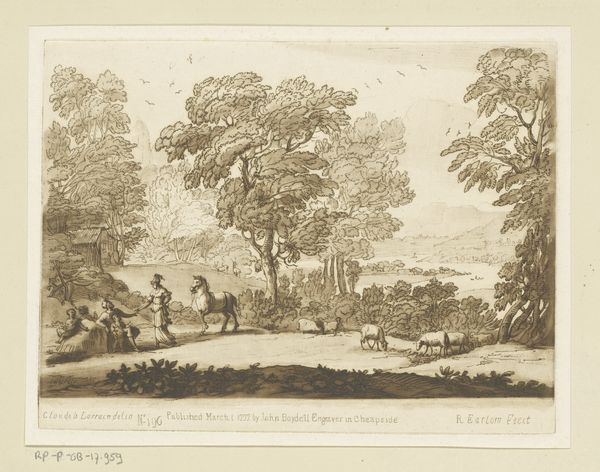
Editor: This is "Hydepark te Londen," or "Hyde Park in London," made between 1699 and 1719 by Michiel van Overbeek. It’s a drawing on paper using ink and pencil. The scene feels like a snapshot of everyday life, but what strikes me is the artist’s choice to use these simple materials for such a detailed scene. What stands out to you? Curator: What interests me is how this drawing participates in a larger visual culture concerned with representing spaces of leisure and privilege. Think about the paper itself, likely handmade and quite valuable. Its use here points to a specific patron, a market interested in consuming images of refinement and the English countryside. It’s not just a depiction of Hyde Park, it's also a commodity, an object circulating within a specific social strata. Who do you think had access to it and why? Editor: So, you're saying the value lies not just in the image itself, but in understanding how its materials and production connect it to social class and consumerism at the time? Maybe only the wealthy could afford it and relate to scenes of leisure in Hyde Park. Curator: Precisely. And the medium itself— drawing— holds an interesting position. Was this preliminary to a print, making it reproducible and more widely accessible? Or was it a unique work, heightening its value as a luxury object? Even the labor involved speaks to something, either careful study and skill, or potentially a more mechanized process of reproduction, with lower artistic ‘value’. Editor: That really changes how I see it. Thinking about the drawing as an object of consumption, connected to labor and social status, gives it a whole new layer of meaning. I initially focused on the idyllic scene, but now I’m seeing the web of economic relationships embedded in it. Curator: Indeed. And that material lens offers a potent critique of seemingly straightforward representations. We see the park, but we're also prompted to ask: for whom, and at what cost? Editor: I hadn’t considered how materials could reveal so much about the historical and social context. Thank you!
Comments
No comments
Be the first to comment and join the conversation on the ultimate creative platform.
 Collect
 React
React Comment
More like this