Copyright: Public domain
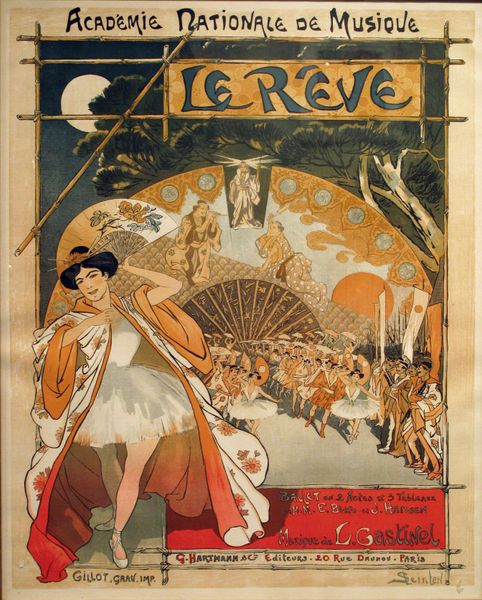
Editor: This is Ivan Bilibin's "Poster of Russian Ballet" from 1930. It's got this whimsical, almost fairytale quality. I'm drawn to the color palette; it feels very deliberately constructed. What aspects of this work stand out to you? Curator: I am particularly interested in Bilibin's construction of space. Notice the flattening of the picture plane, typical of Art Nouveau, which works against a more traditional illusionistic depth. This is heightened by the carefully constructed arrangement of the figures. Editor: How so? Curator: The figures aren’t receding into space. Their arrangement is more like a frieze. And the strong outline around each form emphasizes its two-dimensionality, doesn’t it? Consider also the color choices and application. Are you sensing any tension between surface decoration and depth? Editor: Yes, I see what you mean. The highly patterned costumes, especially on the lead dancer, really flatten her form despite her position in the foreground. But it still feels as though she is the center, leading the dancers in their Russian folk costumes. The more I study this the more complex the picture is. Thank you. Curator: Indeed. Bilibin creates a delicate balance between these pictorial devices. This analysis showcases the inherent power of form in defining content, what some theorists call the essence of 'aboutness.' A useful way to understand an artist's aesthetic and philosophical viewpoints.
Comments
No comments
Be the first to comment and join the conversation on the ultimate creative platform.
 React
React Comment