Copyright: National Gallery
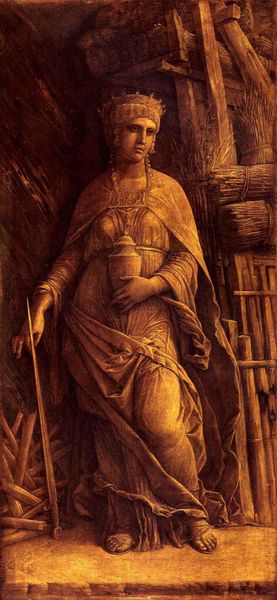
Andrea Mantegna painted this image of The Vestal Virgin Tuccia, though its exact date remains unconfirmed. The artwork presents a monochromatic palette of earth tones, creating a stone-like effect that suggests sculpture more than painting. Tuccia, the central figure, holds a sieve, her gaze introspective. Above her, a garland and vase add to the classical ambiance, all set against a swirling, cloudy backdrop. Mantegna's formal arrangement invites semiotic interpretation. Tuccia’s sieve, a symbol of impossible purity, challenges fixed notions of virtue. The monochrome palette strips away distractions, focusing our attention on form and line. The marble effect raises questions about representation. Are we seeing a painting, or a sculpture rendered in paint? The entire composition is imbued with the cultural codes of the Renaissance, where classical virtue and artistic skill converged. The artist destabilizes conventional meanings through a careful manipulation of form and symbolism. Thus, the painting functions as an invitation to explore deeper philosophical questions about truth, representation, and the very nature of seeing.
Comments
No comments
Be the first to comment and join the conversation on the ultimate creative platform.
 Collect
 React
React Comment
More like this