


Curatorial notes
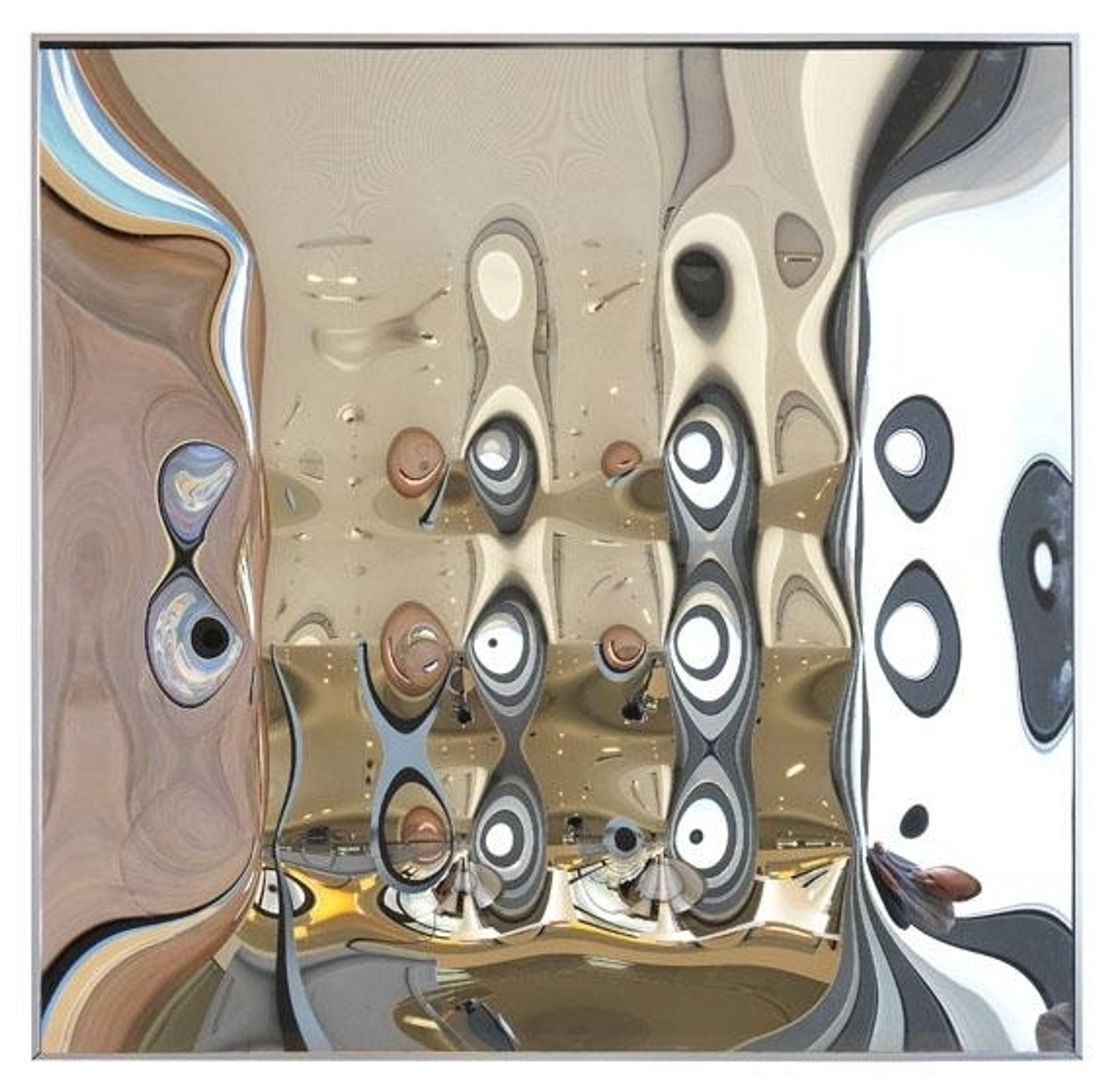
Curator: Victor Bonato’s work, this piece entitled "Grosse Glas-Spiegel-Verformung," which translates to "Large Glass Mirror Deformation," created in 1970, presents a fascinating manipulation of perception captured through photography. What strikes you immediately? Editor: There’s a dreamlike quality; almost unsettling. The distorted reflections create an altered reality. It makes me question what I'm actually seeing. Is this how institutional spaces subtly warp us? Curator: The 1970s were a time when conceptual art challenged traditional notions of art and its purpose. Bonato, as part of this movement, used photography not just to document, but to explore ideas about representation, reality, and viewer perception. The mirrored distortion reflects societal distortions, challenging normalized images of identity. Editor: I see those echoes clearly in its unsettling aesthetic, the clinical, almost sterile setting contrasting with the organic deformation of the reflections. This period also saw significant sociopolitical upheaval and calls for authenticity in how individuals are seen and represented. In a way, these manipulations invite us to confront and deconstruct imposed structures. Curator: Exactly! How do institutions - art spaces and even the mirrored, modern building it's likely photographed in - participate in shaping our sense of self? Bonato challenges our complacency and acceptance of what's considered ‘normal’ in art and the public sphere. Editor: The play with geometry, as we see in many modernist expressions, is fascinating here as well. Rather than seeking purity and clean form, Bonato actively sabotages that ideal, drawing attention to the artificiality of such imposed frameworks. We have the reflective distortion actively fighting against geometric rigidity. Curator: The very act of using a mirror implies reflection, introspection. Yet, it immediately becomes problematic by obscuring and challenging a singular “true” image. It is conceptual, and I'm still figuring out if there's beauty, too. What this artwork provokes for me, beyond mere technical skill, is thought, conversation, disagreement! Editor: And that's where it finds its lasting power, by prompting reflection not only on our reflection but on the frameworks shaping that image, as well.