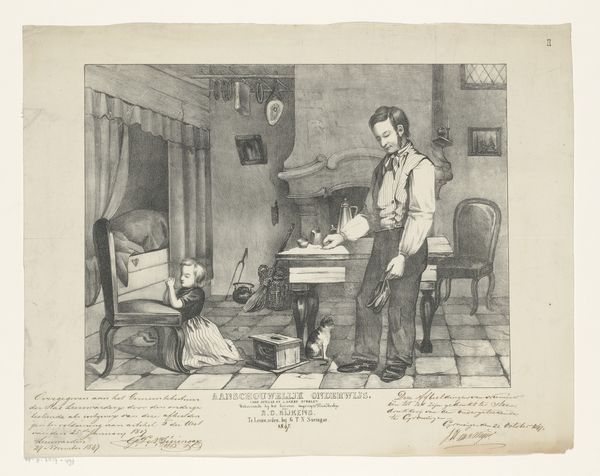
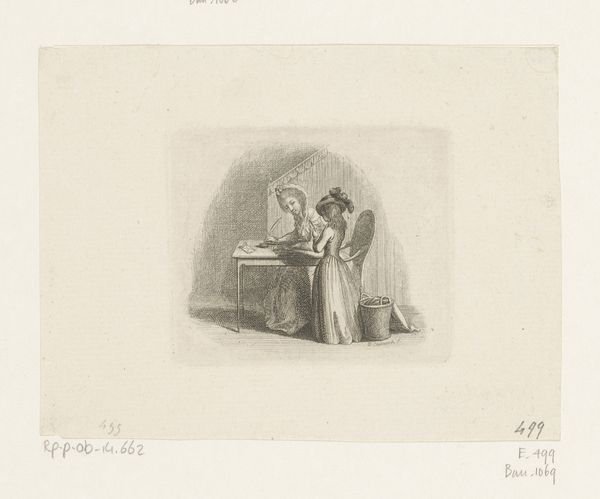
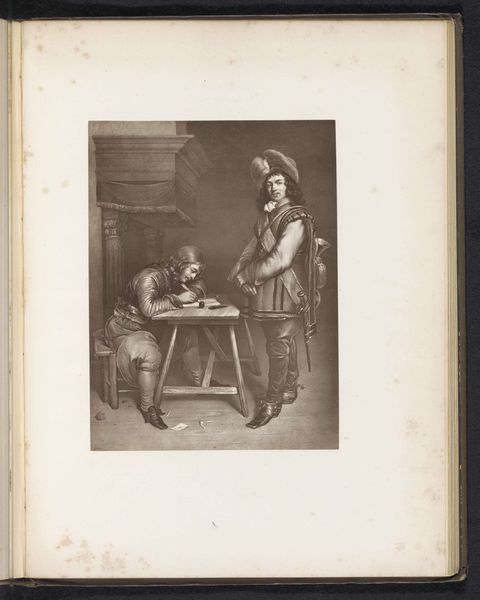
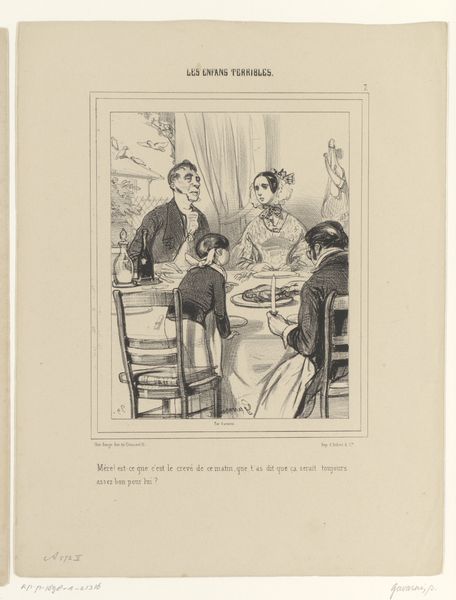
Ontwerp voor illustratie voor De Kolossus der Negentiende Eeuw door P.J. Andriessen (Textill., blz. 26); scène uit het leven van Napoleon, Interieur met Napoleon aan tafel 1877 - 1942
0:00
0:00

Dimensions: height 151 mm, width 211 mm
Copyright: Rijks Museum: Open Domain
Curator: Here we have an interesting preparatory drawing titled "Ontwerp voor illustratie voor De Kolossus der Negentiende Eeuw door P.J. Andriessen," created sometime between 1877 and 1942. It's rendered in pencil and ink, and depicts Napoleon at a table with an officer standing in a doorway. Editor: My initial impression is that this sketch exudes quiet contemplation and maybe even isolation. The monochromatic palette and the subtle shading contribute to a sense of subdued drama. Napoleon is all alone at that huge desk. Curator: Absolutely, there is definitely a psychological tension that seems so suited to pencil drawings, which often reflect a preparatory state. We see Napoleon seemingly strategizing over a map, and I think those pins carry symbolic weight. They speak of power, control, and ambition, and perhaps the burdens of leadership. Editor: Those symbols of power contrast nicely with his small, hunched figure at the enormous desk, don't you think? The table seems to go on forever. And what about the doorway? A symbolic threshold! It suggests a choice, an impending action, or perhaps the arrival of news that will alter his course. Also the man standing is in full formal dress and has a hat in his hand, it seems almost as if he's just walked into frame like someone from the wings on stage. Curator: I like that connection between the door, liminal space, choice, and stage directions. This preliminary illustration probably captures a pivotal moment, rife with symbolic potential, that could reflect both external conflicts and internal struggles. Editor: Exactly. The book to which this work belongs, "The Colossus of the Nineteenth Century," must address the tension between Napoleon’s grand persona and this man in an ordinary interior setting. The whole room almost becomes another character! The lamp looks as if it's casting a heavy burden across Napoleon's shoulders. Even though he's illuminated in the light from it, that also puts him on show as if we the viewer have pulled back a stage curtain to gaze on him. The officer in the background doesn't appear to acknowledge the man's weight, though. Curator: A fruitful examination. I’ve come to appreciate the sketch as a study in contrasts – light and shadow, power and vulnerability, presence and absence. Editor: Indeed. For me, this image serves as a potent reminder of how simple visual elements can come together to build emotional narratives. It also prompts thinking about cultural narratives of masculinity and conquest, the "symbols" of what it is to be Napoleon!
Comments
No comments
Be the first to comment and join the conversation on the ultimate creative platform.
 Collect
 React
React Comment
More like this