

c. 1860 - 1870
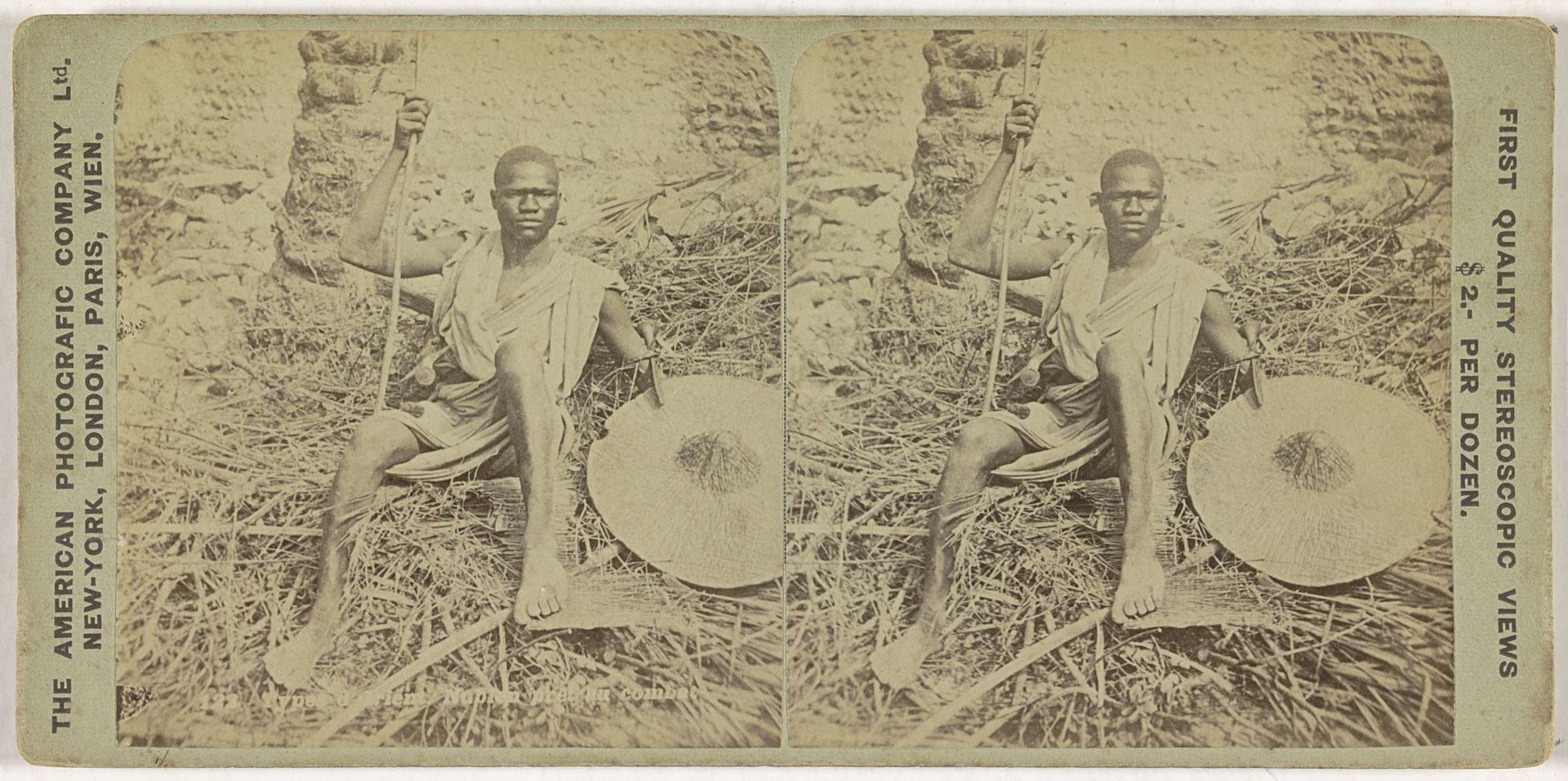
Nubische jongen klaar voor de strijd

Listen to curator's interpretation
Curatorial notes
Editor: Here we have a photograph entitled "Nubische jongen klaar voor de strijd," or "Nubian boy ready for battle," created circa 1860-1870 by an anonymous artist. It appears to be a stereoscopic print, showcasing a young man seated with a shield and spear. I find the subject's direct gaze quite arresting; it holds a weight of untold stories. What stands out to you in this piece? Curator: The power resides in the visual language. Notice the spear, not merely a weapon, but a symbol of lineage, protection, and power extending from the hand. The shield, its circular form evocative of the sun, suggests cyclical protection, regeneration and potentially a deeper spiritual dimension, a continuity of defense across generations. How does the sitter’s posture contribute? Editor: Well, he’s seated, but upright, poised, which conveys a sense of readiness. The composition almost divides him – shield on one side, spear on the other – maybe symbolizing the duality of defense and offense. Curator: Precisely. The artist positions him to embody both passivity and aggression – it begs the question, which posture dominates, and what cultural significance might be conveyed? Consider the broader context: a Western audience viewing this image likely brings their own colonial lens, potentially misinterpreting the symbolic language. It’s vital to unpack those loaded assumptions. Editor: It makes you think about the power dynamics inherent in the creation and reception of such images. What does this photograph, intended for stereoscopic viewing, truly *show* versus what does it *tell* us about the West’s perception of the "Other"? Curator: Exactly! The power isn't just in the image itself, but in how it interacts with our collective memories and preconceived notions. Symbols are potent because they evolve through history and human psychology, carrying a narrative that exceeds the literal representation. Editor: Thank you, this opens up a new dimension of understanding about the cultural weight these symbols carry.