drawing, painting, watercolor
#
drawing
#
water colours
#
painting
#
watercolor
#
geometric
#
watercolour illustration
#
academic-art
#
decorative-art
#
watercolor
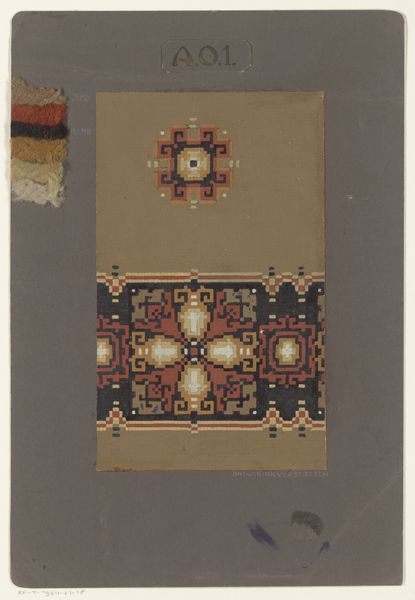
Dimensions: overall: 35.6 x 27.8 cm (14 x 10 15/16 in.) Original IAD Object: 12"x12"approx.
Copyright: National Gallery of Art: CC0 1.0
Curator: Looking at "Wall Decoration, on Adobe Ranch House" by Frank C. Barks, created around 1939, makes me think of those faded photographs where everything's sepia-toned, a ghost of color hinting at warmth. What strikes you initially? Editor: It’s surprisingly calming. There's this quiet order, a layered effect of geometric designs. But the monochromatic palette gives it a sort of nostalgic gentleness; a design muted by time, almost whispering stories of the past. Curator: Barks was a master of subtle nuance. Notice the way he uses watercolors. This piece provides a wonderful snapshot into how domestic spaces were being imagined and decorated in the Southwest. We see three distinct bands: an intricately patterned upper section, a central band composed of simple but stylish cubes, and a solid color at the base. Editor: Absolutely. You know, seeing this makes me think about the Arts and Crafts movement, which celebrated handcraftsmanship. There's a very satisfying balance between utility and visual pleasure here, even though this is “just” a design study. It's almost as if Barks wants you to linger, considering each deliberate decision. Curator: It is. It highlights an interesting shift towards more simplified, geometric forms that were finding their place in American homes. It's a step away from fussy Victorian decor toward a cleaner, more functional aesthetic. The deliberate inclusion of it being for an adobe ranch house signals the beginnings of distinctly American style, drawing on Native American and Mexican design influences. Editor: It makes me wonder how this design choice affects perceptions of Southwestern culture and how they were being packaged. I bet a ranch house decked out in a repeating geometric pattern sent a strong signal, didn’t it? Curator: Indeed, it played into and reshaped it. And let's not forget the politics of aesthetics – who decides what is "authentic," what is "beautiful," and what gets represented in museums? Editor: Food for thought, as always. Thanks for pointing out how one's home reflects this struggle, turning one's four walls into something more layered. Curator: It shows how even the seemingly simplest artwork can open up conversations about cultural identity, and design's role in it.
Comments
No comments
Be the first to comment and join the conversation on the ultimate creative platform.
 Collect
 React
React Comment
More like this