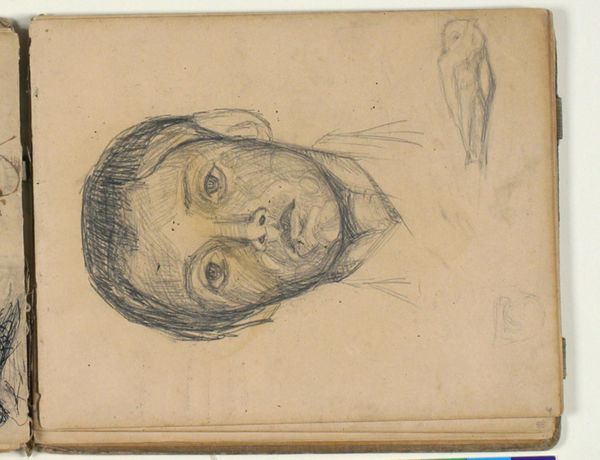
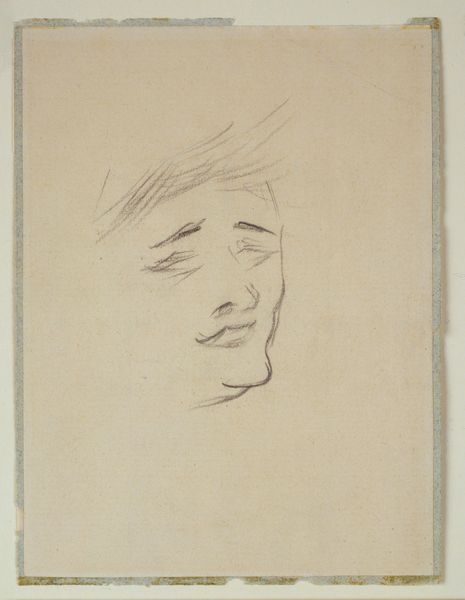
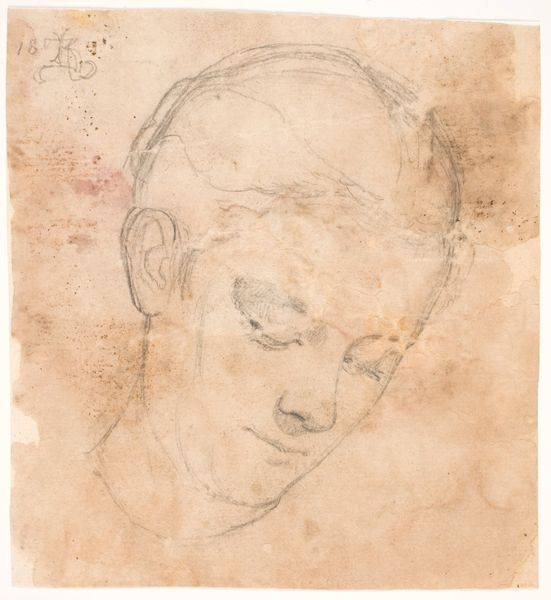
Head of a Tahitian with Profile of Second Head to His Right 1891 - 1893
0:00
0:00


Dimensions: 352 × 369 mm
Copyright: Public Domain
Curator: This captivating drawing, rendered in chalk and charcoal, is entitled "Head of a Tahitian with Profile of Second Head to His Right," a work by Paul Gauguin from around 1891-1893. It’s currently held at the Art Institute of Chicago. Editor: The immediate impression is one of understated power, isn’t it? The warm tone of the paper seems to contain and concentrate the sitter's energy, despite the softness of the lines. The chalk and charcoal are such yielding materials, yet they communicate such directness here. Curator: Absolutely. And look at how Gauguin has deployed two distinct profiles. The main head, seen frontally, carries a resolute gaze, while the secondary, ghostly profile seems to hint at an internal world, a shadow self maybe? Editor: The repetition definitely suggests layers. Thinking about the material production, this was made on paper. Paper meant for sketches, quick works, portability… Gauguin was far from home when he made it. The paper itself is part of a colonial project that connected Tahiti to France. Curator: A provocative point. Speaking of the figure's identity, he is, presumably, Tahitian. How do you read Gauguin's rendering? Does it exoticize or engage authentically? I am drawn to the clear emphasis on this man’s thoughtful character and his deep sense of dignity. Editor: That's complicated. Even these humble materials would have been imported. And we know the image then circulates *back* to France. This face, this Tahitian man, becomes a commodity. Still, you are right. There is nuance. The materials betray a quickness, as though trying to capture something fleeting and human. It is compelling to note the skill with which Gauguin manipulates chalk and charcoal, pushing the boundaries of these modest materials. Curator: Yes, precisely the point. This "humble" drawing becomes something much more than simply preparatory. Gauguin imbues this study with presence. He elevates the Tahitian subject and in doing so offers us a compelling, lasting image. Editor: Considering the way the portrait was created opens avenues to thinking through colonial complexities inherent in both materials and distribution, it highlights Gauguin’s critical positioning in relation to both art and commerce.
Comments
No comments
Be the first to comment and join the conversation on the ultimate creative platform.
 Collect
 React
React Comment
More like this