About this artwork
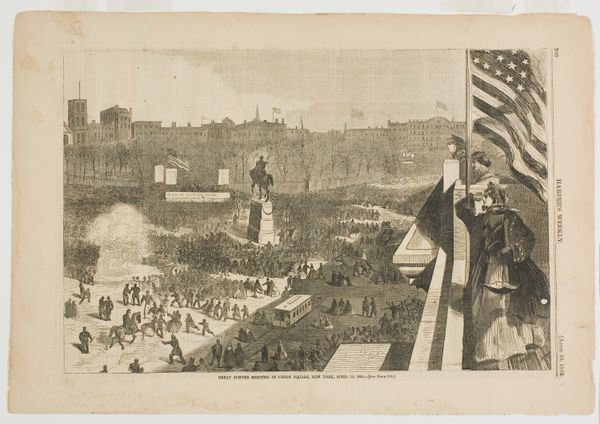
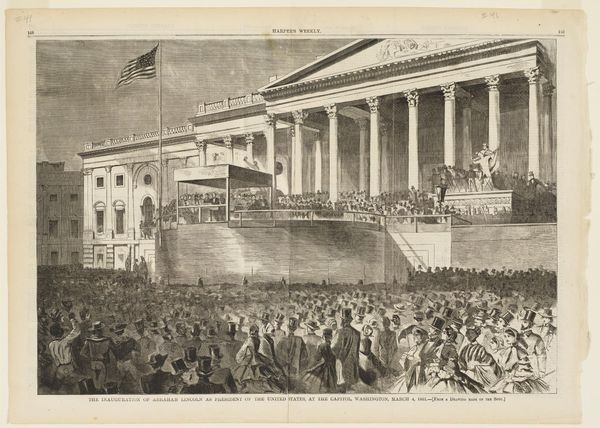
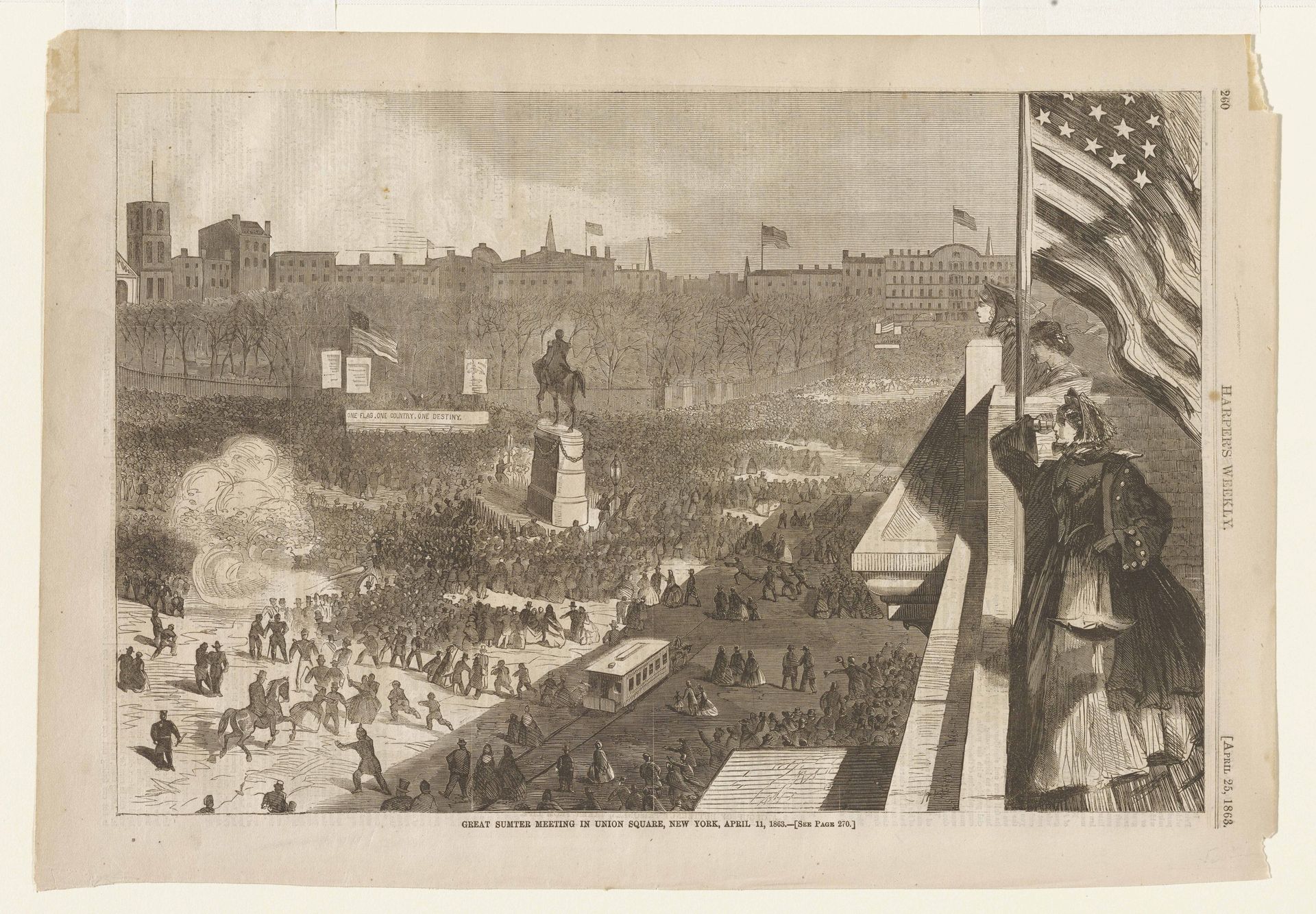
Curator: Winslow Homer’s 1863 wood engraving, "The Great Sumter Meeting in Union Square," presents a fascinating snapshot of Civil War era public sentiment. Editor: It’s immediately striking, this crowded composition! Almost claustrophobic. All these tiny figures compressed together… It gives you a real sense of the mass of people involved. And the hazy smoke, like something’s brewing just beneath the surface. Curator: Exactly. What's happening, in brief, is this. After the bombardment of Fort Sumter, a massive patriotic rally was staged in New York's Union Square. It was a deliberate display of Northern resolve. The location, the flags, the speeches all contributed to that political statement. Editor: It's interesting how Homer chose wood engraving. Think about the labor involved: cutting away at the wood, line by painstaking line. The image could then be reproduced at scale in Harper’s Weekly. A medium that allows a message of Union to be easily and rapidly circulated amongst a broad readership. Curator: Absolutely, the circulation is key. Prints like these shaped public opinion and bolstered support for the war effort, particularly amongst urban populations. But the composition itself plays a role too. The image flattens the crowds, suggesting unanimity, though we know there was far more political and social complexity. Editor: You see it too in the materiality: the stark contrast between light and shadow. The image doesn’t just illustrate, it also manufactures a certain moral clarity. There's the mass production of patriotic fervour right there! The medium itself promotes a singular, unwavering point of view. Curator: Indeed. The artwork reflects and reinforces the period’s nationalistic fervor. Homer subtly uses visual devices to promote a message of unified resolve amidst national crisis. Editor: Looking closely reveals how the artist has managed the making and distribution of collective feeling. It's not simply about recording a historical event but engineering consent through material means. Curator: It leaves you pondering on the profound intertwining between politics and representation, right? Editor: For sure. An insightful example of the war being waged not just on the battlefield but also through print culture.
The Great Sumter Meeting in Union Square
1863


Artwork details
- Medium
- print, woodcut, wood-engraving, engraving
- Dimensions
- 13 3/4 x 9 1/8 in. (34.9 x 23.2 cm)
- Location
- Minneapolis Institute of Art
- Copyright
- Public Domain
Tags
Comments
Share your thoughts
About this artwork
Curator: Winslow Homer’s 1863 wood engraving, "The Great Sumter Meeting in Union Square," presents a fascinating snapshot of Civil War era public sentiment. Editor: It’s immediately striking, this crowded composition! Almost claustrophobic. All these tiny figures compressed together… It gives you a real sense of the mass of people involved. And the hazy smoke, like something’s brewing just beneath the surface. Curator: Exactly. What's happening, in brief, is this. After the bombardment of Fort Sumter, a massive patriotic rally was staged in New York's Union Square. It was a deliberate display of Northern resolve. The location, the flags, the speeches all contributed to that political statement. Editor: It's interesting how Homer chose wood engraving. Think about the labor involved: cutting away at the wood, line by painstaking line. The image could then be reproduced at scale in Harper’s Weekly. A medium that allows a message of Union to be easily and rapidly circulated amongst a broad readership. Curator: Absolutely, the circulation is key. Prints like these shaped public opinion and bolstered support for the war effort, particularly amongst urban populations. But the composition itself plays a role too. The image flattens the crowds, suggesting unanimity, though we know there was far more political and social complexity. Editor: You see it too in the materiality: the stark contrast between light and shadow. The image doesn’t just illustrate, it also manufactures a certain moral clarity. There's the mass production of patriotic fervour right there! The medium itself promotes a singular, unwavering point of view. Curator: Indeed. The artwork reflects and reinforces the period’s nationalistic fervor. Homer subtly uses visual devices to promote a message of unified resolve amidst national crisis. Editor: Looking closely reveals how the artist has managed the making and distribution of collective feeling. It's not simply about recording a historical event but engineering consent through material means. Curator: It leaves you pondering on the profound intertwining between politics and representation, right? Editor: For sure. An insightful example of the war being waged not just on the battlefield but also through print culture.
Comments
Share your thoughts