

1845
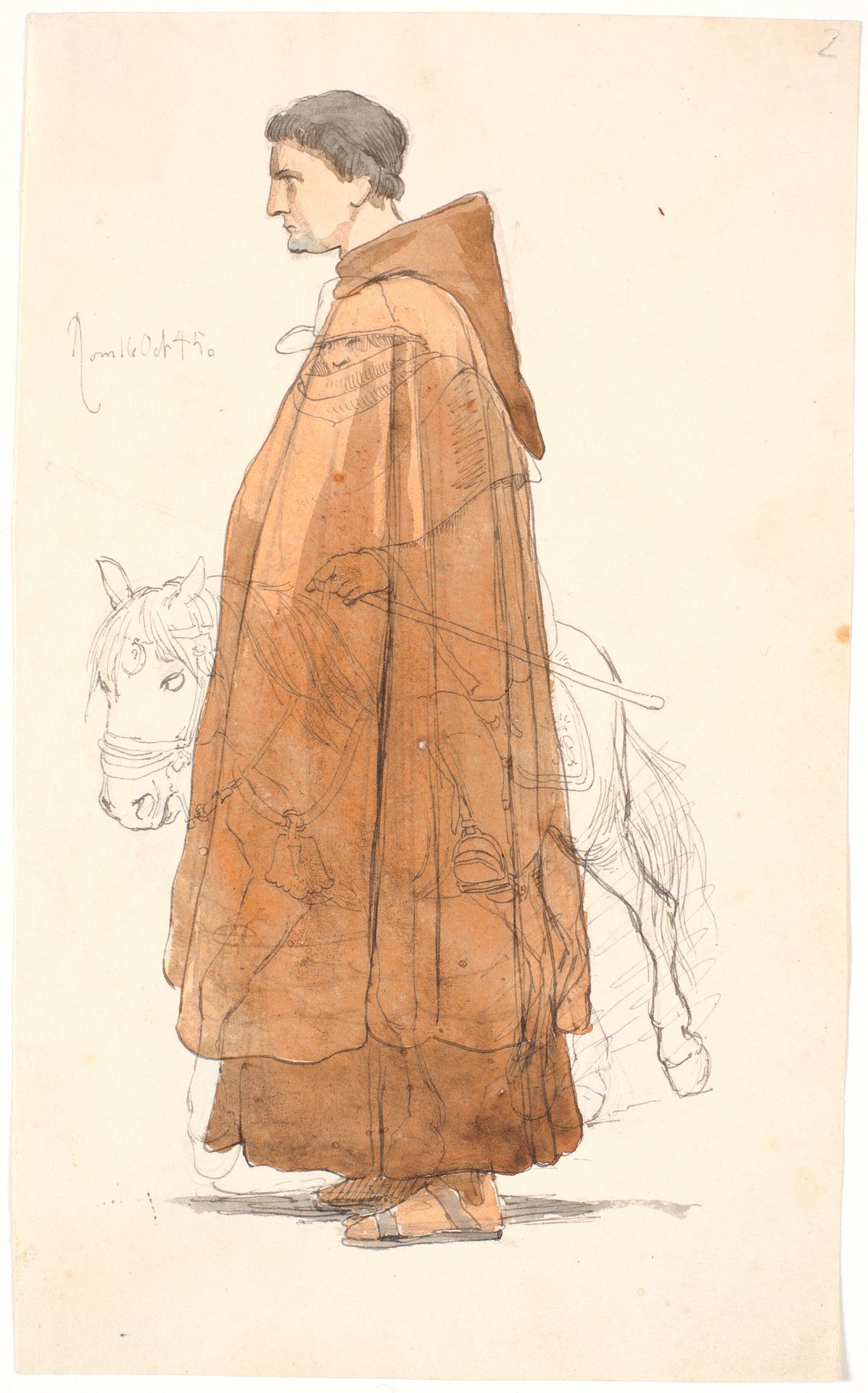
Ung franciskanermunk, stående i profil, ovenpå er der tegnet en ridende campagnol


Listen to curator's interpretation
Curatorial notes
Curator: Here we have a captivating watercolor drawing from 1845 by Johan Thomas Lundbye titled "Young Franciscan Monk, Standing in Profile, on top of which is drawn a Riding Campagnol", currently held at the SMK, the National Gallery of Denmark. Editor: It feels intimate, almost like peering into a personal sketchbook. The muted watercolor wash gives it a gentle, dreamlike quality, while the pencil lines maintain a delicate precision. Curator: Precisely! Lundbye was deeply engaged with the romantic nationalism sweeping through Denmark at the time. He captured landscapes and everyday life of the rural population. Monastic orders would have held complex symbolic importance at that historical juncture. They connected to notions of tradition, authority, as well as religious duty. Editor: I'm intrigued by the almost spectral horse drawn behind the monk. Its form is incomplete and faint, suggesting a secondary thought. This positioning begs the question – is it simply an afterthought, or does the ghostly presence speak to the monk's journey? His mental landscape perhaps? The lines, even incomplete, suggest incredible care and attention to anatomical correctness. Curator: That's a very astute observation. Lundbye was, after all, known for his close observation of nature and his precise renderings of animals, landscapes, and even fashion, all elements he would study directly and incorporate into larger history paintings. What could be more politically symbolic than capturing the presence of religious figures engaged in this sort of mundane moment. Editor: Agreed, and in purely formal terms, the warm tone of the monk's habit contrasts against the almost invisible coolness of the horse. The texture is striking. I see fine washes layered to create depth on his brown habit. There are a number of stylistic and iconographic complexities. Curator: We're offered a glimpse into the visual culture of the period and, crucially, how the observer or the museum-goer actively participates in shaping interpretations, whether intended or unintended by Lundbye himself. Editor: This quiet artwork speaks volumes—an incredible fusion of form and cultural awareness. Curator: Indeed, the intersection of faith, nationalism, and the Danish artistic tradition makes for a particularly powerful piece.