

before 2002
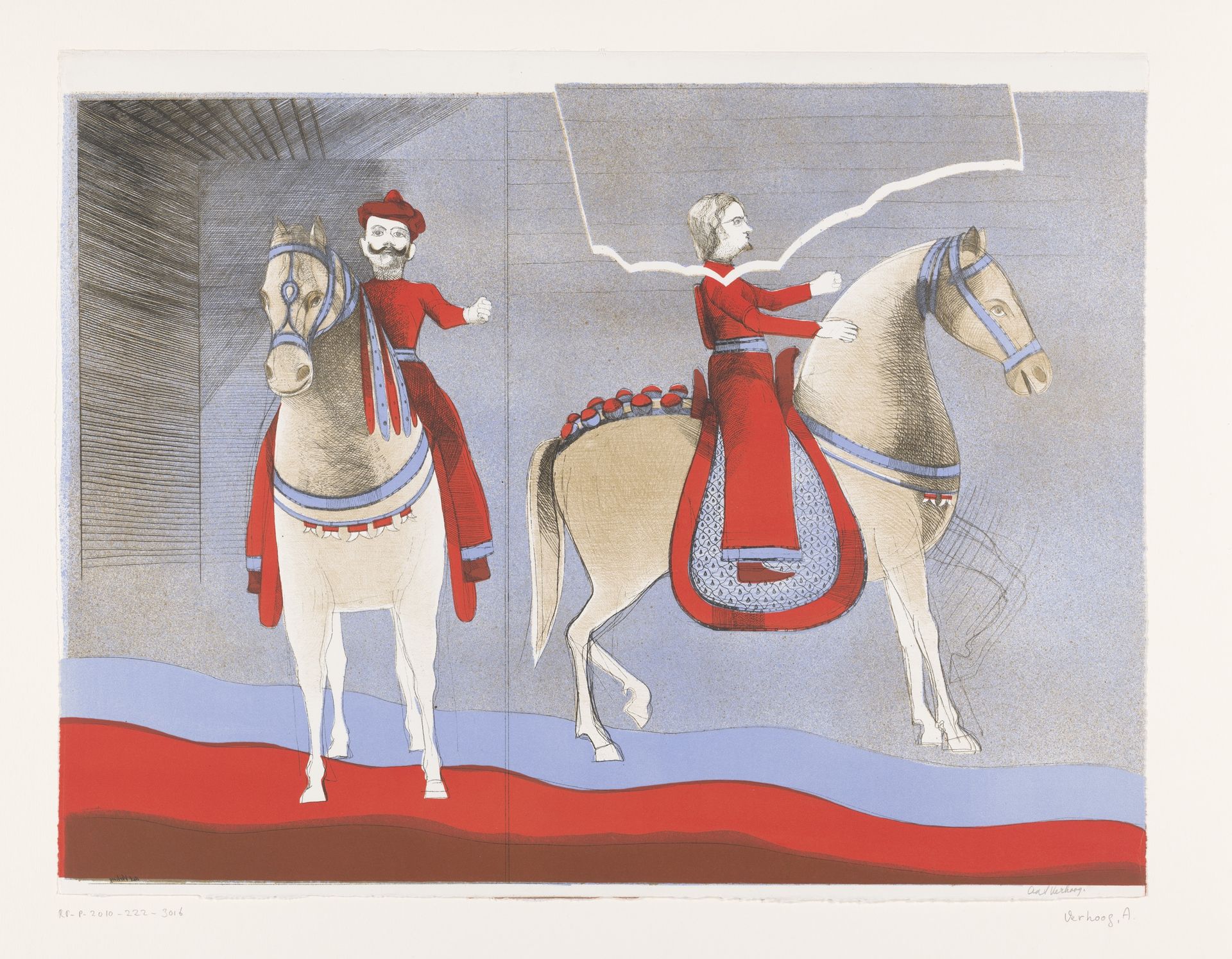
Man in rood op paard

Aat Verhoog
1933Location
RijksmuseumListen to curator's interpretation
Curatorial notes
Curator: Here we have Aat Verhoog's print, "Man in Rood op Paard," or "Man in Red on Horse," created before 2002. It’s currently held here at the Rijksmuseum. The work combines etching and other graphic techniques on paper. Editor: The red pops out, doesn't it? The subjects are presented flatly, with sharp geometric forms. It strikes me as simultaneously playful and unnerving. The colors create a sense of tension and something not being right with the whole picture. Curator: What I find so interesting is how Verhoog is working with established artistic traditions, like equestrian portraiture, yet disrupting them with this distinct stylized rendering. He certainly subverts any expectation of idealized heroic portrayal! Editor: Absolutely. It feels like a comment on the theatricality of power. Are these men figures of authority, or are they simply performers in elaborate costumes? Curator: Considering art history, we often see such equestrian portraits used to convey status and legitimacy. It was a popular trope for centuries to legitimize monarchs! In this piece, however, it becomes a display – even a spectacle. The flatness flattens out the subject entirely as an image rather than an ideal to admire. Editor: And that flatness is enhanced by the color palette, with the use of that striking red against a cooler background. What does this stark red conjure in our understanding of these men? What type of social or political position do they have in the world and how does this print enhance or undermine their authority? Curator: This artwork exists beyond any fixed meaning. It challenges us to confront and reimagine our expectations of power and representation. Verhoog offers us a scene of both historical precedent and a critique of modernity, inviting discourse rather than prescribing an explicit interpretation. Editor: A wonderful, challenging piece that stays with you, prompting questions about history, identity, and representation.