About this artwork
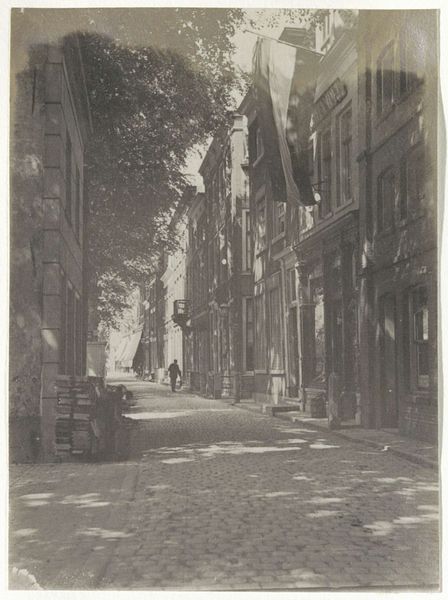
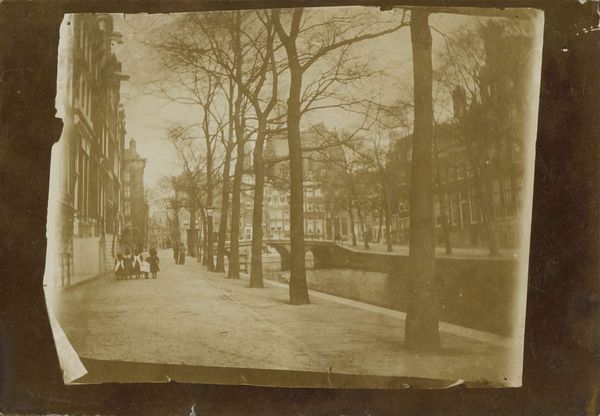
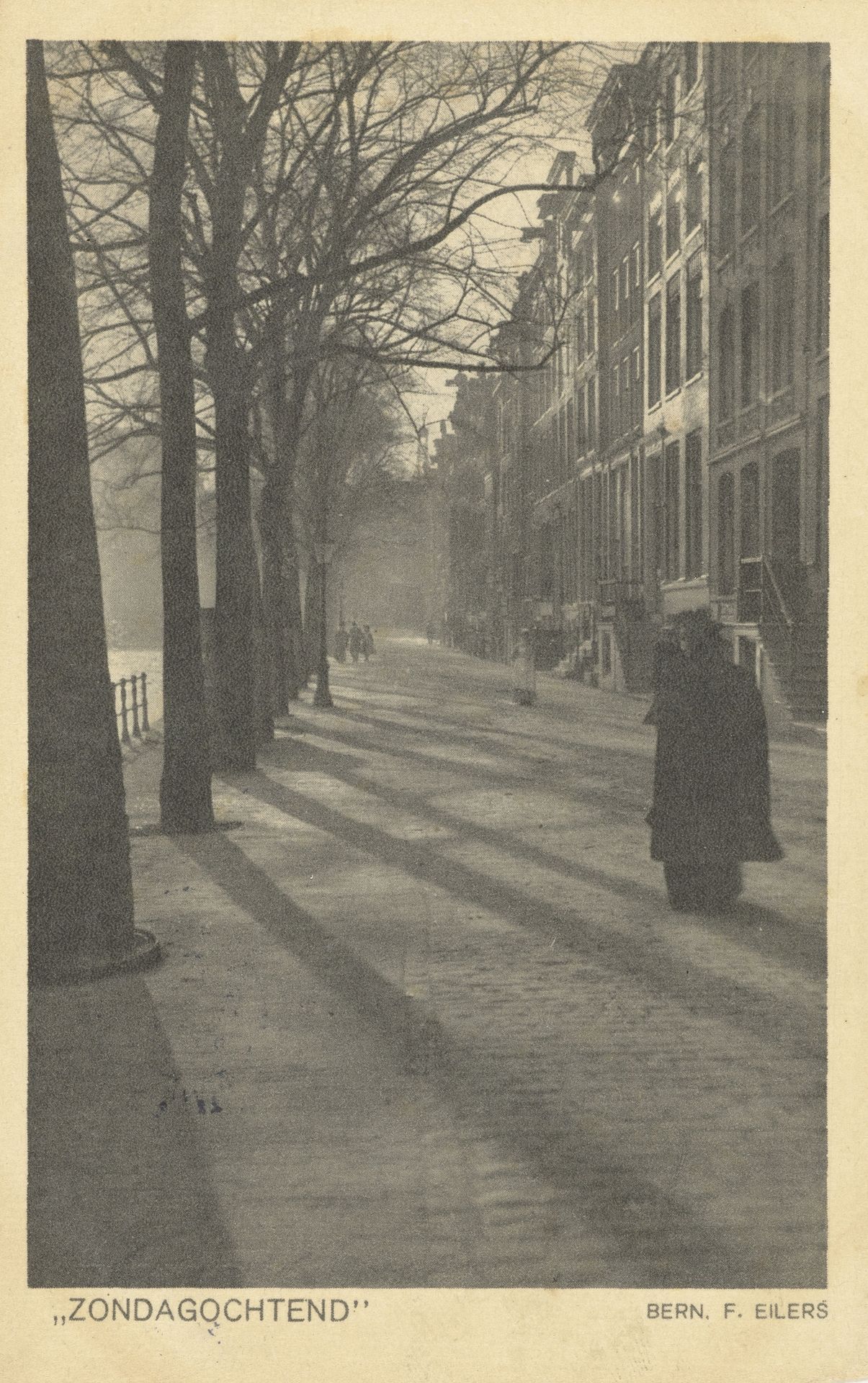
Editor: We’re looking at “De Singel in Amsterdam,” a photograph by Bernard Eilers, taken sometime between 1913 and 1926. It’s a monochromatic scene, and it feels so quiet and still. The shadows of the trees really dominate the composition. How do you interpret this work? Curator: It strikes me immediately as an image steeped in memory and the symbolic weight of the city itself. Consider the very name "Singel"—it refers to a canal, but it also resonates with a sense of singularity, of something distinct and perhaps even solitary. Notice the lone figure walking away from us? Does that evoke the past? How about the future? Editor: That’s interesting. I was just seeing it as a nice street scene, but I see what you mean about the solitary figure. Curator: Eilers’ decision to capture this on a presumably quiet Sunday morning amplifies that feeling. Sunday mornings often carry cultural associations of rest, reflection, and even religious observance, right? What does it feel like the person is turning their back on? Or heading toward? Editor: I guess I hadn't thought of that. Maybe the buildings represent history and the person is going towards some foggy, unknown future, symbolized by the end of the street? Curator: Precisely. And consider the technique itself. The soft focus and tonal range typical of pictorialism evoke a certain nostalgia, a yearning for a simpler past perhaps? In terms of symbolic imagery, this isn't simply a street; it’s a pathway through time, etched with cultural memory. Editor: Wow, I definitely have a richer understanding now, thinking about it as a path through time rather than just a photograph of a street. Curator: Indeed, the photograph allows us to reflect on how visual symbols hold deep cultural meaning. It also prompts introspection about continuity from the past through the present, potentially illuminating pathways to the future.

Artwork details
- Medium
- photography
- Dimensions
- height 140 mm, width 90 mm
- Copyright
- Rijks Museum: Open Domain
Tags
Comments
Share your thoughts
About this artwork
Editor: We’re looking at “De Singel in Amsterdam,” a photograph by Bernard Eilers, taken sometime between 1913 and 1926. It’s a monochromatic scene, and it feels so quiet and still. The shadows of the trees really dominate the composition. How do you interpret this work? Curator: It strikes me immediately as an image steeped in memory and the symbolic weight of the city itself. Consider the very name "Singel"—it refers to a canal, but it also resonates with a sense of singularity, of something distinct and perhaps even solitary. Notice the lone figure walking away from us? Does that evoke the past? How about the future? Editor: That’s interesting. I was just seeing it as a nice street scene, but I see what you mean about the solitary figure. Curator: Eilers’ decision to capture this on a presumably quiet Sunday morning amplifies that feeling. Sunday mornings often carry cultural associations of rest, reflection, and even religious observance, right? What does it feel like the person is turning their back on? Or heading toward? Editor: I guess I hadn't thought of that. Maybe the buildings represent history and the person is going towards some foggy, unknown future, symbolized by the end of the street? Curator: Precisely. And consider the technique itself. The soft focus and tonal range typical of pictorialism evoke a certain nostalgia, a yearning for a simpler past perhaps? In terms of symbolic imagery, this isn't simply a street; it’s a pathway through time, etched with cultural memory. Editor: Wow, I definitely have a richer understanding now, thinking about it as a path through time rather than just a photograph of a street. Curator: Indeed, the photograph allows us to reflect on how visual symbols hold deep cultural meaning. It also prompts introspection about continuity from the past through the present, potentially illuminating pathways to the future.
Comments
Share your thoughts