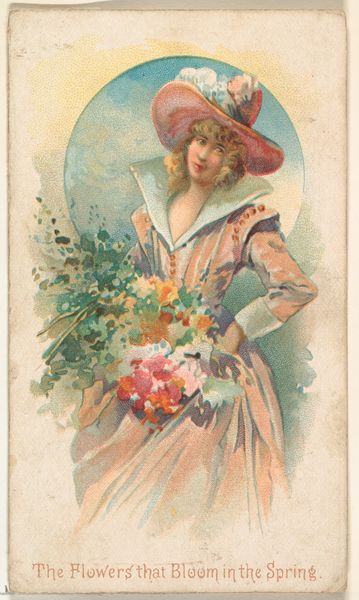
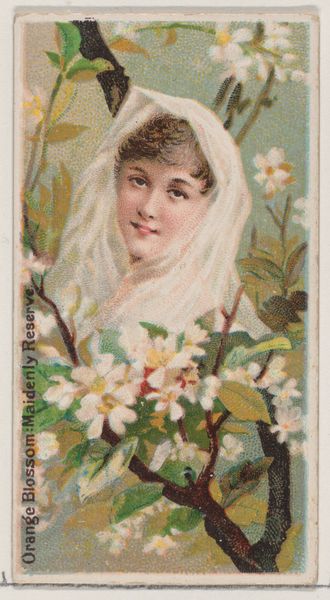
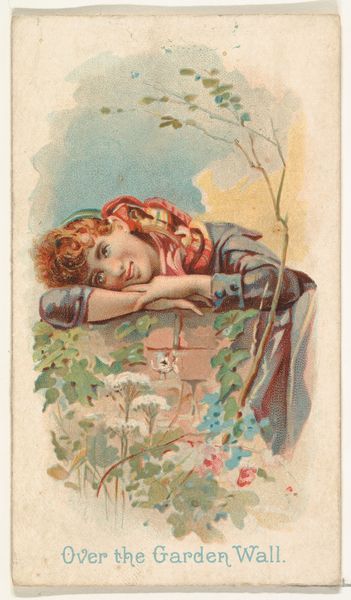
Decoration Day, United States, from the Holidays series (N80) for Duke brand cigarettes 1890
0:00
0:00


drawing, print
#
portrait
#
drawing
# print
#
impressionism
#
figuration
Dimensions: Sheet: 2 3/4 x 1 1/2 in. (7 x 3.8 cm)
Copyright: Public Domain
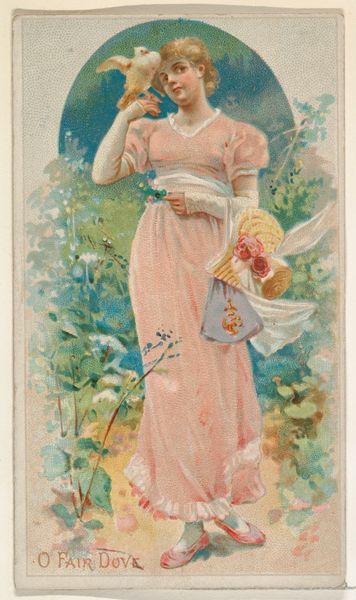
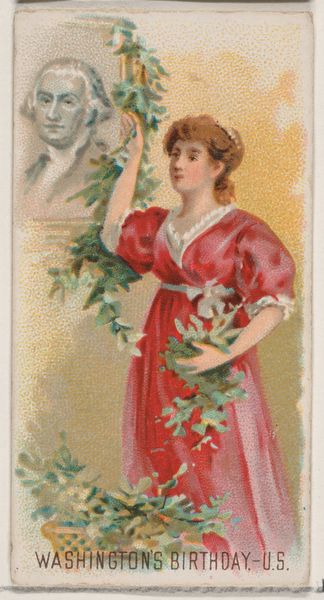
Editor: This chromolithograph from 1890 by W. Duke, Sons & Co. is called "Decoration Day, United States." The soft colours and the elegant woman arranging flowers evoke a sense of serene gentility. What does it say to you? Curator: This card, intended as a premium item to promote Duke brand cigarettes, reflects a specific moment in American consumer culture. Its existence tells us a great deal about the industrial printing processes available, the target demographic of smokers, and how the idealized image of women and remembrance was used to market a product. Consider the materiality: mass-produced paper, cheap inks...how does this contrast with the delicate subject matter? Editor: So you are saying that the material used and its function as advertisement shapes how we interpret its representation of Decoration Day? Curator: Precisely. How the image was consumed speaks to the priorities and aspirations of the era. The card trivializes mourning by packaging it with tobacco consumption and collectible consumerism. Look closely: even the idealized lady embodies a capitalist ideal by buying in to fashion trends. Do you see now how its material existence gives us context for social class at the time? Editor: Absolutely! It's interesting to consider it not just as a pretty image, but as a commodity produced within a specific system. It reveals how manufacturers contributed to shaping values. Curator: It is the connection of industrial materials and practices that enable an intimate look into an artistic choice that serves the cultural norm and economic success of a corporation. Editor: Thanks. I'll never see these old advertising cards the same way. Curator: Nor will I. Thinking of materials, manufacturing and intended user will inform my perspective from now on.
Comments
No comments
Be the first to comment and join the conversation on the ultimate creative platform.
 Collect
 React
React Comment
More like this