Dimensions: 60 x 72 cm
Copyright: Public domain US
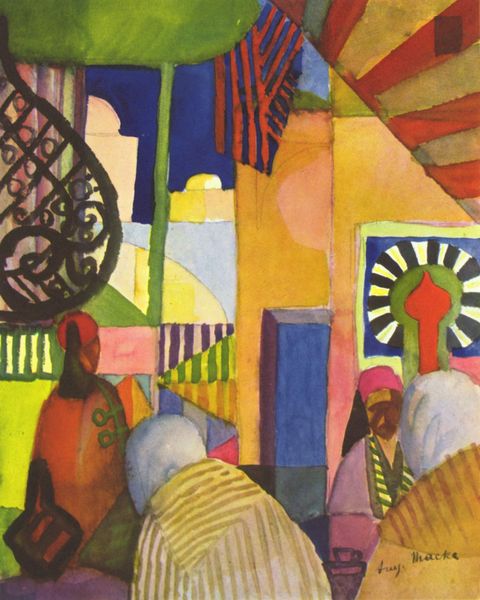
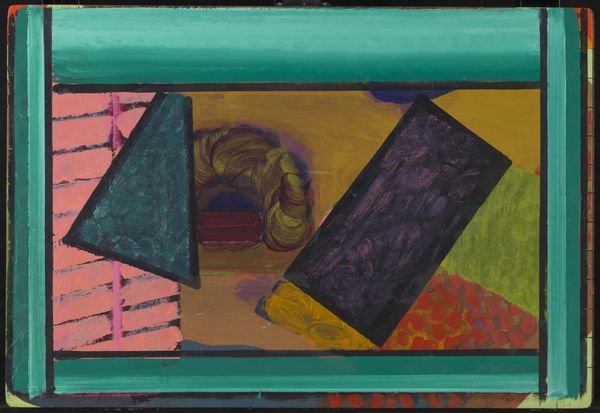
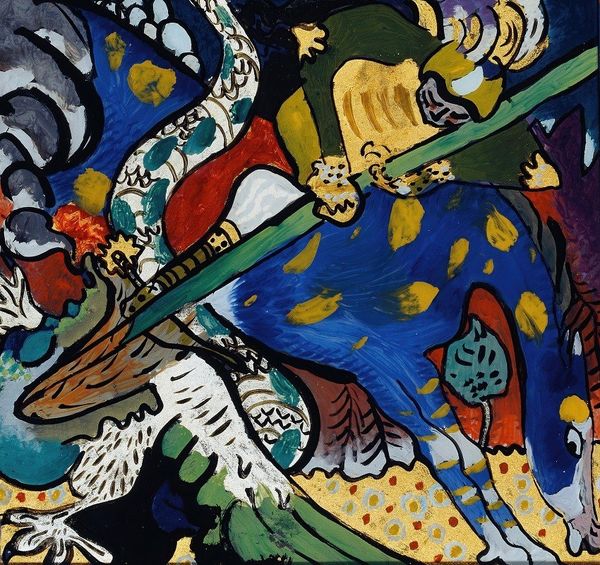
Curator: Martiros Sarian's "Fruit Shop," painted in 1910, immerses us in a vibrant marketplace scene rendered with oil paints. Editor: It has a decidedly dreamlike quality, almost fauvist with that intensity of color. The forms are simplified, bordering on abstraction, which lends a certain primitive charm. Curator: Absolutely. Sarian’s work demonstrates a fascination with orientalism that blends Post-Impressionistic techniques. Look at how he uses color; bold oranges and greens outline shapes creating texture and depth. It almost feels flattened. Editor: That flattening actually strengthens the image by reinforcing the interplay of color and form. It's more about suggestion than photographic realism. We see how this era encouraged artists to evoke feelings and ideas rather than create faithful records. But what do we make of this vendor figure, almost incidental to this array of color? Curator: Here is an important symbol; Sarian spent much of his time examining Armenia's place between Europe and Asia, specifically as it moved into modernism. That vendor has a red Fez, representing Ottoman occupation and foreign rule. What at first seemed a "charming" painting in fact challenges foreign cultural imposition in Armenia through this tension. Editor: That reading truly expands the context of the entire piece, making us question this “exoticism” of place in modern European Art as, in itself, a culturally-imposed fantasy. Sarian turns that dynamic inside out through the construction of form and detail. Curator: Indeed, and through its use of a limited palette which directs our gaze toward the politics represented in the space itself. Editor: I am drawn back to how seemingly simple forms belie complex and important interactions in the culture of turn-of-the-century Europe.
Comments
No comments
Be the first to comment and join the conversation on the ultimate creative platform.
 React
React Comment