drawing, paper, ink-on-paper, ink
#
drawing
#
asian-art
#
landscape
#
figuration
#
paper
#
ink-on-paper
#
ink
Dimensions: 12 × 48 1/4 in. (30.5 × 122.6 cm) (image, left, calligraphy)12 × 144 in. (30.5 × 365.8 cm) (image, right, painting)
Copyright: Public Domain
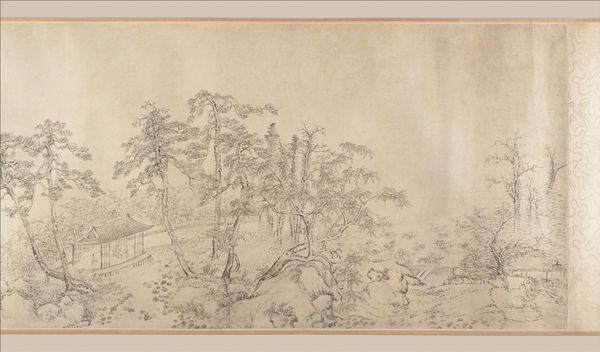
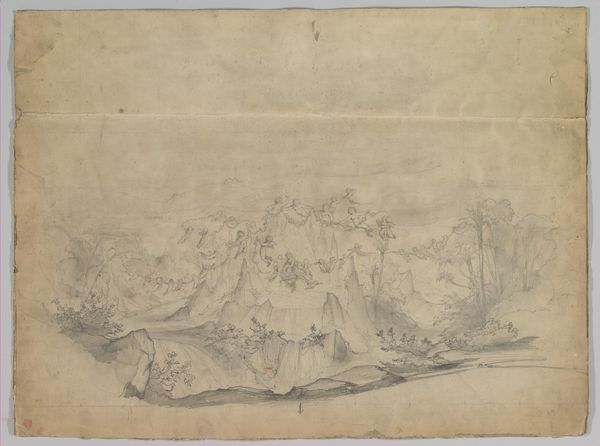
Curator: Welcome! Today, we're looking at “Nymph of the Luo River,” an ink-on-paper drawing created around 1591 by Wang Shanggong. It's currently held in the Minneapolis Institute of Art collection. Editor: It has a dreamlike quality, almost faded, like a memory surfacing. The monochromatic ink wash lends a spectral feel to the landscape and the ethereal figure. Curator: Absolutely. The Nymph is a figure of immense cultural significance, derived from a famous rhapsody written in the third century. Depicting her became a tradition to display erudition and refined artistic sensibility. The landscape style itself speaks to literati painting, valuing subtlety and intellectual expression over photorealistic representation. Editor: So, this work presents not just the image of a mythical being but also reinforces a very specific construction of ideal scholar-artist, male, in conversation with established classics. Curator: Precisely. Artists often navigated political landscapes through coded visual language. What appears as simple, elegant imagery frequently holds layers of social meaning, aimed at communicating power and values within elite circles. Editor: It's interesting to consider what stories aren’t being told through this aesthetic tradition. How might different voices have interpreted the nymph, if given space to visualize her on their own terms? This refined ink-wash technique risks idealizing and distancing the actual socio-economic conditions that were very real at the time. Curator: Well, this aesthetic, with its subtle beauty, does reveal how powerful patronage could shape the narrative. By understanding this drawing, and ones similar, we can examine art's engagement with those power dynamics. It's not about dismissing the work, but enriching the viewer experience to allow for diverse points of analysis. Editor: A vital approach that asks what gets remembered and whom that remembering serves. Curator: Exactly! Thank you for that, let’s move along to our next exhibit!
Comments

minneapolisinstituteofart over 2 years ago
⋮
The classical narrative poem “Nymph of the Luo River,” written by Cao Zhi (192–232 CE), is the subject of this elegantly brushed handscroll. The story recounts an unsuccessful love affair between a poet and a river goddess. The verse, one of the standards of Chinese literature, became a favorite subject of painters. Attached to the painted portion of this scroll is a transcription of the “Nymph of the Luo River” by the late-Ming calligrapher Gu Mengyu, dated 1654. The painting is executed in the “fine-line” technique called baimiao. Although the style demands extraordinary brush control, Wang alternated areas of dry, textured brushwork with even, wirelike lines to add a sense of spontaneity and liveliness to the composition. Only a few paintings by Wang Shanggong reside in Western collections.


Join the conversation
Join millions of artists and users on Artera today and experience the ultimate creative platform.
 Collect
More like this