

2017
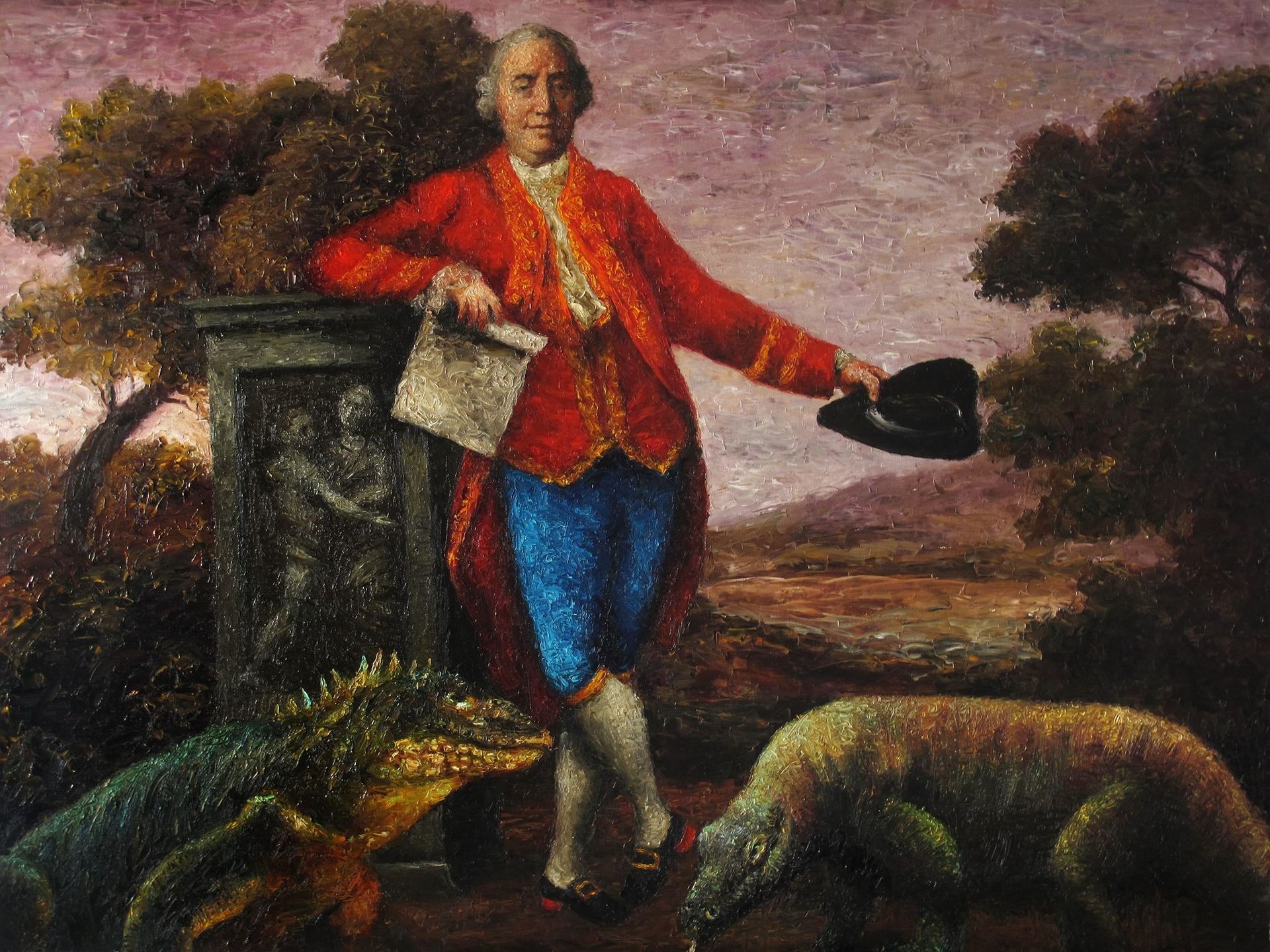
Empirical Subjects of David Hume

Listen to curator's interpretation
Curatorial notes
Alexander Roitburd made this painting, Empirical Subjects of David Hume, using oil on canvas, likely sometime in the early 2000s. In it, we see the Scottish Enlightenment philosopher David Hume surrounded by images and, rather bizarrely, reptiles that evoke the concept of empiricism. Roitburd's work, often associated with Ukrainian postmodernism, frequently blends historical references with contemporary social commentary. Hume's philosophy, emphasizing experience and observation as sources of knowledge, is visually represented here through these empirical subjects. The inclusion of lizards and the statue alludes to observing and categorizing the natural world, a key aspect of empirical thought. Painted after the collapse of the Soviet Union, the work also prompts reflection on Ukraine's re-evaluation of its intellectual history and its relationship to Western philosophical traditions. Roitburd uses his canvas to challenge viewers to re-examine the Enlightenment and its legacy in a post-Soviet context. To understand Roitburd’s painting more fully, one can delve into writings on Ukrainian postmodernism, the history of Western philosophy in Eastern Europe, and the institutional context that shaped the artist's work.