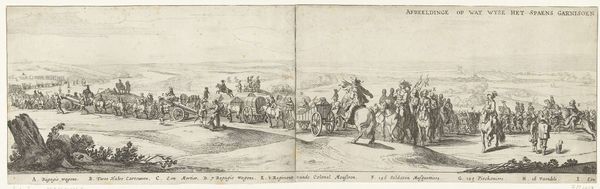
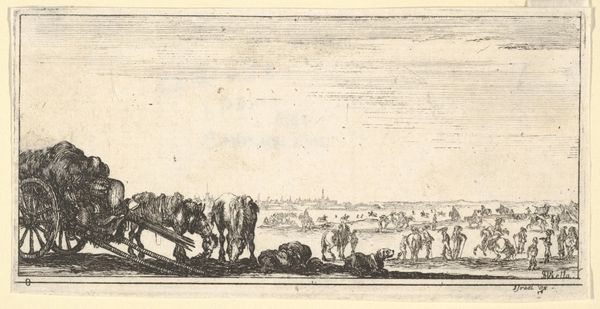
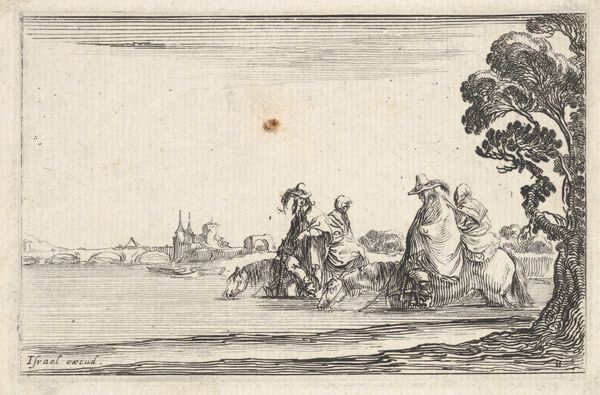
Vertrek van het Spaanse garnizoen uit Huis te Gennep (linkerhelft), 1641 1641
0:00
0:00

balthasarfloriszvanberckenrode
Rijksmuseum
print, engraving
#
baroque
# print
#
landscape
#
line
#
cityscape
#
history-painting
#
engraving
Dimensions: height 141 mm, width 396 mm
Copyright: Rijks Museum: Open Domain
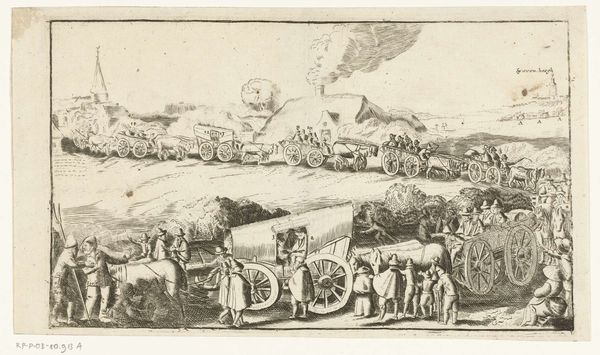
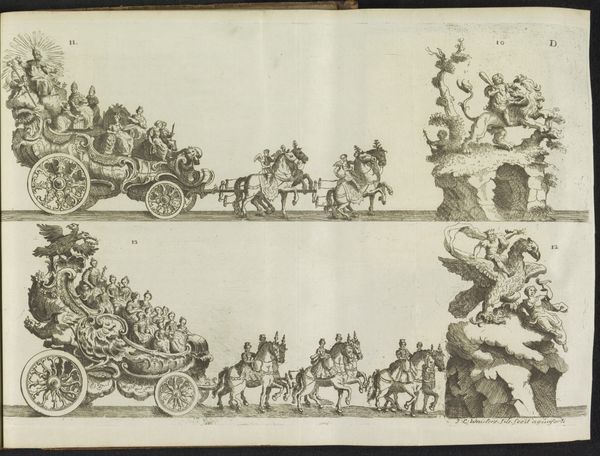
Editor: This is "Departure of the Spanish Garrison from Huis te Gennep," created by Balthasar Florisz. van Berckenrode in 1641. It's a print, an engraving, and the scene feels so…orderly, even celebratory, considering it depicts a withdrawal. What's your read on this piece? Curator: Orderly, yes, but let’s unpack that order. The print, made during the Dutch Golden Age, depicts a very specific moment of geopolitical shift. This seemingly 'orderly' withdrawal masks a power dynamic. The Spanish departure isn't just a logistical event; it's a testament to Dutch resilience and resistance against Spanish rule. How does the linear quality of the engraving strike you in relation to themes of freedom and oppression? Editor: I see what you mean. The lines are so precise, but there’s a subtle sense of…triumph in the forward motion, perhaps. But isn’t that also a simplification of the conflict? Curator: Precisely! Think about whose perspective is centered here. Who commissioned this work, and what narrative were they trying to construct? It presents a seemingly neat conclusion, obscuring the messy realities of war, the displacement of communities, and the enduring power imbalances. Who do you think is excluded from this narrative? Editor: Probably the local people of Gennep, and certainly any dissenters. It's propaganda masked as history, almost. Curator: Indeed. And consider the 'landscape' aspect, framing the procession: does it monumentalize a sense of Dutch national identity being secured through spatial control? How can art be used to legitimise such perspectives, while obscuring marginal experiences? Editor: So, while it appears to be a historical record, it’s also deeply implicated in shaping how we understand that history. This isn’t a neutral image. Curator: Absolutely. Looking closer at this print lets us question the stories we tell ourselves about freedom, power, and whose voices are included in the grand narratives. Editor: Thanks, this engraving has given me a new framework to explore political nuance through art!
Comments
No comments
Be the first to comment and join the conversation on the ultimate creative platform.
 Collect
 React
React Comment
More like this