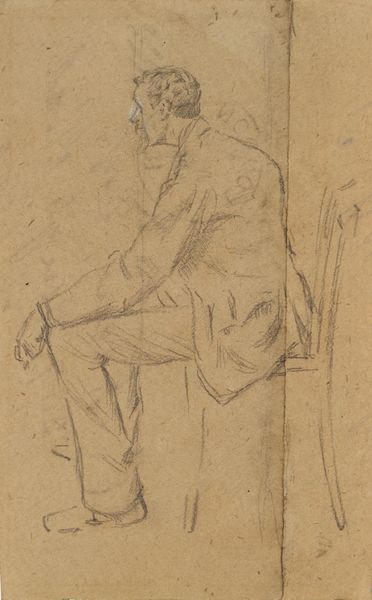
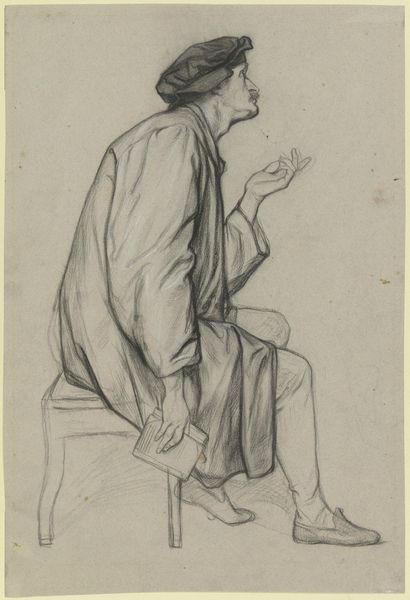
drawing, pencil, chalk
#
portrait
#
pencil drawn
#
drawing
#
baroque
#
figuration
#
pencil
#
chalk
Copyright: Public Domain
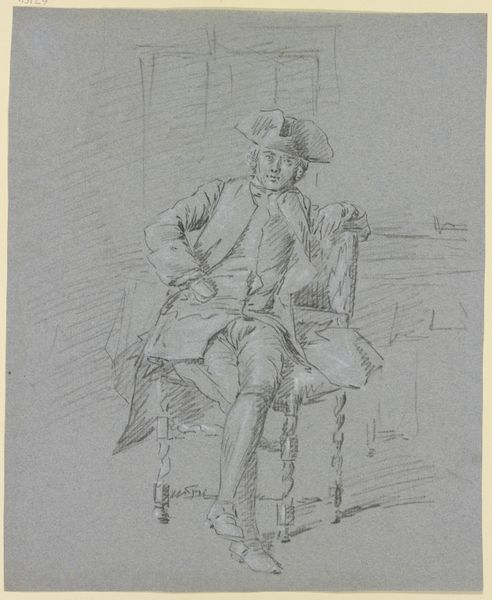
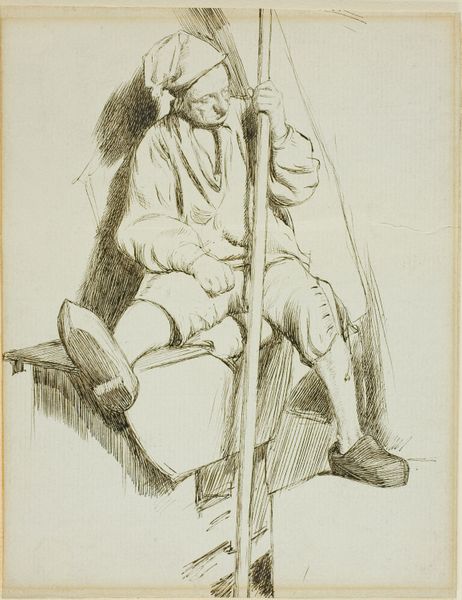
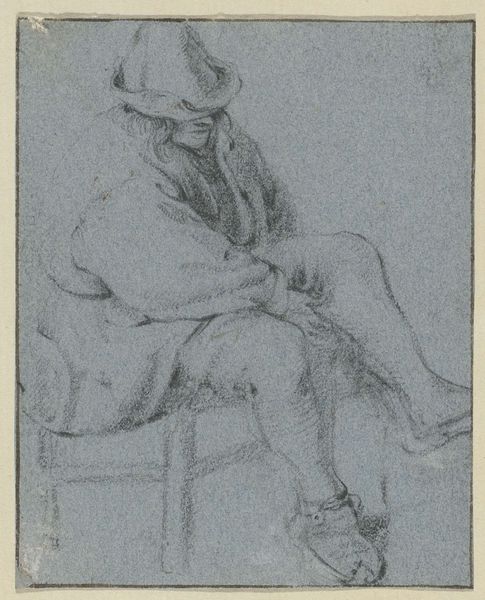
Curator: It has such a wistful air, doesn't it? This work, believed to be by Cornelis Troost, is a drawing rendered in pencil and chalk titled "Sitting Cavalier," residing here at the Städel Museum. Editor: Wistful, yes, but there’s also a resignation in his posture. His dress certainly speaks of a particular social status – perhaps of the leisure classes, whose dominance rested, let’s not forget, on deeply inequitable social structures. Curator: Well, that’s certainly one reading! But his gaze… he seems to be looking slightly beyond us. I imagine him contemplating… clouds! A particularly elegant turn of phrase he’s been polishing. Or perhaps regretting having one glass too many? Editor: Or perhaps, facing the very real precarity of that social position, even in its advantages. After all, this is the era leading up to revolutionary shifts. Curator: Maybe so. But I'm more interested in the rendering of light. It seems to be coming from everywhere and nowhere at once. A touch theatrical. See how it softens the angles of his face and gathers around his knees? The cross-hatching almost makes him look as though he’s sitting within a light projection. Editor: I see it as more revealing than flattering. The medium – drawing, in these delicate strokes – exposes the sitter rather than glorifying him. The informality hints at an accessibility that I think consciously flirts with class boundaries. Curator: Well, whether that’s his conscious intention or not, I appreciate its gentle playfulness. This “Sitting Cavalier” is quite charming and accessible in the very intimate way. I always discover something fresh when I return to him. Editor: And perhaps the next discovery will unearth deeper layers of meaning, further complicating our understanding of the era and its inhabitants. Until then, his gaze will continue to intrigue us.
Comments
No comments
Be the first to comment and join the conversation on the ultimate creative platform.
 Collect
 React
React Comment
More like this