Dimensions: 13 3/4 x 12 5/8 in. (34.93 x 32.07 cm) (sheet)
Copyright: No Copyright - United States
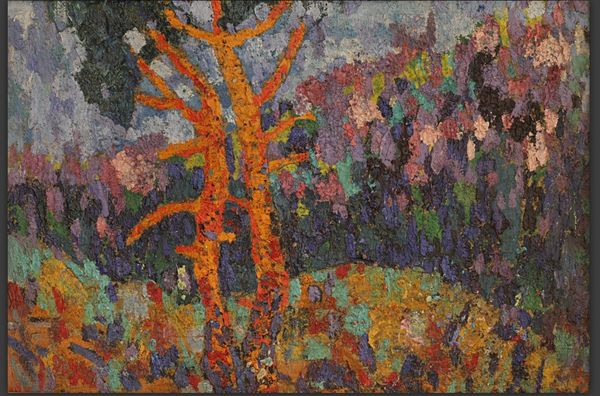
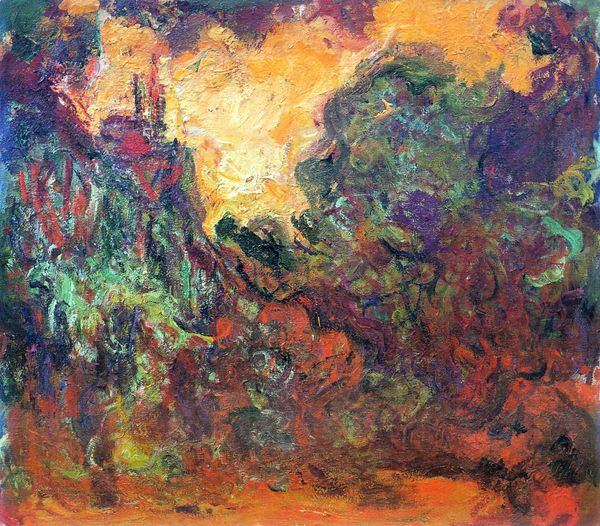
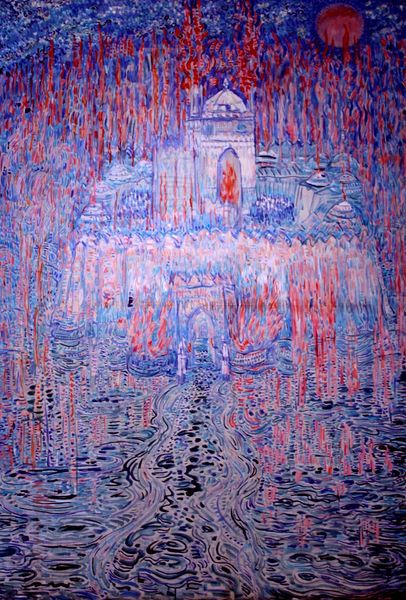
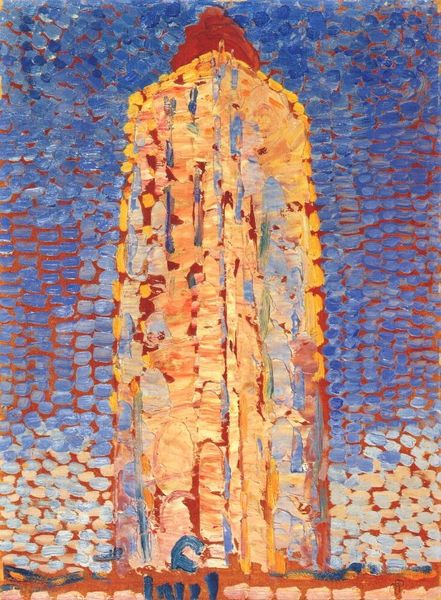
Curator: Just look at this riot of color. It's hard to believe "House with Sunset," dated circa 1914-1916 and created by Aloys Wach, depicts something as simple as a house, rendered here in watercolor with an unmistakable divisionist style. Editor: My immediate impression is energy, almost frantic energy. The staccato strokes of color, especially around the sun, feel like bursts of light and sound exploding off the page. Curator: I agree. While the title suggests serenity, Wach’s application of color evokes something much more dynamic. The house itself, a solid architectural form, seems on the verge of dissolving into the atmosphere. This can reflect the unease of pre-war Europe at the time, as many people questioned the values of progress and the future, this piece challenges familiar aesthetics. Editor: Precisely, the dissolution of form is key here. It isn't merely about representing a physical house, but capturing an ephemeral moment – the fleeting colors and emotional resonance of sunset. The colors—vibrant reds, blues, and yellows—seem almost Fauvist in their intensity, defying a naturalistic depiction. It’s the feeling, more than the subject that takes center stage. Curator: Beyond Impressionism, I perceive a nod toward something primordial here, especially the almost mandala-like halo effect of the setting sun—a universal symbol. But he seems more invested in deconstructing rather than reinforcing symbolic orders. How would that resonate with Viennese audiences around World War I? Editor: He captures that fractured subjectivity—the feeling that things are not as solid, not as fixed, as we once believed. Perhaps this resonated powerfully for those questioning established societal structures at the time. The geometric underpinning suggests some need to impose order in this fragmentation. The use of such modern abstract elements and stylistic approaches highlights the social transition into modernism at the time. Curator: Ultimately, I appreciate how Wach transforms something as mundane as a house into a canvas for exploring perception, light, and feeling. It moves beyond the simple observation and challenges visual structures. Editor: Yes, "House with Sunset" encourages us to see not just what's there, but to feel it, to experience the emotive impact color and form can create. It reveals his historical context by going against the norms of the time period's artistic and cultural narratives.
Comments

minneapolisinstituteofart over 2 years ago
⋮
House with Sunset is a perfect example of the cross-fertilization of styles that existed in Europe just before the First World War. In its strong composition and bold use of color, it shows the influence of German Expressionism, which Wach was exposed to after moving to Berlin from his native Austria in the early 1910s. The luminous colors and radiating light suggest the canvases of Robert Delaunay, whose color abstractions the artist saw on a trip to Paris in 1912. In addition to this, the hatched brushstrokes and vibrating energy of the air recall the paintings of the Italian Futurists. While Wach is not well-known in artistic circles, this luminous watercolor fits squarely into the internationalist tendencies that defined early 20th-century modernism.


Join the conversation
Join millions of artists and users on Artera today and experience the ultimate creative platform.
 Collect
More like this