Copyright: Mircea Cantor,Fair Use
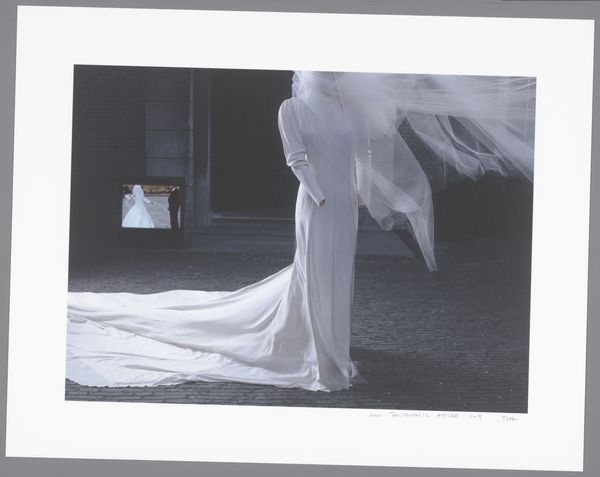
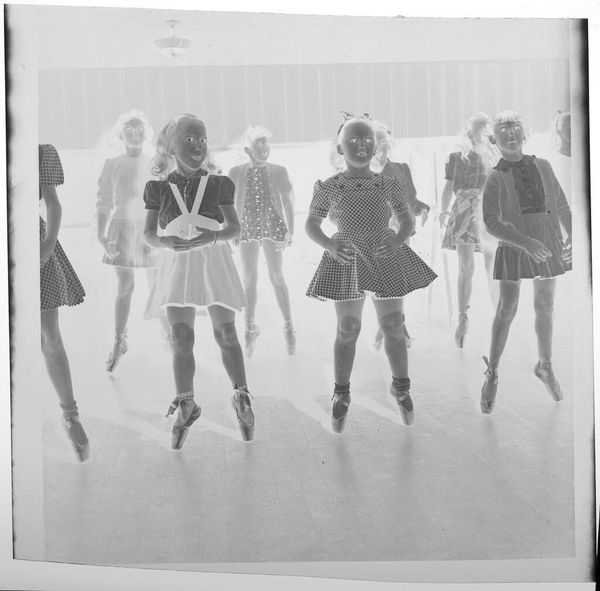
Editor: So this is “Tracking Happiness,” a 2009 performance and photography piece by Mircea Cantor. The image feels really… sterile to me, almost dreamlike with its white on white. But then the repetitive action of the women sweeping is unsettling. How do you interpret this work? Curator: I see Cantor’s piece as a poignant commentary on labor, visibility, and societal expectations. The act of sweeping, often associated with women's work and domesticity, becomes a symbol of the repetitive, often unseen labor that sustains our social structures. Who benefits from this work, and who bears its burden? Does the uniformity of dress speak to a loss of individuality? Editor: That’s interesting, I hadn't considered the domestic aspect. It felt almost ritualistic. Curator: Exactly. Consider how the pursuit of happiness itself can become a form of labor, a societal expectation that demands constant performance. Is this a comment on the commodification of emotions, particularly happiness? Editor: So, the white space could be representative of that emotional void that one has to fill up. Curator: Perhaps. It raises questions about authenticity, and how the pursuit of happiness is being marketed. Cantor often probes themes of migration, identity, and globalization, all intertwined with human conditions. Knowing this, how might we further interpret their synchronized act? Is it harmony, or a form of controlled social behaviour? Editor: I didn't expect it to go so deep. Seeing the art with your point of view sheds light on so many themes about labour. Thanks for helping me see that, I was fixated with its minimal form and didn't reflect much about it. Curator: It’s these complex intersections that make art so powerful! Understanding the artist's social context can enrich our appreciation of their intentions.
Comments
No comments
Be the first to comment and join the conversation on the ultimate creative platform.
 React
React Comment