drawing, paper, ink
#
drawing
#
flower
#
paper
#
ink
#
plant
#
modernism
Copyright: Fernand Leger,Fair Use
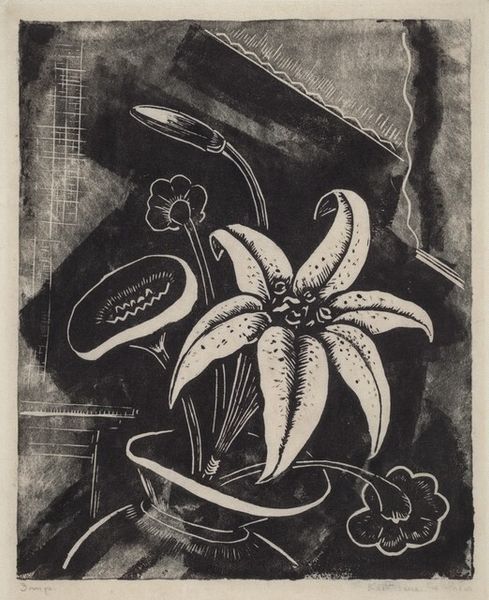
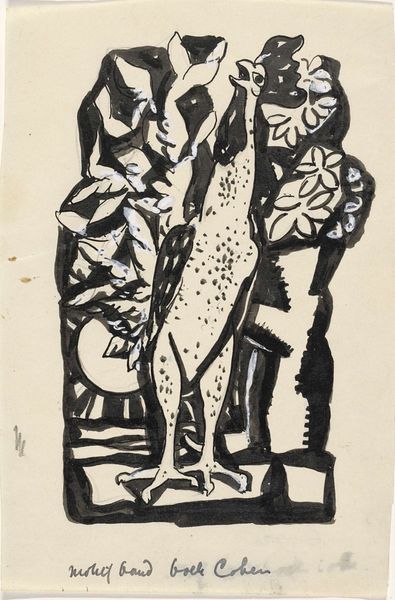
Editor: This is Fernand Léger's "Flower Lamp," created in 1951 using ink on paper. It’s strikingly simple in its stark black and white contrast. It has a strange calmness to it. How would you interpret this work? Curator: Léger was deeply interested in how industrial forms and natural objects could coexist. The lamp, almost like a machine component, sits beside a stylized flower. But more importantly, notice how both are built from almost identical visual language; he renders both flower and lamp with a bold graphic vocabulary. What do you think that suggests about his perception of the natural world versus the manufactured one? Editor: I see how he uses similar shapes and lines. Maybe he’s saying that nature and industry aren't so different, or that industry is trying to imitate nature’s simple beauty? Curator: Exactly. Léger saw beauty in the mechanical, celebrating the dynamism of the machine age. This is post-war. How do you see him visually negotiating tradition and modernity? Editor: Well, the flower feels traditional, like a still life, but the harsh lines are very modern. Curator: Consider also how the flower is more than just a flower. In the language of symbolism, flowers often carry diverse meanings – love, death, fragility. Here, though, its very stylization moves it away from such conventional associations. Instead, he is reducing all of this, stripping everything back to basics, like a modernist visual code. Don't you find that fascinating? Editor: I hadn't thought about the flower like a coded message before. It’s interesting how such simple images can hold so much meaning, especially when you start digging into their context and symbolism. Curator: And the continuity, that even across vastly different contexts and generations, a single image continues to signify. Hopefully, we’ve illuminated the ways visual symbols embed and sustain cultural memory.
Comments
No comments
Be the first to comment and join the conversation on the ultimate creative platform.
 Collect
 React
React Comment
More like this