drawing, hanging-scroll, ink
#
drawing
#
asian-art
#
landscape
#
japan
#
hanging-scroll
#
ink
#
orientalism
Dimensions: 35 1/4 × 10 7/16 in. (89.54 × 26.51 cm) (image)64 1/4 × 13 13/16 in. (163.2 × 35.08 cm) (mount, without roller)
Copyright: Public Domain
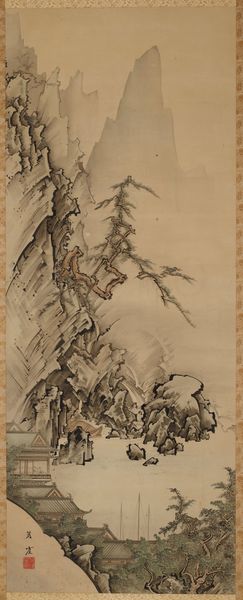
Curator: Look at the quiet solitude evoked by this hanging scroll. Editor: Yes, "Mountain Village" by Tanke Gessen, from the late 18th century. It feels...fragile. All those delicate ink washes on paper. Curator: Fragility speaks to the materiality. The ink itself, how it's ground and applied, dictates the subtle variations in tone and texture that bring the mountains to life. The paper, its source, the method of creation, it is all significant! Editor: I'm struck by the societal implications of landscape art during this period. Think about the role these idealized images played, offering an escape for urban dwellers or even reflecting a scholar’s connection to nature. Consider how a scroll such as this would have been viewed and consumed at that time, its role as a reflection of Japanese identity and values... Curator: Did Gessen choose this format? How much ink was ground for each passage? It's about the labor. Each deliberate stroke carries significance based on its own context. Consider the time involved, the physical skill in using brushes and inks. Editor: True, the physical creation, from sourcing the materials to the artisan’s hand, is vital. But consider also the context in which it hangs today, now preserved and shown within the halls of a museum, a very Western context that, paradoxically, grants new meanings and adds to its perceived value and, possibly, distorts some meanings as well. Curator: It is a question of access. In its original context, viewing was different. Touch was, too. Consider what the materials could signify about that culture, their resources. Editor: And its politics. Who gets to decide what’s art, what's valuable, and where it gets displayed? Even landscape isn't a neutral genre; it conveys social status and ideals. Curator: By shifting our focus to material practices, we understand better the very act of creating and, by extension, exhibiting—the materiality and context both become equally paramount to unlocking meaning in art. Editor: Absolutely. Reflecting on Gessen's choices, his techniques, and how history shapes our viewing offers a richer understanding.
Comments
No comments
Be the first to comment and join the conversation on the ultimate creative platform.
 Collect
 React
React Comment
More like this