#
pictures-generation
Copyright: Barbara Kruger,Fair Use
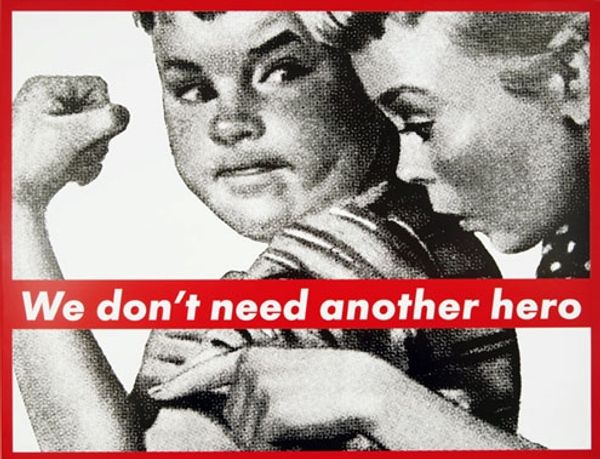
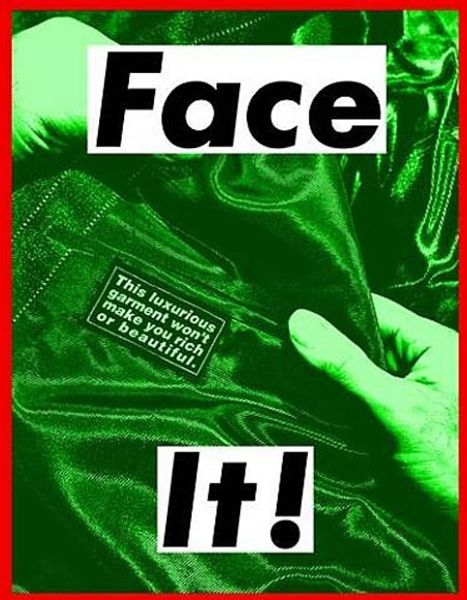
Editor: This is Barbara Kruger’s “Untitled (Your body is a battleground)” from 1989. It's a photograph with text overlaid. It strikes me as incredibly direct and forceful. What do you see in this piece? Curator: The immediate visual dichotomy—the split face, light and shadow—creates a profound sense of inner conflict. This division, amplified by the stark typography, functions as a powerful symbol. Kruger’s layering of text onto the image creates a dialogue. Consider the phrase itself, "Your body is a battleground.” Editor: How so? Curator: Whose body is being discussed? And what battles are being fought? The red and white evoke a sense of urgency. Kruger often appropriates images from mass media and advertising, recontextualizing them to critique power structures, gender roles, and consumerism. She invites us to examine how societal forces inscribe themselves onto our very being. The poster served as feminist propaganda during the 1989 pro-choice march on Washington, responding to legal limitations on reproductive rights. What memory is encoded by it for viewers today? Editor: So it’s not just a personal struggle but a political one too? Curator: Exactly. The photograph, fractured and overlaid with those declarative words, becomes an icon for bodily autonomy and resistance. The symbol lives beyond that moment in 1989. Editor: I didn't realize how many layers there were. The slogan becomes much more pointed now. Curator: Visual symbols build in power over time; context, cultural memory, and political movements shift an image’s meaning. Understanding that evolution unlocks deeper understanding. Editor: I see what you mean. The impact definitely deepens.
Comments
No comments
Be the first to comment and join the conversation on the ultimate creative platform.
 Collect
 React
React Comment
More like this