drawing, ink, pen
#
drawing
#
narrative-art
#
pen sketch
#
figuration
#
ink
#
pen
#
genre-painting
#
rococo
Dimensions: height 235 mm, width 330 mm
Copyright: Rijks Museum: Open Domain
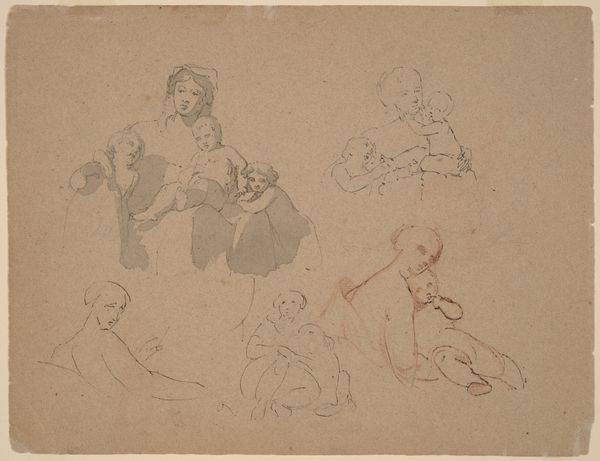
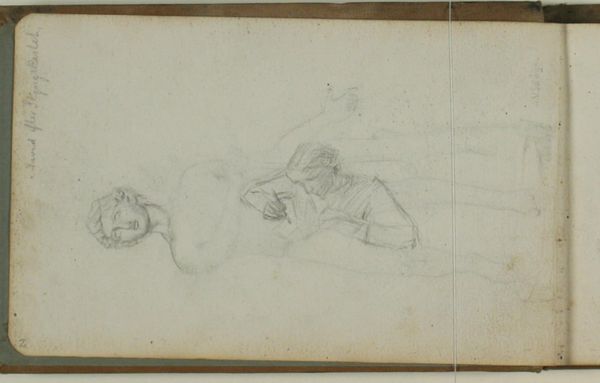
Editor: Here we have "Mother with Children in a Boat", a pen and ink drawing by Francois Boucher, dating somewhere between 1735 and 1800. There's a sweetness to this genre scene. The mother and children appear content in the boat, yet something about the sketch-like quality feels unfinished. What catches your eye about this work? Curator: The incompleteness is key. Boucher gives us not just a scene of motherhood, but rather an _image_ of an idyllic motherhood. Note how the figures are arranged: a pyramid of maternal stability. The fishing net, more like a decorative parasol, hovers above like a halo of domesticity. Ask yourself: is this real life or an aspiration? Editor: An aspiration, definitely! It seems almost staged. Curator: Precisely. It references the Rococo period. Boucher was a master of creating images laden with idealized scenes, playing with the cultural memory of pastoral romance. Think of it as an early form of image-based social construct. How are families represented today? Is it similar or dissimilar? Editor: So the sketchiness reinforces the artificiality, because it feels more fleeting and less like a fixed reality? Curator: Yes, and observe the child pointing outwards, towards something we, the viewers, cannot see. It directs our gaze beyond the confines of the drawing, suggesting a world brimming with possibilities... or perhaps, inaccessible desires. Does the dog amplify a symbolic idea? Editor: I hadn’t even noticed the dog! But, knowing it's there certainly speaks of loyalty, doesn't it? Thank you. I will have to view things with this symbolic point of view in the future. Curator: Indeed. Keep the image, the symbol, as a memory; now go forward to construct new views!
Comments
No comments
Be the first to comment and join the conversation on the ultimate creative platform.
 Collect
 React
React Comment
More like this