Dimensions: height 335 mm, width 240 mm
Copyright: Rijks Museum: Open Domain
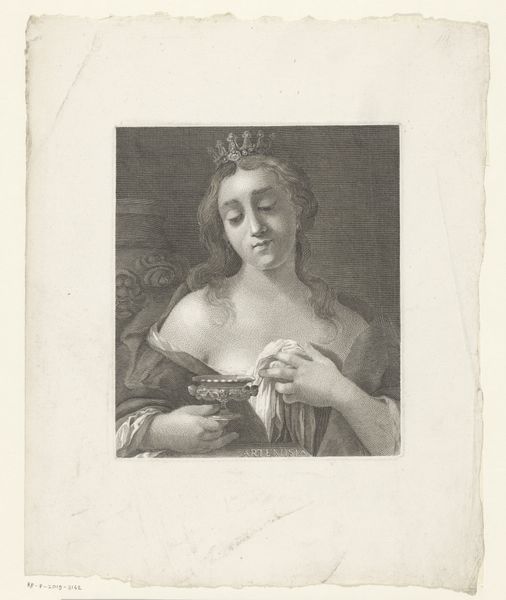
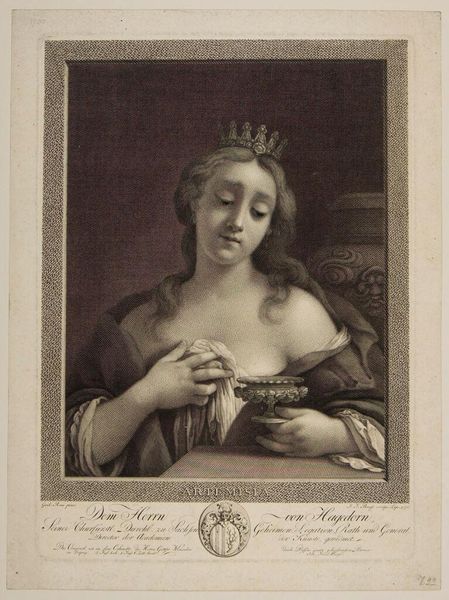
Editor: This is Johann Friedrich Bause’s 1770 engraving, "Artemisia met de as van haar man Mausolus in een beker," or Artemisia with the ashes of her husband Mausolus in a cup. It has a somber and reflective feeling. What do you see in this piece? Curator: Immediately, I see a convergence of symbols, each weighted with meaning that stretches across history. Artemisia herself, the queen, but also the grieving widow. That chalice she holds—it's not just a vessel, it's a potent image of mourning, carrying not wine, but the essence of a lost partner. And look at her crown; even in grief, she’s every bit the queen, duty-bound. Editor: So the cup becomes almost a symbolic portrait? Curator: Exactly. Think of the visual weight we assign to objects. What is grief, if not a holding onto something lost? Consider the etymology of "relic". Doesn't it come from "relinquere", to leave behind? Artemisia literally "retains" her beloved in a relic; it becomes an embodiment of memory itself. What do you make of her averted gaze? Editor: Perhaps a deep introspection. Curator: Perhaps, but maybe also resistance. The Baroque loved drama and clarity. An averted gaze can be a visual clue into a struggle to reconcile her duties with personal agony, wouldn't you agree? It all comes back to how an artist infuses common symbols with added, contextual meaning. Editor: That gives me a new way to look at how art carries stories within symbols.
Comments
No comments
Be the first to comment and join the conversation on the ultimate creative platform.
 Collect
 React
React Comment
More like this