drawing, lithograph, print
#
drawing
#
lithograph
# print
#
figuration
#
orientalism
#
genre-painting
Dimensions: height 315 mm, width 381 mm
Copyright: Rijks Museum: Open Domain
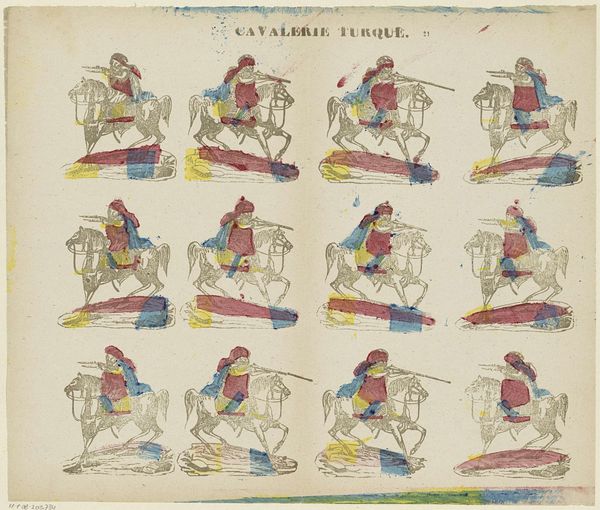
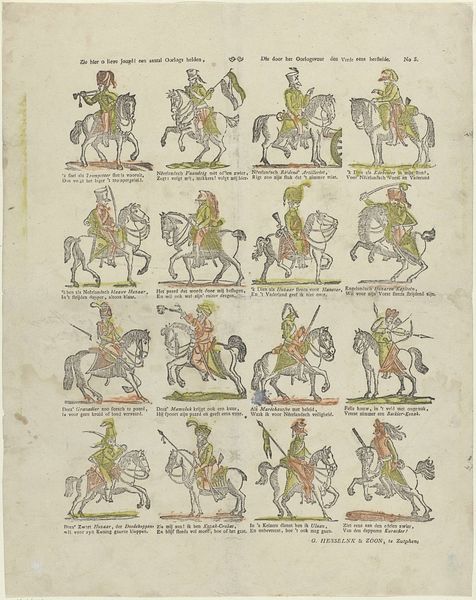
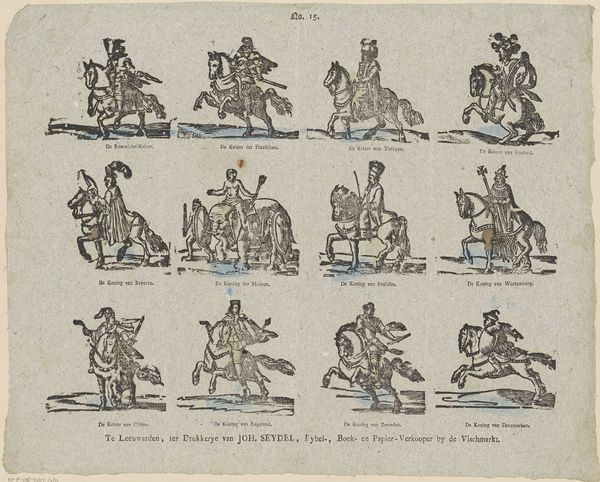
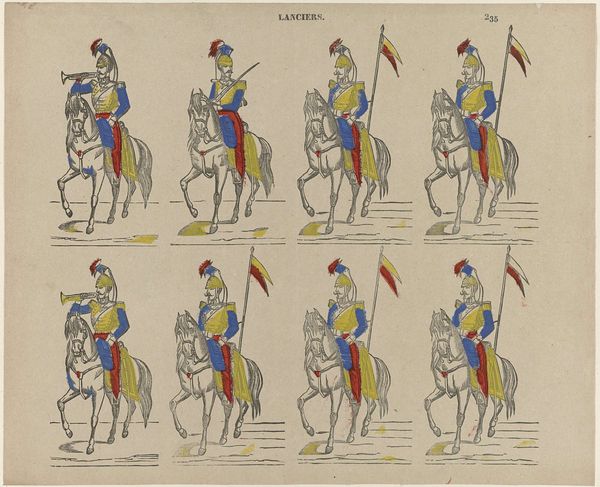
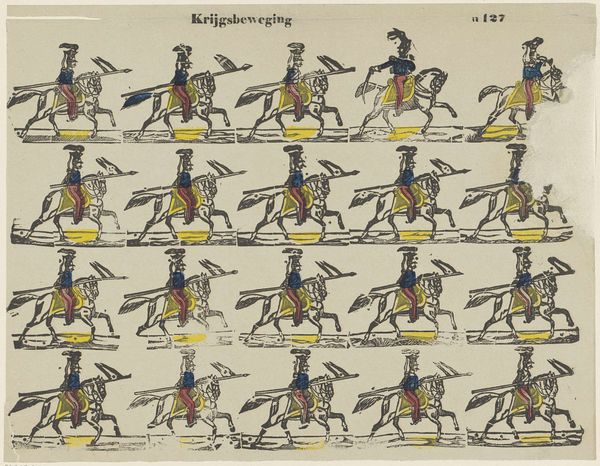
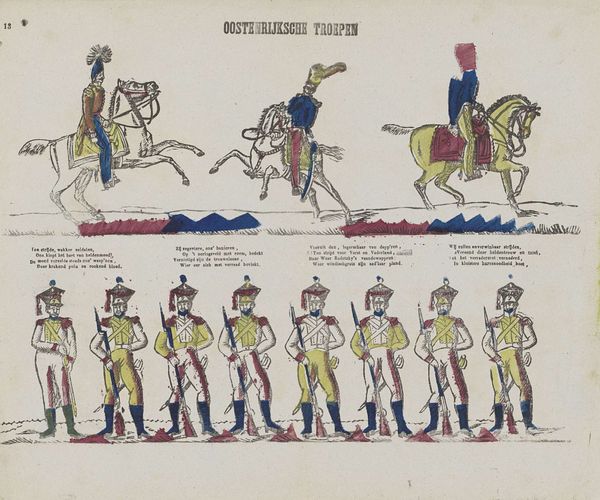
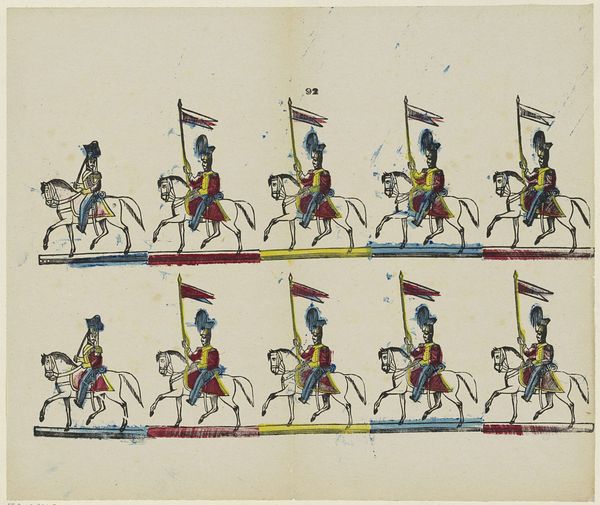
Editor: Here we have "Cavalerie Turque" by M. Hemeleers-van Houter, made sometime between 1827 and 1894. It's a lithograph, a kind of print, depicting twelve mounted Turkish soldiers. What strikes me is the almost whimsical, repetitive nature of the figures, like toy soldiers. What do you make of it? Curator: Whimsical is a good word for it. It reminds me of something I would have found in a little zoetrope as a child! There's something almost charming in the simplicity, isn’t there? Beyond that, though, I see echoes of Orientalism, a Western fascination with and sometimes misrepresentation of Middle Eastern and North African cultures. The figures are romanticized, maybe even simplified to fit a European ideal. I wonder, does that reading resonate with you? Editor: Definitely. I hadn't considered the Orientalist lens so explicitly, but the way they’re presented feels almost… staged. Do you think the repetition is intentional, or perhaps a limitation of the printmaking process at the time? Curator: It could be a bit of both, honestly. Printmaking certainly had its limitations, but the repetition also amplifies that "toy soldier" feeling, right? And it may subtly dehumanize the figures. It's a fascinating tension, isn’t it? A tension between charm, exoticism, and perhaps, a slightly unsettling detachment. Editor: Absolutely. Looking at it now, I can see all those layers at play. Thanks for pointing out the nuances; I feel like I'm seeing it in a completely different light. Curator: And I'm reminded that sometimes the simplest images hold the most complex ideas.
Comments
No comments
Be the first to comment and join the conversation on the ultimate creative platform.
 Collect
 React
React Comment
More like this