


Curatorial notes
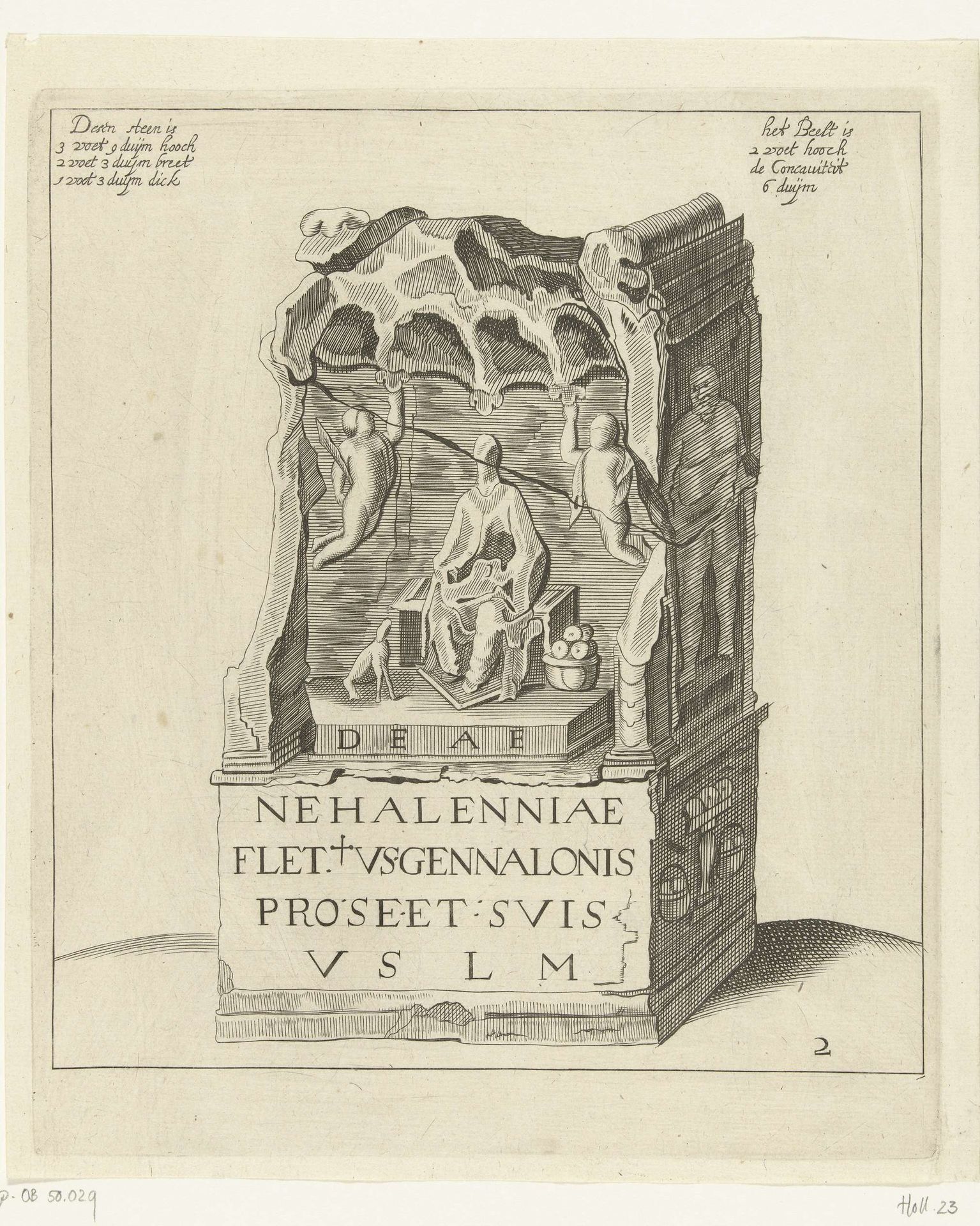
Curator: Before us, we have a print titled "Nehalennia-altaar," made in 1647 by Hendrick Danckerts. It's an engraving, which lends itself to incredibly fine detail. My first thought? This has the somber feel of an epitaph. Editor: I can see that, with the Latin inscription. The use of line—notice how Danckerts employs hatching and cross-hatching to build depth—contributes to this feeling of historical weight, almost archaeological in tone. The composition itself, so rigidly symmetrical, feels deliberate, measured. Curator: The figure in the niche is most likely the goddess Nehalennia, venerated in the Roman Netherlands. The inscription speaks to dedication to her, hinting at her power. The flanking figures remind me of putti from Italian Renaissance art and signify transformation. The presence of the dog echoes loyalty and perhaps guidance, common associations that stretch back through centuries of mythology. And finally, apples: a possible indication of fertility and abundance, also reminiscent of Eve from Genesis and also of the Hesperides. Editor: Interesting interpretation. The print uses such limited tones and it's truly impressive how much is conveyed only through those. The architectonic features--the classical pilasters, the niche—these elements ground it within a specific visual vocabulary, almost self-consciously citing "classical" form in the time of Baroque sensibility. I suppose the print itself mirrors that classical tone too with the rigid symmetry. Curator: Indeed. And such a dedication, etched in a stone altar in the artwork itself, points towards the very core of human beliefs at the time: our enduring desire for security in life's tumultuous sea. The very act of creating and dedicating such alters reflects the core symbolic desire to gain security within what seems to be a random natural environment that controls every moment of one's existence. Editor: The texture of the simulated stone, those deeply carved lines, contrasts vividly with the smoothness of the figures; the putti and central figure seem to almost float. It's this tension—between weighty solidity and ethereal grace—that holds my gaze. Ultimately, I think, this piece demonstrates the ability of a relatively simple medium, the print, to embody complex conceptual frameworks. Curator: A somber beauty—indeed, a tribute carved not just into stone, but now, preserved through ink on paper. It is remarkable the amount of information such seemingly simple depiction holds to convey symbolic imagery for the ages.