About this artwork
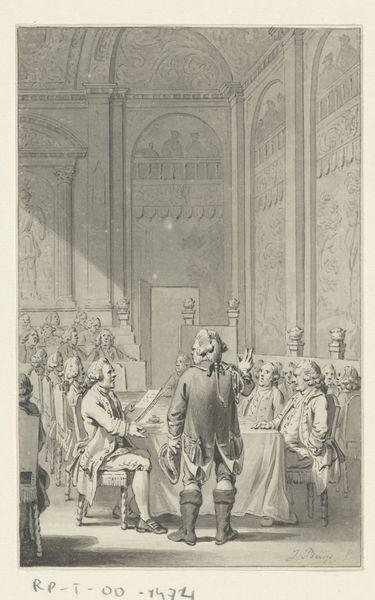
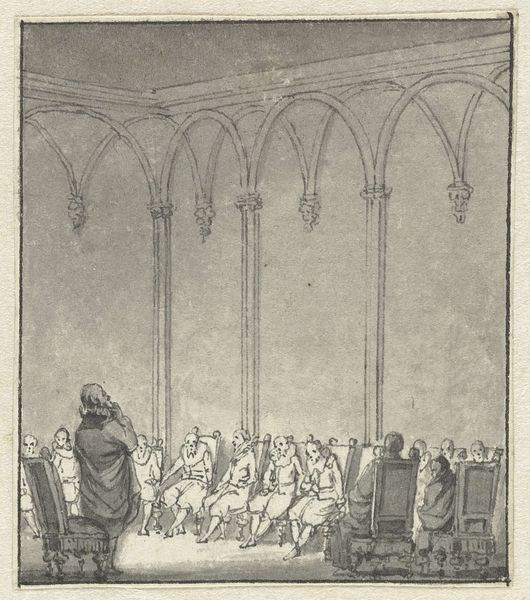
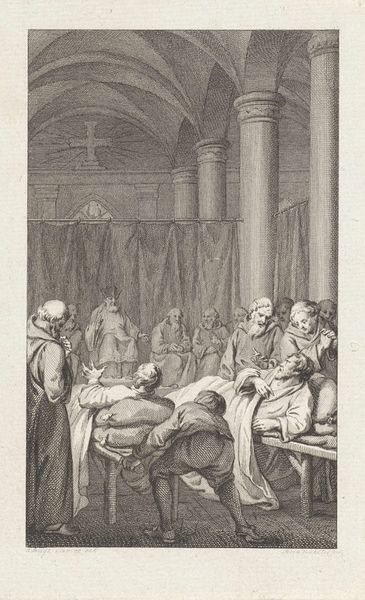
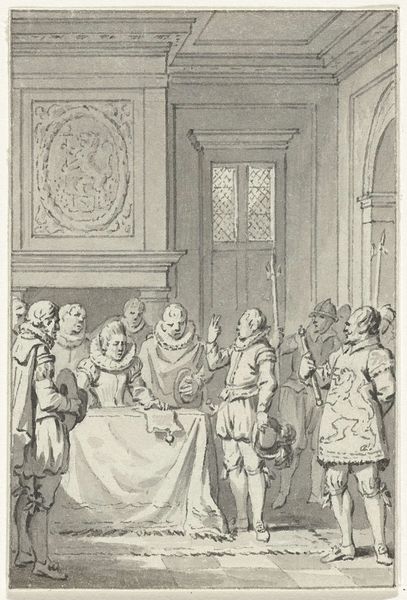
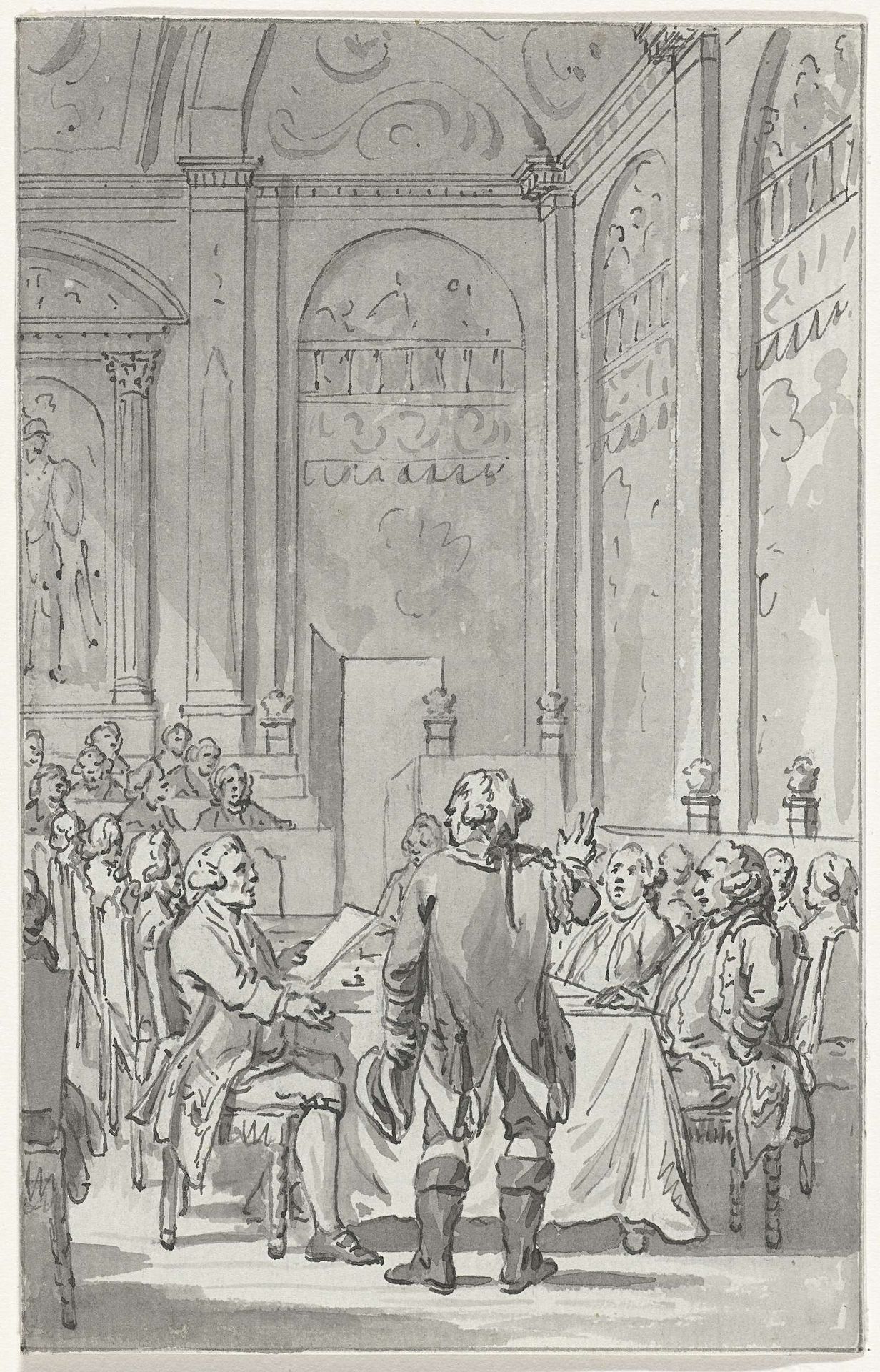
Editor: This is a drawing titled "Lodewijk Ernst, Duke of Brunswick-Wolfenbüttel, Swears the Oath as Field Marshal" made between 1759 and 1801 by Jacobus Buys, currently housed in the Rijksmuseum. It looks like an ink drawing on paper, with a somewhat subdued mood due to its limited color palette. What strikes you when you look at this piece? Curator: Note how the artist uses line to create a sense of depth. Observe the composition. The architectural space, with its columns and arches, establishes a clear framework. Consider the implied lines created by the gazes and gestures of the figures. These lines converge towards the central figure, thereby visually emphasizing his role. Editor: So, the composition reinforces the narrative? Curator: Precisely. Furthermore, the contrast between the detailed foreground figures and the sketchier background enhances the spatial depth. Observe also the recurring shapes and forms within the drawing, the repetition of arched forms in the architecture, echoed in the posture of figures creates a visual rhythm, doesn't it? Editor: I see what you mean. So it's less about the historical context and more about how the artist uses visual elements to create meaning? Curator: Not entirely. Though a formalist approach privileges the internal structure of the artwork, we can use its semiotic logic as a launching point, as it opens paths into thinking about representation. The visual dynamics speak to larger systems of power and visuality. Editor: That makes a lot of sense. I didn’t realize how much you could unpack just by focusing on the composition. Curator: Indeed. It's in the precise rendering, in the balanced asymmetry, and the dynamic arrangement of forms that this work acquires its artistic meaning. There’s always more to see.
Lodewijk Ernst hertog van Brunswijk-Wolfenbüttel legt de eed als veldmaarschalk af, 1759
1759 - 1801

Jacobus Buys
1724 - 1801Location
RijksmuseumArtwork details
- Medium
- drawing, paper, ink
- Dimensions
- height 143 mm, width 91 mm
- Location
- Rijksmuseum
- Copyright
- Rijks Museum: Open Domain
Tags
Comments
Share your thoughts
About this artwork
Editor: This is a drawing titled "Lodewijk Ernst, Duke of Brunswick-Wolfenbüttel, Swears the Oath as Field Marshal" made between 1759 and 1801 by Jacobus Buys, currently housed in the Rijksmuseum. It looks like an ink drawing on paper, with a somewhat subdued mood due to its limited color palette. What strikes you when you look at this piece? Curator: Note how the artist uses line to create a sense of depth. Observe the composition. The architectural space, with its columns and arches, establishes a clear framework. Consider the implied lines created by the gazes and gestures of the figures. These lines converge towards the central figure, thereby visually emphasizing his role. Editor: So, the composition reinforces the narrative? Curator: Precisely. Furthermore, the contrast between the detailed foreground figures and the sketchier background enhances the spatial depth. Observe also the recurring shapes and forms within the drawing, the repetition of arched forms in the architecture, echoed in the posture of figures creates a visual rhythm, doesn't it? Editor: I see what you mean. So it's less about the historical context and more about how the artist uses visual elements to create meaning? Curator: Not entirely. Though a formalist approach privileges the internal structure of the artwork, we can use its semiotic logic as a launching point, as it opens paths into thinking about representation. The visual dynamics speak to larger systems of power and visuality. Editor: That makes a lot of sense. I didn’t realize how much you could unpack just by focusing on the composition. Curator: Indeed. It's in the precise rendering, in the balanced asymmetry, and the dynamic arrangement of forms that this work acquires its artistic meaning. There’s always more to see.
Comments
Share your thoughts